ARTS / CULTURE & LEISURE
China’s main event for International Museum Day opens in Hohhot
Nationwide number of venues at 7,188 in 2025
By in Beijing and Zhang Zhen in Hohhot Published: May 18, 2026 10:06 PM

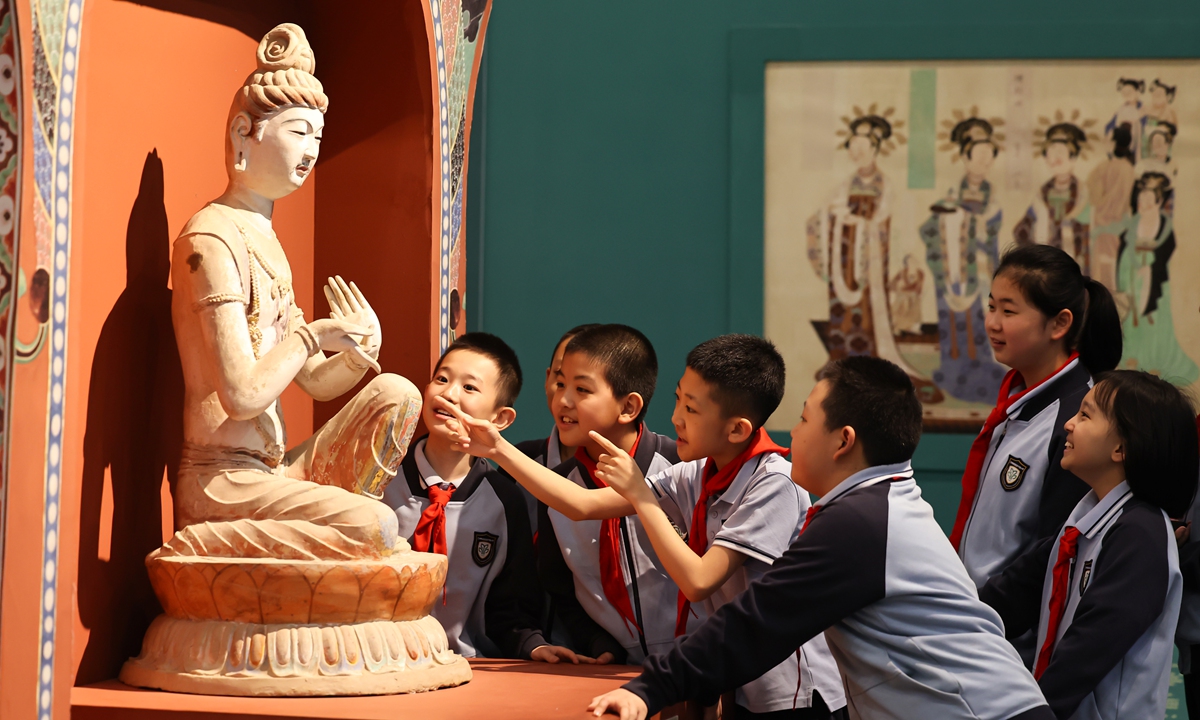
Students observe a Buddha statue at the Dunhuang Art Gallery, part of the Dunhuang Academy, during a themed study tour event in Lanzhou, Northwest China's Gansu Province, on May 18, 2026, International Museum Day. Photo: VCG
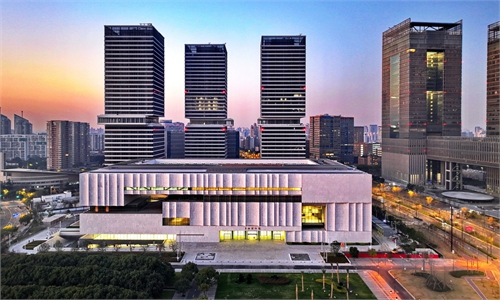
China celebrated the 2026 International Museum Day on Monday, with its flagship national event centered at the Inner Mongolia Museum in Hohhot, capital of North China's Inner Mongolia Autonomous Region. Officials from the National Cultural Heritage Administration (NCHA) released key data during the opening ceremony, underscoring the rapid expansion of the country's museum sector and its growing role as a bridge for cross-civilization exchanges, according to a press release issued by NCHA.The data shows China has added more than 1,400 registered museums over the past five years, bringing the total to 7,188 by the end of 2025. Over 91 percent of these museums are open to the public free of charge.
In 2025, Chinese museums hosted over 40,000 exhibitions and organized more than 580,000 educational activities, attracting 1.56 billion visitors, all record highs as the sector enhances public cultural services and expands social engagement, according to the press release.
This year's International Museum Day theme is "Museums Uniting a Divided World," highlighting the powerful role museums play as bridges across cultural, social, and geopolitical divides, and fostering dialogue, understanding, inclusion, and peace within and between communities worldwide, according to the official website of International Council of Museums.
Tang Wei, deputy director of the NCHA, said that the theme resonates with China's efforts to deepen international cultural exchanges. He noted that China's program will focus on preserving history, enriching cultural life, strengthening national identity and promoting dialogue.
During the ceremony, authorities launched the 2026 "Civilization Bridge Program - Outstanding Overseas Exhibitions of Chinese Cultural Relics" to promote a series of overseas exhibitions of representative Chinese cultural relics aimed at deepening mutual learning among civilizations.
According to NCHA, more than 110 overseas exhibitions of Chinese relics and over 240 inbound exhibitions were held in 2025, covering more than 20 countries and regions across four continents.
A highlight of this year's celebrations is the Golden and Jade Brilliance, Diverse and Splendid China exhibition, which brings together 386 sets of national treasure-level bronze, gold and jade artifacts from 58 cultural and museum institutions across China, spanning from the Neolithic Age to the Ming (1368-1644) and Qing (1644-1911) dynasties, Ji Xiaoqing, director of the region's Department of Culture and Tourism, told the Global Times.
"Gold and jade have long been beloved by the Chinese people, who have used them for jewelry for thousands of years," Wang Ziyi, one of the exhibition guests and the vice president of the Xi'an Museum, told the Global Times.
Wang explained that Chinese jade culture can be traced back nearly 10,000 years, with ancient Chinese crafting jade into various shapes such as jade pig dragons and jade figures. The collection of gold artifacts across 20-plus provinces demonstrates the richness and diversity of Chinese culture.
Commenting on this year's theme, Wang noted that museums are inherently cultural bridges. "With cultural relics as evidence and exhibitions as a language, museums connect different regions, ethnic groups and time periods, and unite the consensus of people of all ethnic groups around the world," he said.
"In a world where some regions are affected by wars and conflicts, museums' cultural function is urgently needed to connect the world and build a better life together," he added.
On boosting global influence, he said Chinese museums could leverage the Belt and Road Initiative to exchange exhibitions.
"We should let our relics go out and bring fine relics from other countries in, so that our people can see the world's diverse cultures, and the world can see China, read about China and understand China," he said.
The 2027 International Museum Day main venue will be Hangzhou, East China's Zhejiang Province. China has held annual events for the day since joining the International Council of Museums in 1983. Since 2009, the NCHA has co-organized a national main venue activity with provincial-level governments. The main celebration in 2026 is set to run for several weeks. Museums across the country will also actively organize diverse and distinctive themed activities to better meet the public's cultural and spiritual needs, according to organizers.
RELATED ARTICLES