ARTS / CULTURE & LEISURE
How Qinqiang Opera is conquering screens and hearts nationwide
By Published: May 18, 2026 10:20 PM
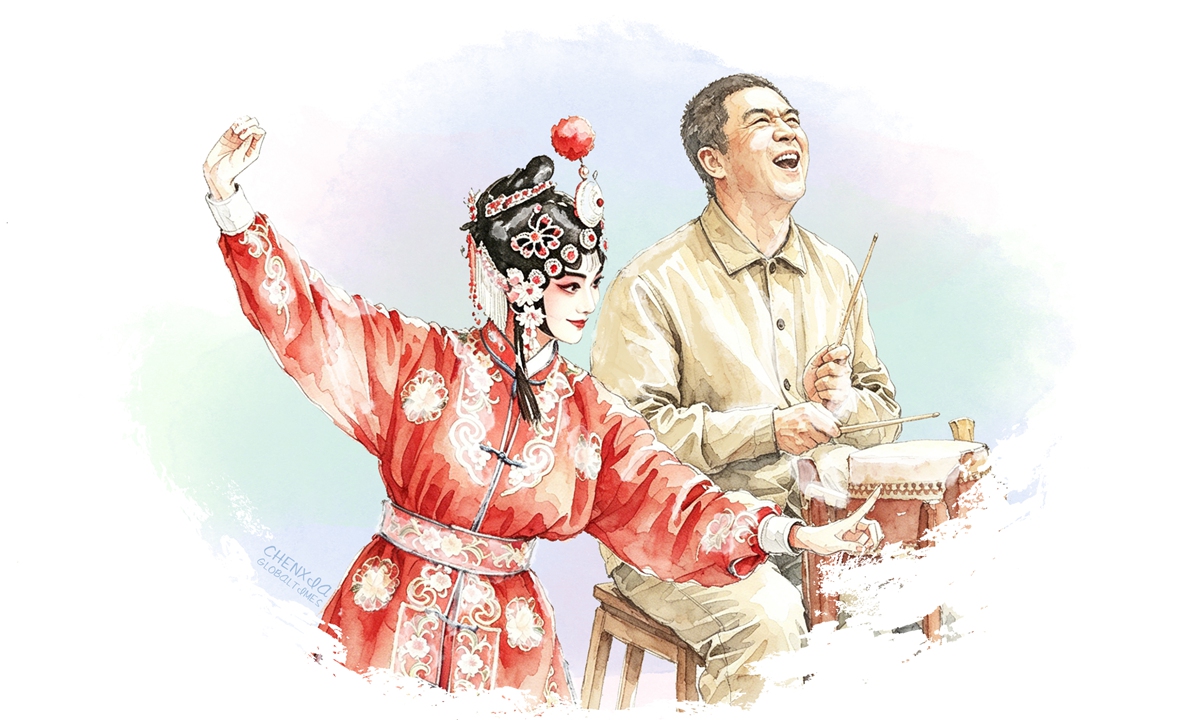
Illustration: Chen Xia/GT
The powerful, raw singing of Qinqiang Opera, a genre of folk Chinese opera originated in Northwest China's Shaanxi Province, echoing from small screens across China is truly something special. A new drama called The Lead has become a hit with strong viewership numbers of about 4 percent. This pure Shaanxi-style drama has crossed regional and age boundaries to touch the hearts of people in Northwest China and surprise young viewers in southern cities who say they are completely hooked.
In an age of short videos and quick entertainment, why is a drama about traditional opera winning so much attention? The answer lies with the very nature of Qinqiang Opera - a national intangible cultural heritage that serves as the soul of the show.
The Lead is more than just a story about a renowned Qinqiang Opera singer. It uses this ancient art form to tell powerful stories of cultural inheritance, personal struggle, and national spirit.
For some young people, traditional Chinese opera sounds outdated, boring, or hard to understand. The Lead changes that completely as it presents Qinqiang Opera as lively, passionate, and full of energy - something many are now calling "China's original rock and rap."
The production team worked with great care. They invited national first-class actress and Plum Blossom Award winner Ren Xiaolei to serve as opera consultant and act in the drama. She made sure every song, every movement, and every scene was authentic.
Lead actress Liu Haocun, who plays Yi Qin'e, began training six months before filming. She practiced the opera's singing, walking, and gestures until they became natural to her.
This attention to detail turns the drama into a "Qinqiang Opera museum on screen." There is no heavy preaching - only real feelings from the yellow earth of Shaanxi. The rough, wild power of Qinqiang Opera breaks through modern walls and pulls young viewers deep into the story.
Actor Wang Hang from the Shaanxi Provincial Opera Research Institute has deep feelings about the art form. He noted that Qinqiang Opera is a major art form with rich urban characteristics. Its stories often feature loyal ministers, heroes, emperors and generals, showing the bold, passionate and intense spirit of Northwest people.
"Qinqiang Opera has strong explosive power, strict performance rules, and a rich variety of acting styles. People can now feel this deep, soul-stirring, solemn and tragic art form from the Northwest for themselves," he noted.
It shows how one becomes a real "star"- the hard training, the life experiences, and the full journey. Drama is like life, and life is like drama.
The story follows Yi Qin'e over 50 years -from a simple girl herding sheep to a star on the stage. Through hard times, betrayals, and sacrifices, she never gives up.
Her uncle Hu Sanyuan (played by Zhang Jiayi) represents the older generation. Before going to prison, he kneels and says "opera is bigger than heaven," showing his deep love for the art. The "bitter tone" and "happy tone" of Qinqiang Opera perfectly match the ups and downs of the characters' lives.
The drama also shows 40 years of the huge changes in Chinese society. The opera troupe becomes a small mirror of the whole society. Different generations face the same question: What to do when traditional culture loses popularity?
Some give up, some get lost in fame, but others - like Yi Qin'e - keep working hard out of pure love for the art. Their struggles look like the lives of many ordinary Chinese people trying to become the "lead" of their own stories.
The success of the TV series has brought new attention to Qinqiang Opera. Short video creators are now singing Qinqiang Opera to gain followers. This brings quick popularity, which is good for spreading awareness.
However, Lei Linjing, director of the Organization Department of the Shaanxi Provincial Theatre Association, warns against relying only on this fever. In an interview with the Global Times, she said, "The attention is like the wind. After the wind passes, what remains depends on our own ability. Online celebrities can give free promotion, but only good new works can help Qinqiang Opera go further."
She is right. True protection of heritage does not mean keeping it in a museum. It means keeping it alive and attractive to today's audiences. The real task for Qinqiang Opera artists is to create more excellent works that respect tradition while speaking to modern people.
Through Qinqiang Opera, viewers get to touch something deep in Chinese culture: toughness, hard work, and honesty. This kind of storytelling gives people pride in our culture. It shows that Chinese stories can be both traditional and modern at the same time.
As the drama says, a true lead is not the person standing in the spotlight receiving applause. It is the person who keeps going despite difficulties and stays true to their passion.
The loud voice of Qinqiang Opera tells us: As long as people continue to work hard and create with heart, this ancient art will never end. Its stage will always remain open. In the same way, every Chinese person can become the lead of their own life by holding onto their dreams with the same spirit.
The author is a reporter with the Global Times. life@globaltimes.com.cn
RELATED ARTICLES