BRASIL 247 / MORE
Brazilian Development Bank president highlights green transition, Latin American integration and training of public managers
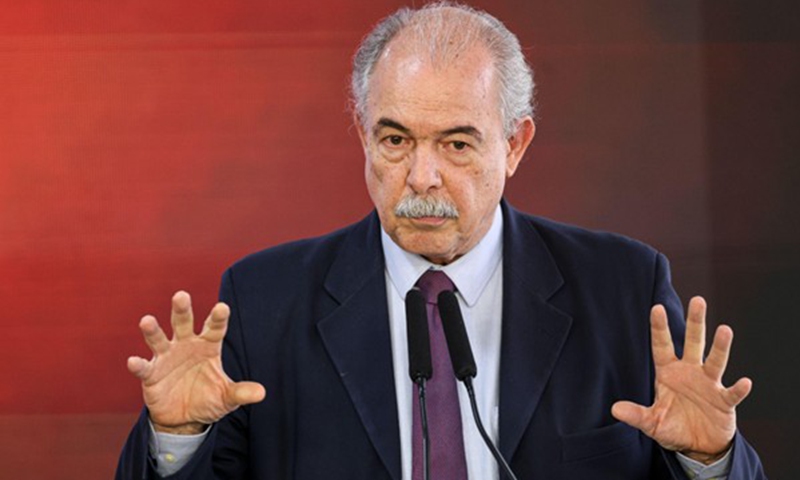
Aloizio Mercadante, president of Brazilian Development Bank. Photo: Agência Brasil
By Brasil 247 - Aloizio Mercadante, president of BNDES, defended the strategic role of the state, the green transition and neoindustrialization as key paths for Latin American development during a lecture in Rio de Janeiro on Thursday. According to Brasil 247, Mercadante highlighted R$29 billion in investments for Rio Grande do Sul, a R$30 billion credit line for app drivers and taxi drivers, and the training of a group with 66 participants from more than 15 countries.
The lecture opened the fourth day of the second edition of the Maria da Conceição Tavares School of Government and Development, an initiative organized by BNDES in partnership with the Economic Commission for Latin America and the Caribbean.
Mercadante said Brazil and Latin American countries need to strengthen public planning capacity to address inequality, climate change and technological challenges. He argued that the region must train managers with technical expertise, social commitment and strategic vision.
"Public servants are essential for the quality of services and for any development project," he said. "We need to train professionals capable of thinking about the state and acting with concrete solutions."
The BNDES president also defended greater cooperation among Latin American and Caribbean countries. According to him, the school aims to create a permanent network among public managers to share experiences, formulate policies and deepen regional integration.
While discussing the legacy of economist Maria da Conceição Tavares, Mercadante said she helped build a Latin American developmentalist vision focused on regional sovereignty and overcoming inequality.
In his assessment of global growth models, Mercadante criticized the concept of a "minimal state" and defended a balance between state and market. He cited Asian economies, especially China, as examples of countries that combined state planning, innovation and economic dynamism.
"Development requires planning, public investment and strong institutions," he said. "The market alone cannot solve structural challenges, especially in late-industrializing countries such as those in Latin America."
Climate policy was also central to the lecture. Mercadante highlighted the role of BNDES in financing emergency and structural actions, including R$29 billion in support for Rio Grande do Sul after recent floods. He also mentioned the creation of a department focused on natural disasters.
The BNDES president defended permanent international funds to support countries affected by extreme climate events and reinforced the importance of prevention, monitoring and economic reconstruction policies.
On the energy transition, Mercadante said Brazil holds a strategic position because of its renewable energy matrix and the potential of biofuels such as ethanol and biodiesel. He also mentioned initiatives involving sustainable aviation fuels and low-carbon mobility technologies.
Mercadante again defended a neoindustrialization policy for Latin America focused on innovation, value-added production and sustainability. He cited the Nova Indústria Brasil program and BNDES investments in healthcare, artificial intelligence, mobility, green economy and critical minerals.
"The challenge is not only extracting resources, but developing complete and innovative production chains," he said.
The BNDES president also announced economic inclusion measures, including a R$30 billion financing line for app drivers and taxi drivers to purchase vehicles under facilitated conditions. According to him, the initiative aims to reduce costs, increase income and stimulate the transition toward less-polluting models.
On public security, Mercadante defended the use of technology and artificial intelligence to create "smart cities," with monitoring systems and data analysis focused on preventing and combating organized crime.
Internationally, he defended multilateralism, cooperation among developing countries and rule-based trade agreements. Mercadante also criticized unilateral practices in global trade and reinforced the need for Latin American integration through investments in infrastructure, energy and regional production chains.
The Maria da Conceição Tavares School brings together 66 participants, including 33 Brazilians and 33 participants from other Latin American and Caribbean countries. The in-person stage in Rio takes place between May 18 and 22. The online phase is scheduled from June to September 2026, and the final stage will be held at Cepal headquarters in Santiago on a date yet to be defined.
Tereza Campello, BNDES' socio-environmental director, also defended the return of the state's role in regional development during the opening session. "We will not face these challenges with an absent or weak state," she said. "We are facing the need to restore the role of the state in the socioeconomic development agenda based on our Latin American reality."
Campello also argued that the climate debate should not be limited to the energy transition. "We are often led to think about the climate crisis based on paradigms designed for the Global North," she said. "If we focus only on carbon-equivalent metrics, we will never fully use the development potential that Latin America and the Caribbean have as providers of nature-based solutions."
Camila Gramkow, director of Cepal in Brazil, said the construction of regional responses "depends on the training of diverse leaderships and dialogue among countries, institutions and different trajectories."
The program also includes figures such as José Antonio Ocampo, Esther Dweck, Daniel Olesker, Celso Amorim, Carlos Nobre, Uma Rani, Ha-Joon Chang and Antonio Andreoni. Inspired by Maria da Conceição Tavares, the school combines theoretical, instrumental and applied training to discuss economic, social and environmental development proposals for Latin America and the Caribbean.
(Reported by Brasil 247 on May 21, 2026)
