SPORT / FOOTBALL
China’s U17 football team finally begins to understand their true potential ahead of U17 Asian Cup final against Japan: analysis
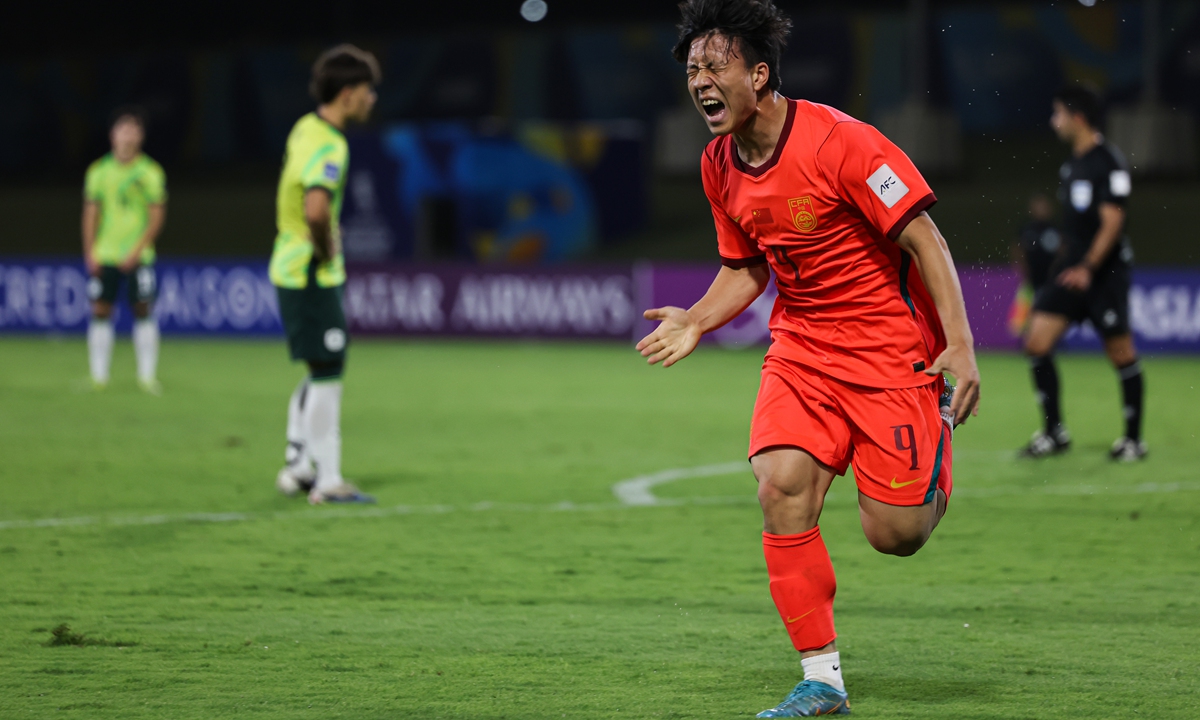
China's Xie Jin celebrates after scoring a goal against Australia at the U17 Asian Cup on May 19, 2026 in Jeddah, Saudi Arabia. Photo: VCG
For years, Chinese football has struggled with a familiar problem whenever facing Asia's top teams. Against Japan in particular, Chinese teams at various age levels frequently appeared overwhelmed by the pace, intensity and confidence of their opponents.However, this Chinese U17 team has changed that perception.
On Friday night, the Chinese team will face their Japanese counterparts in the final of the U17 Asian Cup, marking the country's first appearance in the tournament final since 2004. Regardless of the result, this campaign has already offered something Chinese football has lacked for a long time: young players learning not merely how to compete internationally, but also how to win under pressure. That distinction matters.
Chinese football has produced talented youth teams before. There have been generations that impressed in friendlies or dominated domestic youth competitions, only to fade once they reached senior football. The issue was never simply technical ability. More often, it was the absence of meaningful experience in high-pressure international matches during their formative years.
This U17 side is beginning to close that gap. The U17 Asian Cup has highlighted the team's rapid psychological growth. Earlier in the group stage, China lost narrowly 2-1 to Japan. Yet unlike many previous encounters between Chinese and Japanese national teams, the match was far from one-sided. The Chinese team matched Japan physically and tactically for long stretches, with Zhao Songyuan scoring the equalizer before Japan eventually found the winner through tournament-leading scorer Maki Kitahara.
At that stage, however, the Chinese players still looked tense at key moments. The fear of losing remained visible. But after the group stage, the same Chinese players looked mentally transformed.
China advanced from the group only after surviving a dramatic final round in which Japan's victory over Indonesia indirectly kept the Chinese team alive in the tournament and secured its qualification for the U17 World Cup. But survival alone did not carry them into the final. The team still had to defeat Saudi Arabia and Australia in the knockout rounds, and they did so without conceding a goal.
That is not luck. That is growth.
Against Australia in the semifinal, China looked composed from the opening whistle. Forward Shuai Weihao, who had previously been sidelined due to a contract dispute with his club, once again demonstrated why he has emerged as one of the breakout players of the tournament, scoring the opener after being set up by captain Zhou Yunuo. Winger Xie Jin later sealed the victory that sent China into its first final in 22 years.

Illustration: Liu Rui/GT
Several individuals have embodied the broader progress of this generation.
Shuai has provided not only goals, but also the physical presence and confidence often lacking in previous Chinese youth forwards. Midfielder Wan Xiang has shown composure in possession even against technically superior opponents, while striker Zhao Songyuan's movement and energy have consistently troubled opponents' defenses. On the wings, Kuang Zhaolei has shown directness and creativity shaped partly by his overseas development experience in Spain.
Perhaps most importantly, captain Zhou's leadership at the back reflects a team no longer intimidated by reputation alone. His comments after the semifinal - acknowledging Japan's quality while insisting China can compete if it maintains confidence - captured the mentality shift within this squad.
That confidence did not emerge overnight.
In recent years, the Chinese Football Association has increased overseas training camps and arranged more international friendlies for youth national teams. Friendlies alone cannot guarantee progress, but they help normalize international competition for young players. This U17 Asian Cup has now provided the missing step: meaningful tournament football where every mistake carries consequences. And that experience is invaluable.
The Chinese team has already secured qualification for the FIFA U17 World Cup later this year, where it will face Spain, Morocco and Fiji in the group stage after the draw on Thursday. For these players, competing against elite football nations at their own age level may ultimately prove even more important than the result of Friday's final. It allows them to understand directly where they stand internationally - technically, tactically and mentally.
Spanish youth football, in particular, represents the benchmark China has long tried to study from afar. Facing such opponents in a competitive tournament gives young Chinese players something far more valuable than theory. That is why this run matters beyond one tournament.
For too long, Chinese football development has focused heavily on avoiding failure. Young players were often taught not to lose rather than encouraged to learn how to win, as friendlies frequently focused on similarly matched opponents rather than world-class teams. But winning is also a skill - one built through repeated exposure to pressure, adversity and expectation.
The lesson from this U17 team is not that Chinese football has suddenly solved all of its long-standing problems. It has not. Youth success does not automatically translate into senior success, especially in a football system that has historically struggled to develop players after they grow up.
But this tournament has shown something important: when Chinese players regularly experience high-level international competition from a young age, the psychological gap with Asia's strongest teams begins to shrink.
Young players who grow accustomed to competing - and occasionally winning - on major international stages are far less likely to freeze later in their careers. And perhaps for the first time in many years, this China U17 team looks like a generation beginning to understand not only how to play international football, but also how to believe it belongs there.
The author is a reporter with the Global Times. life@globaltimes.com.cn
RELATED ARTICLES