PHOTO / CHINA
Electromagnetic engineering designer chases his expert ambition in Tianjin
Published: May 24, 2026 09:34 AM
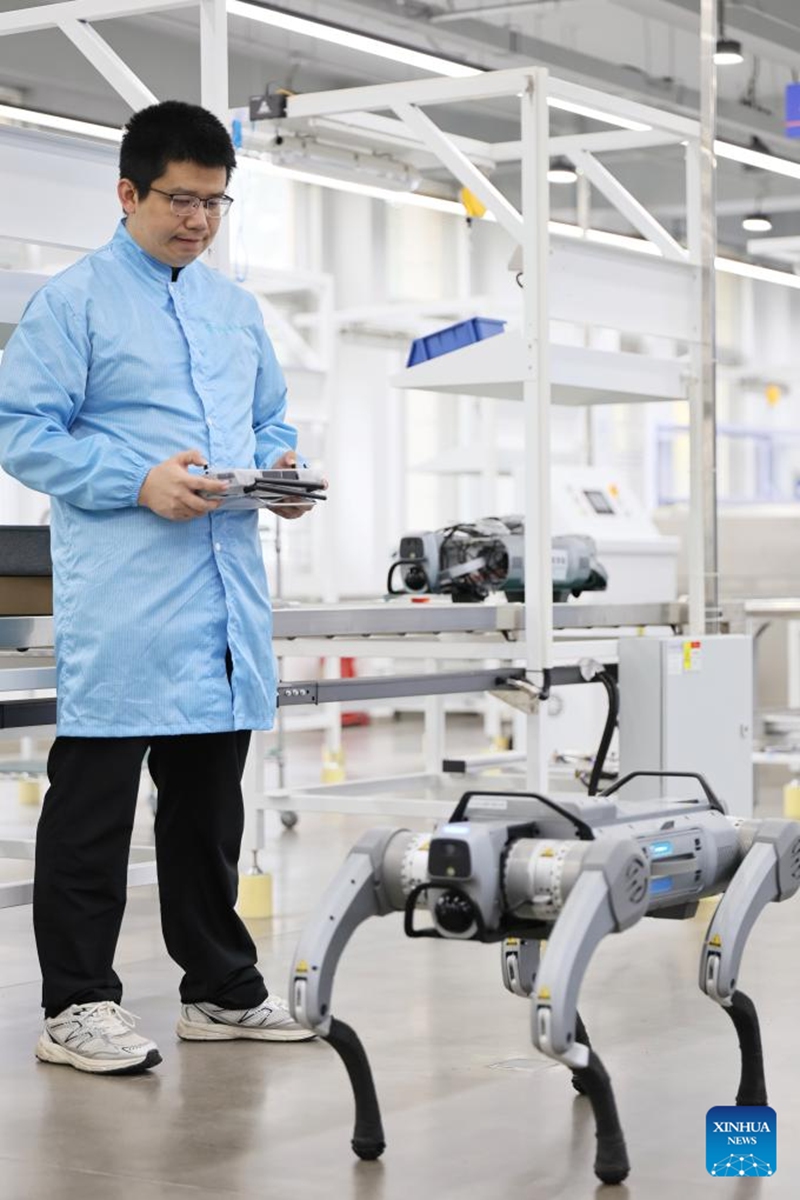
Fu Mingda operates a quadruped robot at Galileo (Tianjin) Technology Co., Ltd. in Tianjin, north China, May 22, 2026. Thirty-three-year-old Fu Mingda, an electromagnetic engineering designer at Galileo (Tianjin) Technology Co., Ltd., has his sights set on becoming a technical expert in the motor industry. To that end, he has been tackling key challenges in the independent research and development (R&D) of core robotic components.

After earning his master's degree from Shenyang University of Technology in 2018, Fu relocated to Tianjin to focus on the R&D and design of aviation motors. He later joined Galileo, where he was involved in the in-house development of quadruped robot joint modules from the ground up.

At the time, the company relied on externally procured joint modules that were prone to overheating and damage. Furthermore, these outsourced parts could not meet complex performance requirements, such as performing somersaults, climbing slopes, and carrying heavy loads.

In less than six months, Fu achieved a technological breakthrough. Overseeing the process from initial electromagnetic design to supplier development, assembly, and testing, he drove the project through four major iterations and dozens of minor optimizations. Impressively, the very first prototype reached advanced standards in the industry.

Today, fueled by the rapid growth of China's domestic robotics industry, Fu remains busier than ever. He expressed full confidence that, through continued dedication, he will realize his ambition of becoming a leading technical expert in the motor sector.  Photo: Xinhua

Fu Mingda operates a quadruped robot at Galileo (Tianjin) Technology Co., Ltd. in Tianjin, north China, May 22, 2026. Thirty-three-year-old Fu Mingda, an electromagnetic engineering designer at Galileo (Tianjin) Technology Co., Ltd., has his sights set on becoming a technical expert in the motor industry. To that end, he has been tackling key challenges in the independent research and development (R&D) of core robotic components.

After earning his master's degree from Shenyang University of Technology in 2018, Fu relocated to Tianjin to focus on the R&D and design of aviation motors. He later joined Galileo, where he was involved in the in-house development of quadruped robot joint modules from the ground up.

At the time, the company relied on externally procured joint modules that were prone to overheating and damage. Furthermore, these outsourced parts could not meet complex performance requirements, such as performing somersaults, climbing slopes, and carrying heavy loads.

In less than six months, Fu achieved a technological breakthrough. Overseeing the process from initial electromagnetic design to supplier development, assembly, and testing, he drove the project through four major iterations and dozens of minor optimizations. Impressively, the very first prototype reached advanced standards in the industry.

Today, fueled by the rapid growth of China's domestic robotics industry, Fu remains busier than ever. He expressed full confidence that, through continued dedication, he will realize his ambition of becoming a leading technical expert in the motor sector. Photo: Xinhua
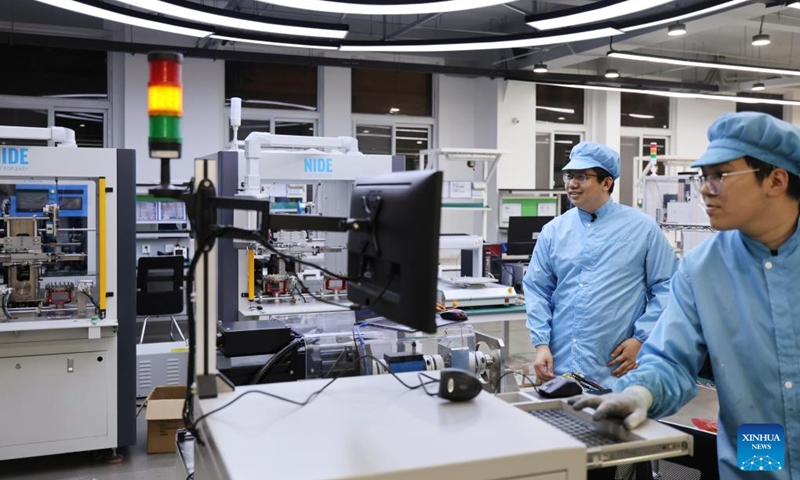

Fu Mingda (L) works with his colleague on the joint assembly line at Galileo (Tianjin) Technology Co., Ltd. in Tianjin, north China, May 22, 2026. Thirty-three-year-old Fu Mingda, an electromagnetic engineering designer at Galileo (Tianjin) Technology Co., Ltd., has his sights set on becoming a technical expert in the motor industry. To that end, he has been tackling key challenges in the independent research and development (R&D) of core robotic components.

After earning his master's degree from Shenyang University of Technology in 2018, Fu relocated to Tianjin to focus on the R&D and design of aviation motors. He later joined Galileo, where he was involved in the in-house development of quadruped robot joint modules from the ground up.

At the time, the company relied on externally procured joint modules that were prone to overheating and damage. Furthermore, these outsourced parts could not meet complex performance requirements, such as performing somersaults, climbing slopes, and carrying heavy loads.

In less than six months, Fu achieved a technological breakthrough. Overseeing the process from initial electromagnetic design to supplier development, assembly, and testing, he drove the project through four major iterations and dozens of minor optimizations. Impressively, the very first prototype reached advanced standards in the industry.

Today, fueled by the rapid growth of China's domestic robotics industry, Fu remains busier than ever. He expressed full confidence that, through continued dedication, he will realize his ambition of becoming a leading technical expert in the motor sector. Photo: Xinhua
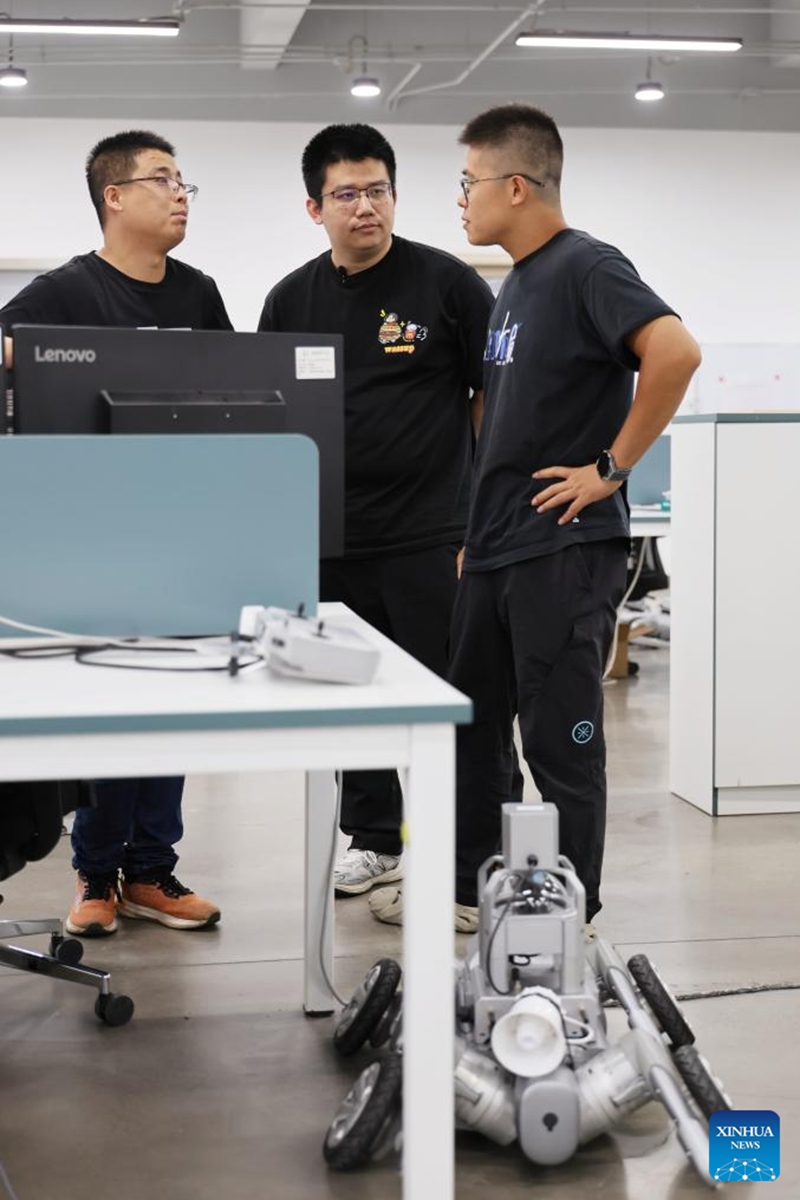
Fu Mingda (L) works with his colleague on the joint assembly line at Galileo (Tianjin) Technology Co., Ltd. in Tianjin, north China, May 22, 2026. Thirty-three-year-old Fu Mingda, an electromagnetic engineering designer at Galileo (Tianjin) Technology Co., Ltd., has his sights set on becoming a technical expert in the motor industry. To that end, he has been tackling key challenges in the independent research and development (R&D) of core robotic components.

After earning his master's degree from Shenyang University of Technology in 2018, Fu relocated to Tianjin to focus on the R&D and design of aviation motors. He later joined Galileo, where he was involved in the in-house development of quadruped robot joint modules from the ground up.

At the time, the company relied on externally procured joint modules that were prone to overheating and damage. Furthermore, these outsourced parts could not meet complex performance requirements, such as performing somersaults, climbing slopes, and carrying heavy loads.

In less than six months, Fu achieved a technological breakthrough. Overseeing the process from initial electromagnetic design to supplier development, assembly, and testing, he drove the project through four major iterations and dozens of minor optimizations. Impressively, the very first prototype reached advanced standards in the industry.

Today, fueled by the rapid growth of China's domestic robotics industry, Fu remains busier than ever. He expressed full confidence that, through continued dedication, he will realize his ambition of becoming a leading technical expert in the motor sector. Photo: Xinhua


Fu Mingda (C) talks with his colleagues at Galileo (Tianjin) Technology Co., Ltd. in Tianjin, north China, May 22, 2026. Thirty-three-year-old Fu Mingda, an electromagnetic engineering designer at Galileo (Tianjin) Technology Co., Ltd., has his sights set on becoming a technical expert in the motor industry. To that end, he has been tackling key challenges in the independent research and development (R&D) of core robotic components.

After earning his master's degree from Shenyang University of Technology in 2018, Fu relocated to Tianjin to focus on the R&D and design of aviation motors. He later joined Galileo, where he was involved in the in-house development of quadruped robot joint modules from the ground up.

At the time, the company relied on externally procured joint modules that were prone to overheating and damage. Furthermore, these outsourced parts could not meet complex performance requirements, such as performing somersaults, climbing slopes, and carrying heavy loads.

In less than six months, Fu achieved a technological breakthrough. Overseeing the process from initial electromagnetic design to supplier development, assembly, and testing, he drove the project through four major iterations and dozens of minor optimizations. Impressively, the very first prototype reached advanced standards in the industry.

Today, fueled by the rapid growth of China's domestic robotics industry, Fu remains busier than ever. He expressed full confidence that, through continued dedication, he will realize his ambition of becoming a leading technical expert in the motor sector. Photo: Xinhua
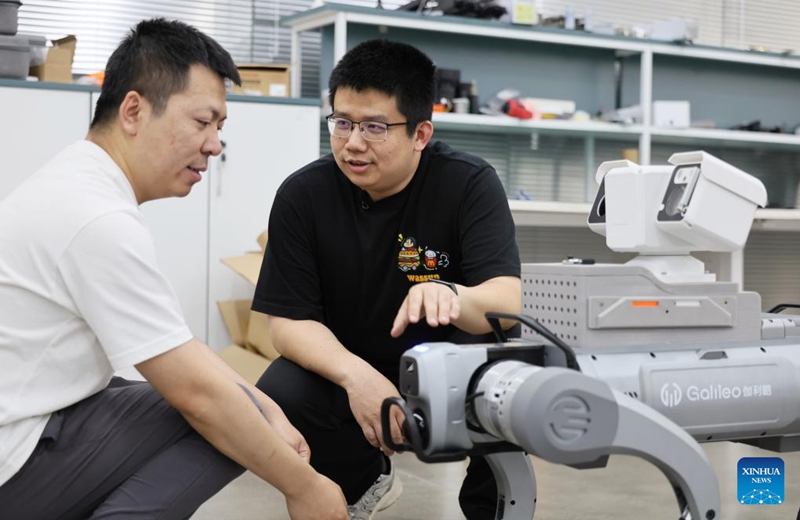
Fu Mingda (C) talks with his colleagues at Galileo (Tianjin) Technology Co., Ltd. in Tianjin, north China, May 22, 2026. Thirty-three-year-old Fu Mingda, an electromagnetic engineering designer at Galileo (Tianjin) Technology Co., Ltd., has his sights set on becoming a technical expert in the motor industry. To that end, he has been tackling key challenges in the independent research and development (R&D) of core robotic components.

After earning his master's degree from Shenyang University of Technology in 2018, Fu relocated to Tianjin to focus on the R&D and design of aviation motors. He later joined Galileo, where he was involved in the in-house development of quadruped robot joint modules from the ground up.

At the time, the company relied on externally procured joint modules that were prone to overheating and damage. Furthermore, these outsourced parts could not meet complex performance requirements, such as performing somersaults, climbing slopes, and carrying heavy loads.

In less than six months, Fu achieved a technological breakthrough. Overseeing the process from initial electromagnetic design to supplier development, assembly, and testing, he drove the project through four major iterations and dozens of minor optimizations. Impressively, the very first prototype reached advanced standards in the industry.

Today, fueled by the rapid growth of China's domestic robotics industry, Fu remains busier than ever. He expressed full confidence that, through continued dedication, he will realize his ambition of becoming a leading technical expert in the motor sector. Photo: Xinhua

Fu Mingda (L) works with his colleague on the joint assembly line at Galileo (Tianjin) Technology Co., Ltd. in Tianjin, north China, May 22, 2026. Thirty-three-year-old Fu Mingda, an electromagnetic engineering designer at Galileo (Tianjin) Technology Co., Ltd., has his sights set on becoming a technical expert in the motor industry. To that end, he has been tackling key challenges in the independent research and development (R&D) of core robotic components.

After earning his master's degree from Shenyang University of Technology in 2018, Fu relocated to Tianjin to focus on the R&D and design of aviation motors. He later joined Galileo, where he was involved in the in-house development of quadruped robot joint modules from the ground up.

At the time, the company relied on externally procured joint modules that were prone to overheating and damage. Furthermore, these outsourced parts could not meet complex performance requirements, such as performing somersaults, climbing slopes, and carrying heavy loads.

In less than six months, Fu achieved a technological breakthrough. Overseeing the process from initial electromagnetic design to supplier development, assembly, and testing, he drove the project through four major iterations and dozens of minor optimizations. Impressively, the very first prototype reached advanced standards in the industry.

Today, fueled by the rapid growth of China's domestic robotics industry, Fu remains busier than ever. He expressed full confidence that, through continued dedication, he will realize his ambition of becoming a leading technical expert in the motor sector. Photo: Xinhua

Fu Mingda (L) works with his colleague on the joint assembly line at Galileo (Tianjin) Technology Co., Ltd. in Tianjin, north China, May 22, 2026. Thirty-three-year-old Fu Mingda, an electromagnetic engineering designer at Galileo (Tianjin) Technology Co., Ltd., has his sights set on becoming a technical expert in the motor industry. To that end, he has been tackling key challenges in the independent research and development (R&D) of core robotic components.

After earning his master's degree from Shenyang University of Technology in 2018, Fu relocated to Tianjin to focus on the R&D and design of aviation motors. He later joined Galileo, where he was involved in the in-house development of quadruped robot joint modules from the ground up.

At the time, the company relied on externally procured joint modules that were prone to overheating and damage. Furthermore, these outsourced parts could not meet complex performance requirements, such as performing somersaults, climbing slopes, and carrying heavy loads.

In less than six months, Fu achieved a technological breakthrough. Overseeing the process from initial electromagnetic design to supplier development, assembly, and testing, he drove the project through four major iterations and dozens of minor optimizations. Impressively, the very first prototype reached advanced standards in the industry.

Today, fueled by the rapid growth of China's domestic robotics industry, Fu remains busier than ever. He expressed full confidence that, through continued dedication, he will realize his ambition of becoming a leading technical expert in the motor sector. Photo: Xinhua


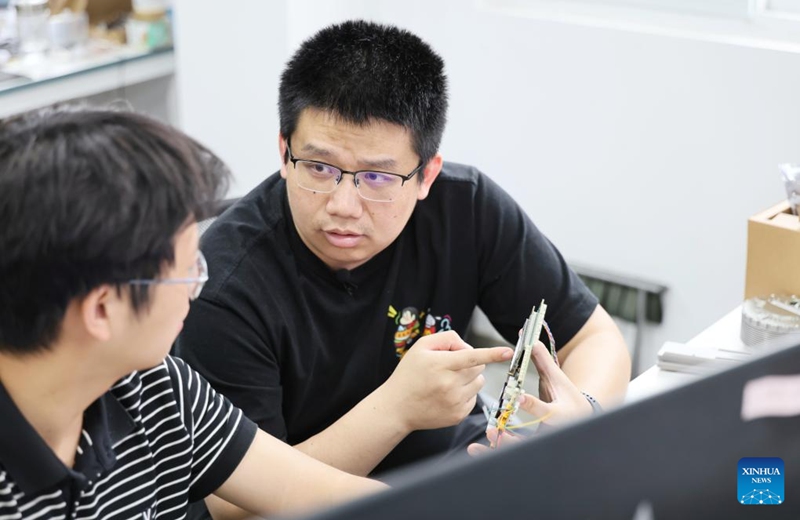
Fu Mingda (R) talks with his colleague at Galileo (Tianjin) Technology Co., Ltd. in Tianjin, north China, May 22, 2026. Thirty-three-year-old Fu Mingda, an electromagnetic engineering designer at Galileo (Tianjin) Technology Co., Ltd., has his sights set on becoming a technical expert in the motor industry. To that end, he has been tackling key challenges in the independent research and development (R&D) of core robotic components.

After earning his master's degree from Shenyang University of Technology in 2018, Fu relocated to Tianjin to focus on the R&D and design of aviation motors. He later joined Galileo, where he was involved in the in-house development of quadruped robot joint modules from the ground up.

At the time, the company relied on externally procured joint modules that were prone to overheating and damage. Furthermore, these outsourced parts could not meet complex performance requirements, such as performing somersaults, climbing slopes, and carrying heavy loads.

In less than six months, Fu achieved a technological breakthrough. Overseeing the process from initial electromagnetic design to supplier development, assembly, and testing, he drove the project through four major iterations and dozens of minor optimizations. Impressively, the very first prototype reached advanced standards in the industry.

Today, fueled by the rapid growth of China's domestic robotics industry, Fu remains busier than ever. He expressed full confidence that, through continued dedication, he will realize his ambition of becoming a leading technical expert in the motor sector. Photo: Xinhua

Fu Mingda (R) talks with his colleague at Galileo (Tianjin) Technology Co., Ltd. in Tianjin, north China, May 22, 2026. Thirty-three-year-old Fu Mingda, an electromagnetic engineering designer at Galileo (Tianjin) Technology Co., Ltd., has his sights set on becoming a technical expert in the motor industry. To that end, he has been tackling key challenges in the independent research and development (R&D) of core robotic components.

After earning his master's degree from Shenyang University of Technology in 2018, Fu relocated to Tianjin to focus on the R&D and design of aviation motors. He later joined Galileo, where he was involved in the in-house development of quadruped robot joint modules from the ground up.

At the time, the company relied on externally procured joint modules that were prone to overheating and damage. Furthermore, these outsourced parts could not meet complex performance requirements, such as performing somersaults, climbing slopes, and carrying heavy loads.

In less than six months, Fu achieved a technological breakthrough. Overseeing the process from initial electromagnetic design to supplier development, assembly, and testing, he drove the project through four major iterations and dozens of minor optimizations. Impressively, the very first prototype reached advanced standards in the industry.

Today, fueled by the rapid growth of China's domestic robotics industry, Fu remains busier than ever. He expressed full confidence that, through continued dedication, he will realize his ambition of becoming a leading technical expert in the motor sector. Photo: Xinhua


Fu Mingda (R) talks with his colleague at Galileo (Tianjin) Technology Co., Ltd. in Tianjin, north China, May 22, 2026. Thirty-three-year-old Fu Mingda, an electromagnetic engineering designer at Galileo (Tianjin) Technology Co., Ltd., has his sights set on becoming a technical expert in the motor industry. To that end, he has been tackling key challenges in the independent research and development (R&D) of core robotic components.

After earning his master's degree from Shenyang University of Technology in 2018, Fu relocated to Tianjin to focus on the R&D and design of aviation motors. He later joined Galileo, where he was involved in the in-house development of quadruped robot joint modules from the ground up.

At the time, the company relied on externally procured joint modules that were prone to overheating and damage. Furthermore, these outsourced parts could not meet complex performance requirements, such as performing somersaults, climbing slopes, and carrying heavy loads.

In less than six months, Fu achieved a technological breakthrough. Overseeing the process from initial electromagnetic design to supplier development, assembly, and testing, he drove the project through four major iterations and dozens of minor optimizations. Impressively, the very first prototype reached advanced standards in the industry.

Today, fueled by the rapid growth of China's domestic robotics industry, Fu remains busier than ever. He expressed full confidence that, through continued dedication, he will realize his ambition of becoming a leading technical expert in the motor sector. Photo: Xinhua

Fu Mingda (R) talks with his colleague at Galileo (Tianjin) Technology Co., Ltd. in Tianjin, north China, May 22, 2026. Thirty-three-year-old Fu Mingda, an electromagnetic engineering designer at Galileo (Tianjin) Technology Co., Ltd., has his sights set on becoming a technical expert in the motor industry. To that end, he has been tackling key challenges in the independent research and development (R&D) of core robotic components.

After earning his master's degree from Shenyang University of Technology in 2018, Fu relocated to Tianjin to focus on the R&D and design of aviation motors. He later joined Galileo, where he was involved in the in-house development of quadruped robot joint modules from the ground up.

At the time, the company relied on externally procured joint modules that were prone to overheating and damage. Furthermore, these outsourced parts could not meet complex performance requirements, such as performing somersaults, climbing slopes, and carrying heavy loads.

In less than six months, Fu achieved a technological breakthrough. Overseeing the process from initial electromagnetic design to supplier development, assembly, and testing, he drove the project through four major iterations and dozens of minor optimizations. Impressively, the very first prototype reached advanced standards in the industry.

Today, fueled by the rapid growth of China's domestic robotics industry, Fu remains busier than ever. He expressed full confidence that, through continued dedication, he will realize his ambition of becoming a leading technical expert in the motor sector. Photo: Xinhua