ARTS / CULTURE & LEISURE
When dialects become the voice of Chinese cinema

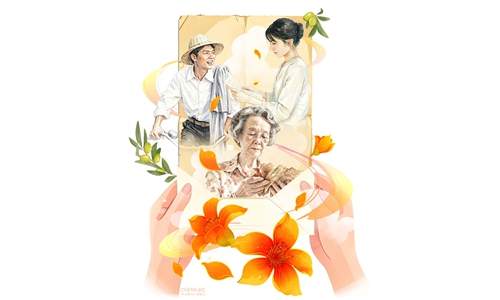
Illustration: Liu Xiangya/GT
A Chaoshan (Teochew)-dialect film has become one of China's biggest cinematic surprises of the year. Dear You, with more than 95 percent of its dialogue in the Chaoshan dialect, has climbed to become the second-highest-grossing film of the year, trailing only Pegasus 3.Despite the fact that most viewers outside southern China do not understand the dialect being spoken, audiences across the country have embraced the story, and it has earned a 9.2/10 rating on review platform Douban, suggesting that emotional resonance can extend far beyond linguistic boundaries.
The film is part of a broader trend in recent years, in which dialect versions of films and television dramas have increasingly received strong critical and audience acclaim.
For example, during the recent May Day holidays, Vanishing Point used the Chongqing dialect extensively to anchor its suspenseful narrative in the city's distinctive urban setting. Earlier productions such as Minning Town and the Shanghainese version of Blossoms Shanghai also received praise for their use of regional speech, which adds a greater sense of authenticity to the storytelling.
Once regarded as too local or niche for mainstream audiences, dialects are increasingly becoming a powerful narrative tool in Chinese cinema.
Veteran Beijing-based film critic Shi Wenxue told the Global Times that these dialect productions have succeeded because they follow the fundamentals of storytelling: believable characters and convincing narratives. Dialects, he added, give films a stronger sense of place and everyday life, functioning almost like a work's "personality" that distinguishes it from more standardized productions.
This is particularly evident in Dear You. Actors from different parts of the Chaoshan region speak with their native accents. The grandmother speaks with a Jieyang accent, while other characters in the film use speech patterns associated with Chaoyang and Shantou, according to the Guangming Daily.
Rather than creating barriers, these linguistic differences enhance the film's realism and reflect the region's internal diversity. Yet the appeal of dialect productions goes beyond cultural novelty.
At its heart, Dear You tells the story of a Chaoshan family separated by war. During that era, many Chaoshan people left for Southeast Asia in search of survival and opportunity.
Beijing-based resident Tang Ye, 29, told the Global Times that the use of the Chaoshan dialect in the film made the historical setting feel more authentic and immersive.
"Emotions are universal," Tang said. "Even when I don't understand the language, I can still deeply relate to the feelings portrayed on screen."
That's because it isn't the dialect that has moved audiences. It's the emotion.
The same principle applies to works such as Vanishing Point and Minning Town. In Vanishing Point, the Chongqing dialect contributes to both the city's vibrant street culture and the film's tense atmosphere. In Minning Town, the contrast between the speech of local villagers in Northwest China and the accents of the experts from Fujian Province helps illustrate the social realities behind China's significant poverty alleviation stories. In each case, dialects serve the narrative rather than overshadowing it.
Dialect-driven storytelling is especially powerful for its realism. By preserving the rhythms of everyday speech, dialect-driven storytelling creates characters that feel less constructed and more lived-in. Recent films such as Dear You show how a dialect is the natural language of daily life.
According to Shi, more than a linguistic tool, dialects offer a window into a region's history, culture and daily life. The way characters speak can reveal where they come from and how they see the world. For filmmakers, dialects provide a way to establish a sense of place and make stories feel more authentic.
At the same time, dialect productions can strengthen regional identity, revitalize local cultural traditions and generate broader cultural and tourism interest, Shi told the Global Times. The success of Blossoms Shanghai sparked renewed attention to Shanghai's history and urban culture, while Dear You has introduced more audiences to Chaoshan culture and qiaopi, the letters and remittances sent home by earlier generations of overseas Chinese.
Still, industry practitioners should also be mindful in the production of dialect films, Shi noted.
When a dialect becomes a floating cultural symbol disconnected from character and story, it risks losing its artistic value. Another challenge arises when performers attempt unfamiliar dialects without mastering their pronunciation and cadence, which may undermine the sense of immersion that dialect productions depend upon.
Audiences are not embracing dialect productions because they are different, but because they feel real. The rise of dialect cinema suggests that the more confidently a story is rooted in its own cultural soil, the more powerfully it resonates with universal emotions, noted Shi.
The unexpected rise of dialect-centered films like Dear You suggests that the future of China's film market may lie in greater specialization, audience segmentation and distinctive storytelling rather than one-size-fits-all productions, Lai Li, an analyst at Maoyan, told the Global Times.
The author is a reporter with the Global Times. life@globaltimes.com.cn
RELATED ARTICLES