ARTS / CULTURE & LEISURE
Keeping classical wisdom alive for the modern world
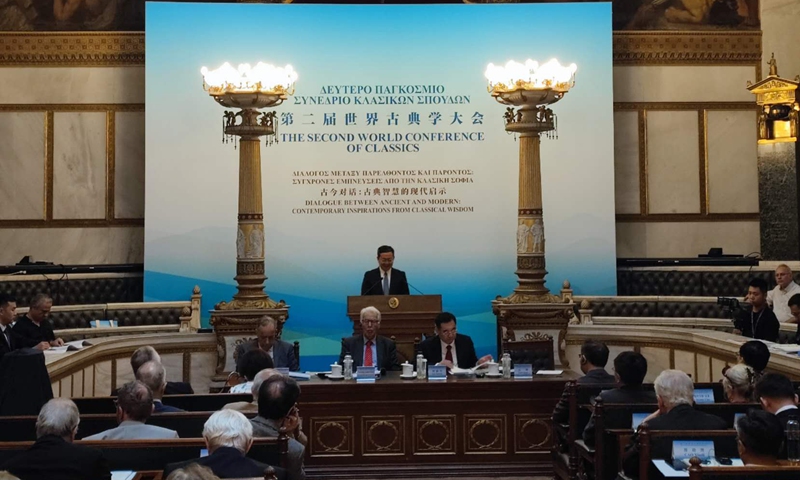
Photo: Courtesy of Xie Yahong
The Second World Conference of Classics will open in Athens, Greece on June 9, 2026. Under the theme "Dialogue between Ancient and Modern: Contemporary Inspirations from Classical Wisdom," the conference will be jointly hosted by the Chinese Academy of Social Sciences, the Ministry of Education and the Ministry of Culture and Tourism of China, the Greek Ministry of Culture, and the Academy of Athens.
In fact, classical studies concern far more than classical theories and texts. Through the sustained efforts of generations of scholars, the hope has always been that classical wisdom may transcend the long river of history, regain vitality in the present age, and continue to illuminate contemporary life.
Today, technological advancement and productive forces are flourishing at an unprecedented pace, while the arrival of the digital and intelligent era has connected the world in ways never seen before. Still, modern society grapples with uniquely contemporary challenges: disordered values, growing utilitarianism, and individual alienation.
Against this backdrop, the seemingly distant ancient world has instead become an intellectual resource through which we reflect upon and improve contemporary life. It helps us explore how to preserve humanistic values, cultivate ideal character, and refine moral qualities in an era of accelerating technological development.
Since the First Opium War, successive generations of Chinese intellectuals have waged a sustained struggle to save the nation from peril. Research into ancient Greek and Roman civilizations likewise serves as a key channel for them to draw on Western ideological legacies and reshape the Chinese nation's spiritual makeup.
Over the past two decades and more, China's growing national strength, together with sustained academic efforts, has enabled us to understand Western civilization from a more equal and composed perspective.
Research into ancient Greek and Roman civilizations helps us understand Western civilization at its roots, thereby promoting exchanges and mutual learning among civilizations and enabling Chinese civilization, on its path toward rejuvenation, to draw upon all outstanding achievements of human civilization.
The reason ancient texts and classical wisdom have endured uninterrupted across millennia lies in the tireless efforts of generations of classicists who have carried the torch forward. German classicist Fritz-Heiner Mutschler stands as one exemplary figure among them.
Born in Heidelberg, Germany in 1946, Mutschler taught for many years at Heidelberg University after completing his doctoral studies, specializing in classical philology and ancient history. From 1988 to 1992, he was invited to teach in China at the Institute for the History of Ancient Civilizations at Northeast Normal University.
Returning to Germany in 1993, he helped establish the Institute of Classical Philology at Dresden University of Technology. In 2011, he returned to China once again as chair professor of humanities at Peking University, where he became deeply involved in curriculum development at the university's Center for Classical and Medieval Studies until his retirement in 2016.
Affectionately nicknamed "Lao Mu" by his Chinese students - a warm honorific blending the Chinese respectful prefix Lao (meaning respected elder) with the shortened form of his surname Mutschler - he left an indelible impression on everyone he taught.
During my years at Peking University, I had the privilege of studying ancient Greek under him. He always sat on top of the classroom desk while teaching, speaking rapidly and passionately as he guided us through reading and translating Homer's The Iliad. Gradually, the magnificent and extraordinary world of epic poetry unfolded before us.
To us, Mutschler resembled the noble hero Hector from The Iliad, brave and loyal, upright and compassionate.
His strict teaching style intimidated us, yet outside class he was an elderly scholar who cared for his students with patience and warmth. He and his wife often invited us to meals, smiling as they watched us eat enthusiastically. He eagerly participated in our cultural and recreational activities and generously mentored younger scholars as they stepped onto the academic stage.
In the Western context, classics traditionally refers to the study of ancient Greece and Rome. In recent years, both Chinese and international scholars have increasingly hoped to build a broader conception of classical studies, one that incorporates Chinese classical scholarship into the global map of classical research.
To this end, Mutschler devoted himself wholeheartedly to creating opportunities for Chinese scholars to engage with international academia on equal terms and helping Chinese classical scholarship reach the world.
Back in 2003, together with German sinologist Achim Mittag, Mutschler invited Chinese and Western scholars to participate in a comparative research project on the Roman Empire and ancient China, bringing comparative studies between Chinese civilization and Greco-Roman civilization into the field of classical studies.
In 2014, he organized an international symposium at Peking University dedicated to comparative studies of the Book of Songs and the Homeric epics, pioneering comparative analysis between these two foundational classics of Chinese and Western civilizations.
Whether through teaching or organizing conferences, the amount of labor involved was difficult to measure. Yet Mutschler never lost heart and always moved forward.
In 2024, he attended the first World Conference of Classics held at Yanqi Lake in Beijing. But before he could witness the opening of the second conference, he passed away peacefully this April.
Mutschler was an epitome of the scholars who devoted enormous energy to advancing classical studies in China. The seeds they planted have already spread far and wide.
Today, a new generation of scholars is assuming responsibility for carrying forward the intellectual lineage of classical studies and safeguarding the wisdom of civilization.
China's classical studies have already produced substantial achievements.
The "Classics and Interpretation" series, devoted to translating and studying canonical texts and scholarship related to Western classical civilization, has published more than 800 volumes to date.
Specialized research institutions have been established, including the classical studies office of the Institute of Foreign Literature at the Chinese Academy of Social Sciences, the Department of Classics at Sichuan University, and the Center for Classical and Medieval Studies at Peking University.
Serving as a bridge between Chinese and foreign classical studies, the first World Conference of Classics was successfully held, while the Chinese School of Classical Studies was established in Athens.
As the second World Conference of Classics approaches, scholars from different cultural traditions will transcend geographical and intellectual boundaries through exchanges and dialogue. Together, they will reinterpret classical wisdom to answer urgent real-world challenges facing contemporary humanity.
Through classical studies, civilizations can learn from one another through mutual reflection and mutual respect, offering insights into contemporary human life. This is the best way to carry forward the legacy of classical studies and the clearest testament to its relevance today.
(Yue Shenghao is a staff member of the Classical Studies at Chinese Academy of Social Sciences)
