BRASIL 247 / MORE
Portinari in Beijing: "China's development is what my father dreamed for Brazil," says João Candido Portinari
Exhibition introduces millions of Chinese visitors to the painter who made workers and the excluded protagonists of Brazilian art
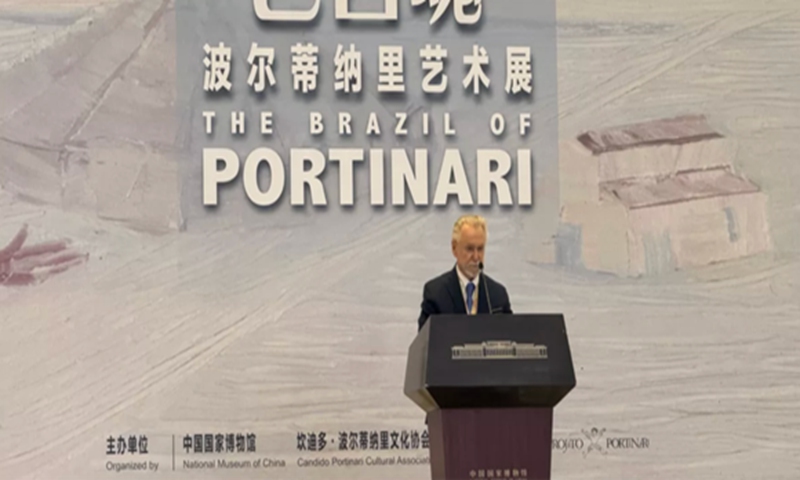
Photo: Brasil 247
By Brasil 247 - The opening of the exhibition "Brazil Through Portinari" at the National Museum of China in Beijing marks one of the most significant moments in cultural diplomacy between Brazil and China in recent years. As part of the official Brazil-China Cultural Year program, the exhibition brings the work of Brazil's most celebrated social painter to the country's leading museum, where it will remain for four months and may attract up to millions of visitors, according to Brasil 247.
During the opening ceremony, João Candido Portinari, son of the artist and president of the Candido Portinari Cultural Association, reflected on the broader meaning of the exhibition in an interview with Brasil 247. "I have the feeling that China's development is what Portinari dreamed for Brazil," he said.
His statement draws a connection between Candido Portinari's artistic vision and the social transformation experienced by China over recent decades. In his paintings, Portinari portrayed rural workers, migrants, peasants and impoverished families living on the margins of economic development. His art denounced inequality while expressing hope that progress could benefit those whose labor built the nation.
Born in 1903 in the town of Brodowski, in the state of São Paulo, to Italian immigrant parents, Portinari dedicated his artistic career to depicting the Brazilian people. A member of the Brazilian Communist Party (PCB), he believed that art should be committed to social reality and to the construction of a more just society. In works such as "Coffee Farmer," "Coffee," "Retirantes" and "Dead Child," he transformed workers and marginalized communities into central figures of Brazil's national narrative.
According to João Candido Portinari, there is a strong affinity between his father's social vision and China's development process. Over the past decades, China has lifted hundreds of millions of people out of poverty and carried out one of the largest socioeconomic transformations in modern history. While Portinari's paintings depicted the hardships of exclusion and poverty, his son views China's experience as a concrete demonstration that development can be placed at the service of the population.
The reflection gains additional significance because it comes at a moment when millions of Chinese visitors are being introduced to Portinari's work. At the entrance of the exhibition, visitors encounter a text written by João Candido Portinari presenting the Brazilian artist to the Chinese public and explaining his importance to Brazilian culture and the universal scope of his work.
The exhibition is supported by Petrobras, Grupo Pátria and several Brazilian and Chinese institutions engaged in promoting cultural exchanges between the two countries.
In the text displayed at the exhibition, João Candido describes the event as the realization of a dream built over decades through the work of Projeto Portinari. "It is with profound emotion that I see this dream come true in the heart of Beijing," he wrote.
The statement reflects the historical significance of the exhibition. Although Portinari has enjoyed international recognition for decades, his work has rarely been presented on a scale comparable to that offered by the National Museum of China, one of the world's most important cultural institutions.
Explaining his father's universal appeal, João Candido writes: "Many ask how a painter born among the coffee plantations of Brazil's red-soil countryside could achieve such a universal language. The answer lies in a structural truth: Portinari did not merely paint figures; he painted the very essence of the human condition."
This perspective helps explain why his work continues to resonate across cultures and continents. While his subjects were deeply Brazilian, the emotions present in his paintings—hope, suffering, dignity, solidarity and resilience—belong to a universal human experience.
Throughout the twentieth century, few Brazilian artists created such a powerful representation of the country. While much traditional artistic production focused on elites and urban centers, Portinari directed his attention toward rural laborers, immigrants, migrants from Brazil's Northeast, Black Brazilians, peasants and poor children.
His art became both a visual testimony to Brazilian inequality and a celebration of the strength and dignity of ordinary people. This outlook was closely connected to his political convictions. As a communist activist and advocate of social justice, Portinari believed that art should contribute to raising awareness about the country's challenges. His work never remained indifferent to human suffering.
At the same time, his art extended beyond social criticism. Portinari consistently affirmed universal values such as fraternity, solidarity and peace.
In another passage of the text presented to visitors, João Candido describes his father's work as a bridge between peoples. "To see Portinari's work is to see the Brazilian people—their struggles, their faith and their resilience. But it is more than that: it is to see a bridge."
The metaphor appears particularly appropriate at a time of growing cooperation between Brazil and China. Beyond introducing a Brazilian artist to Chinese audiences, the exhibition promotes an encounter between two historical experiences shaped by the pursuit of national development and improved living conditions for their populations.
Through Portinari's paintings, Chinese visitors gain access to Brazil's social history, its contradictions and its challenges. At the same time, the exhibition symbolizes the strengthening of cultural ties between two nations that play an important role in the construction of a more balanced and multipolar international order.
João Candido also recalls the humanist commitment that defined his father's life and work. "My father's absolute commitment to humanity culminated in the monumental diptych War and Peace at the United Nations, an ethical manifesto and a call for harmony among peoples."
The panels, regarded as one of the greatest achievements of Brazilian art, summarize Portinari's universal vision. Beyond portraying Brazil, he sought to understand the tragedies and aspirations of humanity as a whole.
Concluding his message to Chinese visitors, João Candido summarizes the spirit of both the exhibition and the Brazil-China Cultural Year. "May this exhibition be an embrace between our cultures and proof that, through art, our peoples will always walk together."
Over the next four months, millions of Chinese visitors will encounter a Brazil portrayed by an artist who devoted his life to painting workers, peasants, migrants and the excluded. They will also discover an artist who believed that development only has meaning when it reaches the people.
For João Candido Portinari, this may explain why contemporary China reflects ideals that inspired much of his father's work. In Beijing, Portinari's paintings do more than tell the story of Brazil. They help build a bridge between two nations connected by the belief that culture, sovereignty and human development can advance together.
