ARTS / CULTURE & LEISURE
Poetry lessons open new worlds for children in rural schools
Growing with verse
By Published: Jun 11, 2026 10:51 PM

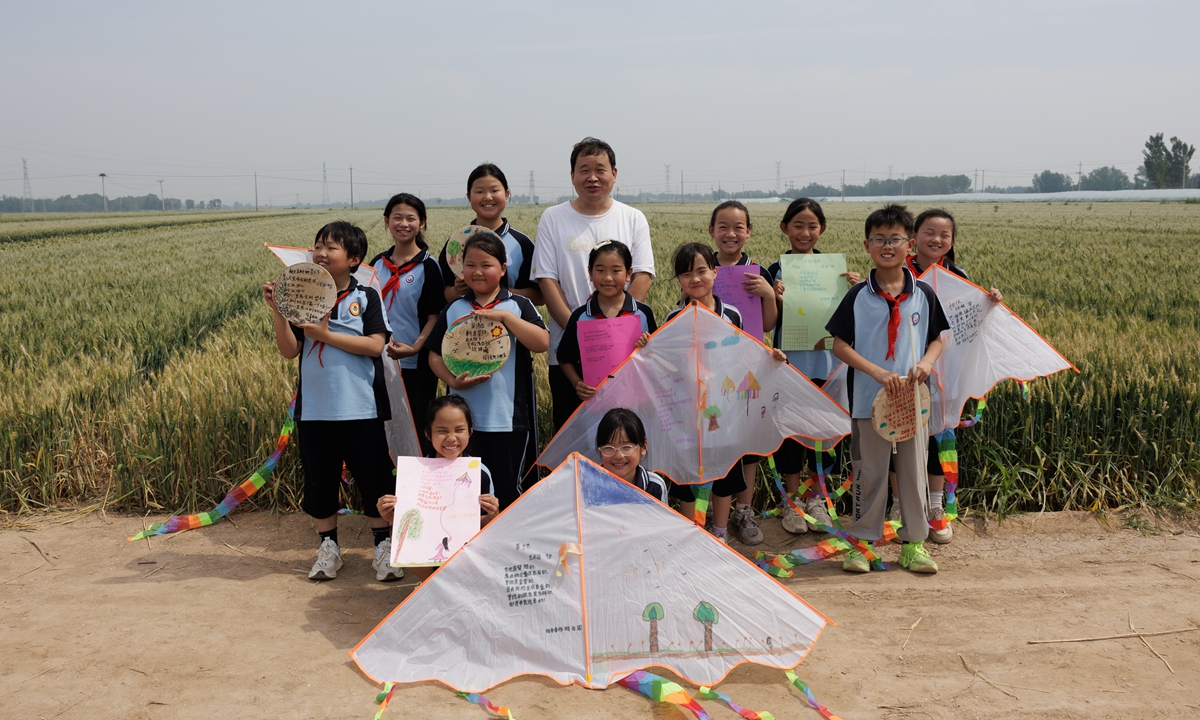
Yang Zhanguo (center) poses for a photo with his students in Yingtaoyuan township in Liaocheng, Shandong Province. Photo: Courtesy of Yang Zhanguo
In some remote corners of East China's Luxi Plain and Southwest China's Hengduan Mountains, there are schools where teachers and students are embracing poetry deeper. There, with a pen and a sheet of paper, students follow their teachers out to cornfields and rice paddies, listening to cicadas, breathing in the scent of rice, and writing quiet lines of poetry in the fresh air. This is their poetry lesson.During poetry classes, children write about growing up: "In the wheat field, there is a group of me. At 12, I long to grow up; at 20, I miss my childhood." They write about their parents: "My parents are like traffic lights. When it rains and we go home, he is still standing there." They also write about spring: "I wait quietly in the earth for a wildflower to lift its head."
Yang Zhanguo, a primary school teacher in Yingtaoyuan township in Liaocheng, East China's Shandong Province, has integrated poetry into his lessons for several years. He told the Global Times that before he began teaching poetry, he never quite believed the saying, "All children are born poets," but now, he truly understands what it means.
"First, children really do have much more imagination than adults," he said. "Second, their feelings are pure and sincere, expressed straight from the heart." These natural gifts, combined with patient guidance, mean his students often write poetry that surprises and even amazes him.
Hundreds of miles away, another teacher, Yang Deli, shared a similar feeling. At her school in Changning county, Southwest China's Yunnan Province, she has set up a poetry club. Through teaching poetry, she has discovered that every child has a different reason for joining and takes away something unique from the experience.
Some simply think writing poetry is fun. Some use poetry as a way to pour out their feelings. Quite a few children from rural areas have gone on to see new places or join exchange events thanks to their poetry, broadening their minds. Some even use poetry to prove their worth and regain confidence.
Poetry is genuinely changing the lives of children in these remote places.
Poetry through the seasons
Before starting poetry classes at their schools, both Zhanguo and Deli received training from the Shiguang Four Seasons Poetry Youth Service Center, a rural poetry education non-profit that has instructed teachers from 3,332 primary and secondary schools in poetry lessons as of March.
They learned about lessons centered on four themes, "spring light, summer shade, autumn day, and winter sun," and strove to blend poetry not just into language classes but also into school activities and outdoor experiences.
Zhanguo noted that in his school, poetry class is never limited to four walls. The wheat field, a riverbank, or beneath a willow can all be classrooms. Children use a wall as a desk or lie on the ground to write poems on their kites.
During Grain Rain, the sixth solar term of China's traditional calendar and the final chapter of spring, Zhanguo leads students to plant sweet potatoes and peanuts. Come autumn, they harvest the crops together. These outdoor lessons encourage students to put their real-life experiences into verse.
"Our school is on the plains, so I take students out to the fields in spring to see the great waves of wheat, and to the river in autumn to watch the reeds," he said. "We use the whole world as our classroom, encouraging children to observe, feel, and create poetry in nature."
Deli discovered that living in the countryside means children can smell flowers, hear insects, see the stars, and experience the energy and beauty of nature every day. Many lines in their poems are inspired by what they see around them.
For example, one student noticed how colorful the campus became in spring, with different flowers blooming everywhere. When writing a poem on the theme of "secrets," she wrote:
"When the spring wind blows,
all secrets turn into flowers of every color,
blossoming everywhere."
Childhood illuminated by poetry
Deli has taught poetry for seven years, guiding hundreds of students into the world of verse. Over time, she has seen real changes in these children.
She told the Global Times that she taught a quiet, shy girl whose family was of modest means and whose grades in Chinese often hovered right at the passing mark. The girl was very unsure of herself.
But once she started writing poetry, she kept at it, never giving up even when her poems were simple. Later, her work was published, earning her a small payment and an award certificate. This completely changed the girl - he grew more confident and cheerful, and by the time she finished primary school, her grades had greatly improved.There are also sensitive and uncertain students in Zhanguo's classes who are often puzzled by life but full of curiosity about new things. "Poetry," Zhanguo said, "has become a perfect way for them to express themselves."
For children who are shy and rarely speak in the classroom, Zhanguo organizes more outdoor lessons. When the classroom's four walls open up to the world, children can relax completely, feeling physically and emotionally safe. In these immersive classes, they slowly learn to open up, observe, ask questions, and finally, express themselves.
What Zhanguo hopes for most is that poetry education helps the children form habits of finding, loving, and expressing beauty. Poetry has opened a new door for them, helping them see different kinds of beauty in daily life.
"Even years from now, if they no longer write poetry, this experience will still stay in their hearts," he said. "Children who grow up with poetry's companionship will look at the world with kindness and warmth. That is the most precious gift poetry leaves them."
RELATED ARTICLES