BRASIL 247 / MORE
China reaffirms friendship with Latin America and proposes new phase of green and digital infrastructure cooperation
Forum highlights record trade, productive integration, energy transition and digital transformation
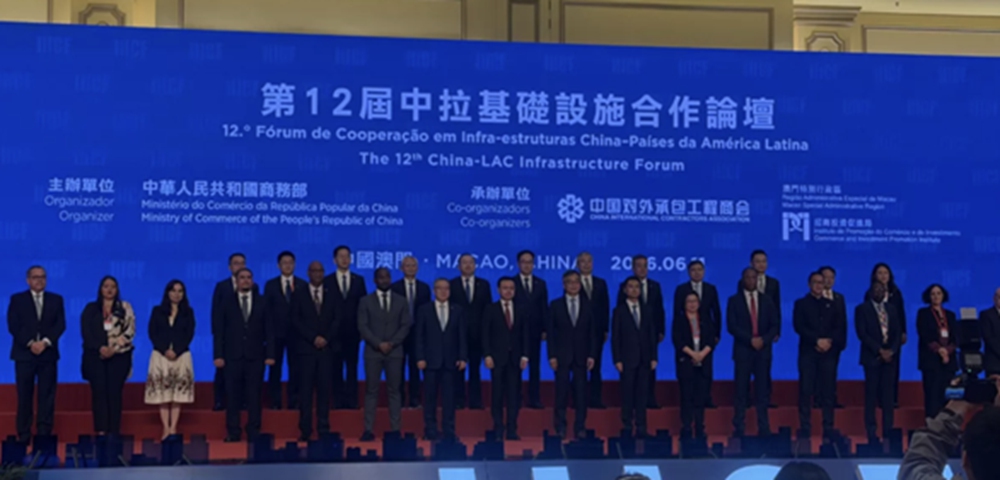
By Leonardo Attuch, in Macao for Brasil 247 - China reaffirmed its long-term commitment to Latin America and the Caribbean during the 12th China-Latin America Infrastructure Cooperation Forum (China-CELAC), held on Thursday in Macau. According to Brasil 247, the event brought together government officials, representatives of international organizations, and executives from major infrastructure, energy and technology companies to discuss a new stage of China-Latin America relations based on sustainable infrastructure, industrialization, the digital economy and strengthened multilateralism.
The forum's main political message was delivered by Zhang Run, Director-General of the Department of Latin American and Caribbean Affairs at China's Ministry of Foreign Affairs.
According to Zhang, despite a global environment marked by conflicts, instability and major geopolitical changes, relations between China and Latin America continue to advance steadily, supported by political trust, expanding economic cooperation and stronger people-to-people ties.
Zhang presented figures illustrating the growing economic integration between the two regions. According to him, bilateral trade reached a record $549 billion in 2025. During the first five months of 2026, trade volume totaled $247.3 billion, representing growth of 17.6 percent compared with the same period of the previous year.
He emphasized that Chinese imports from Latin America increased by 27.6 percent, reaching $120 billion. According to Zhang, the figures demonstrate a more balanced trade relationship. He also highlighted recent measures to deepen integration, including visa exemptions for citizens of Brazil, Argentina, Chile, Peru and Uruguay, as well as the expansion of direct flights between China and Latin American countries, including Brazil.
Zhang said that recent surveys conducted by international research institutions show an increase in positive perceptions of China among Latin Americans, making China the only major extra-regional power whose image has improved in the region.
Wang Qi, deputy director general of the Department of Outward Investment and Economic Cooperation at China's Ministry of Commerce, presented an overview of infrastructure cooperation between China and Latin America. He said projects developed under the Belt and Road Initiative have enabled the construction of a comprehensive cooperation network covering transportation, energy, telecommunications and urban development.
Wang highlighted the Port of Chancay in Peru as one of the most significant examples of this cooperation. According to him, the new infrastructure reduced maritime transportation time between Peru and Asia from 35 days to 23 days, lowering logistics costs and strengthening trans-Pacific economic integration.
Another example cited was Bogotá Metro Line 1 in Colombia, which is expected to reduce average commuting times from more than two hours to 27 minutes. Wang stated that projects carried out by Chinese companies in Latin America have already contributed to the creation of nearly one million jobs, while also supporting the construction of hospitals, schools, bridges, airports, roads and ports across the region.
During his presentation, Wang outlined three pillars for the next phase of cooperation.
The first is the integration of infrastructure and industrial development. He said Latin America needs to expand its participation in global production chains and that infrastructure can play a decisive role in this process.
The second pillar is ecological transition. Wang stated that China intends to deepen cooperation in clean energy, green infrastructure, sustainable transportation and green finance.
The third pillar is digitalization. According to him, Latin American infrastructure is moving beyond simple physical connectivity toward a new stage of digital connectivity.
"The stronger the winds and waves, the more the China-Latin America community with a shared future should sail forward together," Wang said.
The discussions took place amid the growing presence of major Chinese infrastructure groups in Latin America. Participants included representatives from PowerChina, China Energy Engineering, China Railway Construction Corporation, China Harbour Engineering and Huawei.
The participation of these companies reflects China's strategy of combining investments in traditional infrastructure with projects focused on energy transition, smart grids, digitalization and logistics modernization.
PowerChina has expanded its activities in the region in areas such as renewable energy, electricity transmission, water infrastructure and major engineering projects, sectors considered priorities for Latin American development.
At the opening session, China's International Trade Representative and Vice Minister of Commerce Li Chenggang called for deeper economic cooperation between China and Latin America.
According to Li, both sides should strengthen multilateralism, expand trade and investment liberalization and increase cooperation in areas including renewable energy, smart power grids, environmental protection, smart cities, data centers and 5G networks.
Li also emphasized the importance of promoting innovative financing mechanisms and increasing the participation of companies and financial institutions in infrastructure projects.
Representing CELAC, Guyana's Minister of Public Works Juan Anthony Edghill stated that countries in the region attach great importance to maintaining dialogue with China.
The minister noted that bilateral cooperation has gained momentum since the establishment of the China-CELAC Forum in 2014.
"We have witnessed exponential growth in our cooperation agenda," Edghill said.
He stated that cooperation with China has contributed to advancing the national and regional priorities of Latin American and Caribbean countries and called for a partnership based on inclusion and mutual benefit.
Throughout the forum, Chinese and Latin American officials conveyed a common message: amid growing international uncertainty and geopolitical disputes, cooperation in infrastructure, energy, technology and sustainable development is becoming an increasingly important pillar of relations between China and Latin America, reinforcing the role of the 12th China-CELAC Infrastructure Forum in Macao as one of the main platforms for strategic coordination between the two regions.
(Reported by Brasil 247 on June 11, 2026)
