SPORT / FOOTBALL
Unbeaten Asian teams at World Cup prompts realistic reflection among Chinese fans
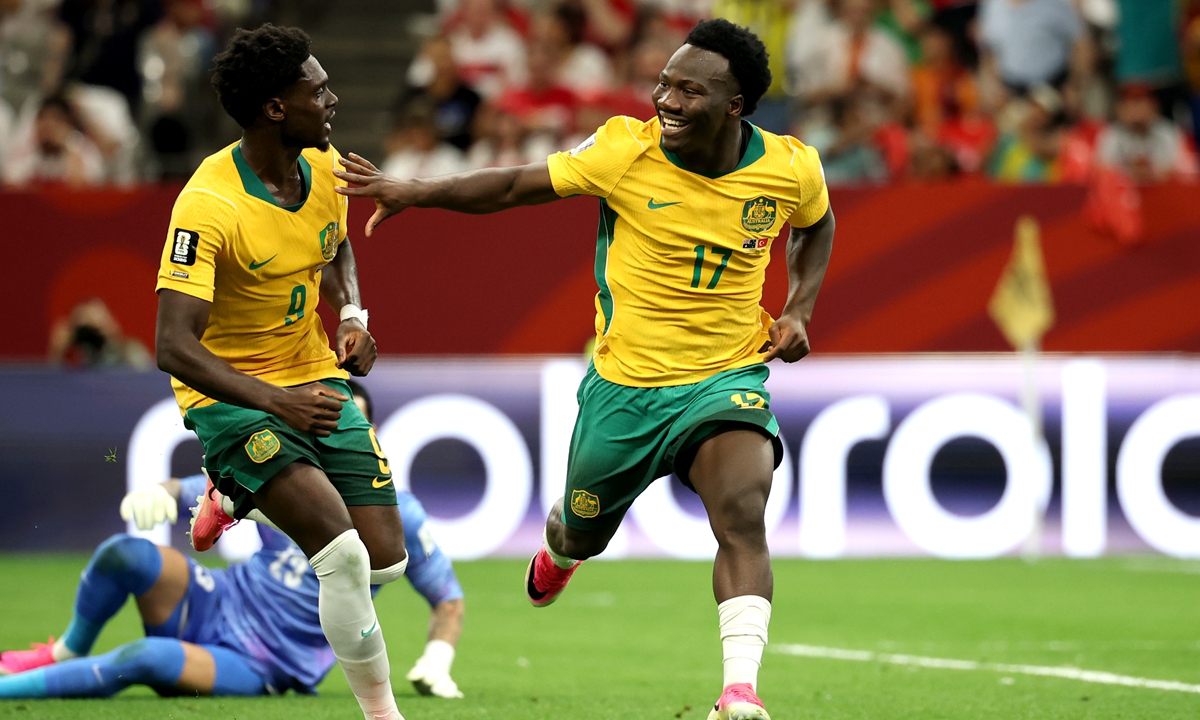
Nestory Irankunda of Australia (right) celebrates scoring a goal with teammate Mohamed Toure during the FIFA World Cup Group D match between Australia and Turkey at BC Place Vancouver on June 13, 2026 in Vancouver, British Columbia. Australia ultimately defeated Turkey 2-0. Photo: VCG
With two wins and a draw, teams from the Asian Football Confederation (AFC) at the FIFA World Cup have made an impressive start to the tournament remaining undefeated in their opening matches against European opponents.
This brilliant run of South Korea, Qatar and Australia has triggered a wave of realistic reflection among Chinese football fans, who are increasingly admitting that the gap between the Chinese national team and Asia's elite is still too wide to bridge.
South Korea kicked off the momentum with a tactical 2-1 comeback victory over the Czech Republic, marking their third consecutive World Cup tournament with a win against European opposition.
Meanwhile, former tournament hosts Qatar showcased immense resilience by battling through heavy pressure to snatch a dramatic 1-1 equalizer against Switzerland in stoppage time, securing their first-ever World Cup finals point.
Australia, which has competed in the AFC since 2006 despite being geographically located in Oceania, capped off the run on Saturday in Vancouver with a clinical 2-0 shutout against Turkey, despite fielding a squad valued significantly lower than their opponents'.
"We owe the Chinese national team an apology," RedNote user Siunaa_Evyn wrote, saying the team was simply outperformed rather than underachieving.
Football commentator Han Qiaosheng also weighed in. "Do you really see the quality of Asian football?" he wrote on Sina Weibo. "Now you can understand how difficult it is for the Chinese national team to qualify for the World Cup."
For Chinese fans watching from the sidelines, these results have shed an entirely new light on their own national team's recent failures.
During the most recent World Cup Asian qualifiers, China suffered narrow but definitive defeats to these exact opponents on away pitches, losing 1-0 to South Korea, 1-0 to Qatar and 2-0 to Australia.
While those close margins initially left some fans harboring a sense of lingering regret, seeing these three Asian teams either defeat or hold their own against established European opponents on the world stage has brought a major reality check.
The sentiment brought by the fans on Chinese social media is that even with the World Cup expanding to 48 teams and granting Asian teams 8.5 qualification slots, it is entirely normal and reasonable that China failed to qualify.
Many football fans and sports commentators illustrate the widening chasm by comparing the diverging paths of two young starlets, Australia's Nestory Irankunda and China's Wang Yudong.
Just three years ago, during the 2023 U17 Asian Cup qualifiers, the two teenagers were the talk of youth football as they finished as the tournament qualification's joint top scorers.
Irankunda, who spent time with German giants Bayern Munich before moving to England's Watford, solidified his rise to global prominence by scoring a crucial goal in Australia's 2-0 victory over Turkey at the World Cup.
In stark contrast, Wang has seen his development slow this season with Zhejiang FC in the domestic Chinese Super League, scoring five goals after 15 league rounds but yet to replicate the rapid upward trajectory many had anticipated.
"Once regarded as peers, their paths have completely drifted," noted a Chinese football fan.
"Irankunda successfully translated his youth success into opportunities in Europe, the once-frequent conversations regarding Wang's pathway to Europe have seemingly ground to a halt.
Sports commentators also said the difference largely stems from the pace and competitiveness of their respective domestic football environments.
"It is quite simple to understand when you look at the environments. The competitive landscape is completely different for the duo," sports commentator Li Ming wrote on Weibo.
"The domestic league lacks the intensity, physical demands, and high-tempo rhythm of the Australian A-League, which can limit the development potential of young players," Li said.
