Clashes erupt as thousands protest G7 in Geneva; summit expected to expose deep Western divisions as unity frays and strategic gaps widen: Chinese expert
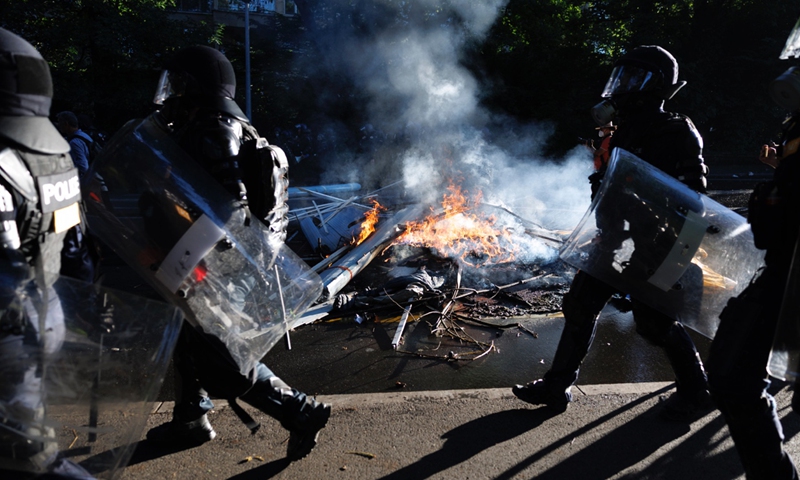
No-G7 activists clash with riot police during a demonstration against the G7 summit in Geneva, Switzerland on June 14, 2026. Protests opposing the G7 summit, which is scheduled to take place from June 15 to 17 in Evian, France, are centered this weekend in nearby Geneva. Activists have chosen Geneva for its accessibility compared to the high-security perimeter surrounding Evian. Photo: VCG
The protest started out peacefully at around 3:30 pm with demonstrators waving banners bearing messages such as: "No to the G7 and all imperialist alliances!" and "Abort the G7," according to Le Monde.
Chanting slogans with a range of messages, supporting Palestinians, climate action, feminism and anti-capitalist activism, the protesters made their way through a barricaded city, as helicopters hovered above. At around 7:00 pm, police estimated the number of demonstrators at 20,000, including around 600 "Black Bloc" radical protesters, according to the report.
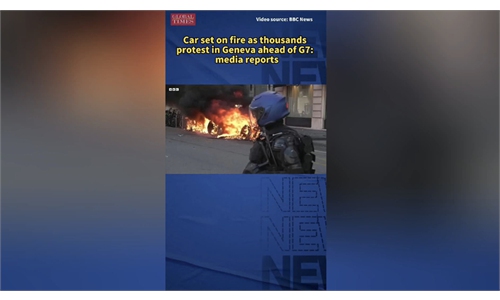
Shortly after the march began, groups of black-clad protesters in masks began breaking through barriers protecting some of the upscale apartment buildings along the route, and set cars alight, per Le monde.
A Reuters report said that some 20,000 people gathered for a march that was initially peaceful but protesters later targeted what they depicted as symbols of capitalism and multilateralism, including the parked Tesla and the UN office. Demonstrators ripped bricks from the ground to throw at police, while children cried as teargas wafted over downtown Geneva's sun-baked streets, according to Reuters.
According to the Euronews, a violent standoff extended into the evening after a series of incidents - including a car set ablaze and a bank's windows smashed. Swiss and French authorities say they have deployed thousands of police to provide security for the summit. In France, authorities say they will deploy more than 13,000 police and gendarmerie officers to ensure security in the summit area just across the border. Over 800 French border control officers will be active, up from about 60 normally.
Besides the increased police presence, authorities have also blocked off roads, banned unauthorized gatherings and pledged financial support for businesses that could be hit by unrest. Scores of businesses and shops in the resort French town have boarded up their shopfronts with wooden panels as a precaution, per the Euronews.
The summit will see leaders discuss issues including the Middle East, Ukraine and global economic imbalances. Most of the leaders will be arriving at Geneva Airport before making their way to Evian, per the Euronews.
Protests ahead of the summit are not the only issue at the G7 summit that many media outlets have covered. Greater attention has also been paid to differences among member countries. For example, Le Monde noted that the G7 summit will be one of the first major international gatherings since the US and Israel launched a war against Iran in late February, upending the Middle East and widening transatlantic tensions.
The divisions within the G7 are not only deep, but fundamental. The US no longer supports the globalization agenda, while its strong opposition to Europe's prevailing multicultural politics has created sharp differences between the two sides over national governance and the handling of international affairs. These differences are difficult to bridge, and the summit will only further expose the fragmentation of the Western camp and the deep contradictions between the US and Europe, Li Haidong, a professor at China Foreign Affairs University, told the Global Times.
Despite mounting domestic and external challenges, the G7 still wants to hold the summit because the traditional Western camp is losing ground in both domestic governance and global influence. Other G7 members hope to awaken the US and project an image of Western unity, but that unity has already eroded. The gap between the G7's strategic ambitions, agenda-setting plans and actual capabilities is continuing to widen, the expert noted.
A New York Times report said that when the US leader arrives on Monday afternoon in Evian, an Alpine spa town on the southern shore of Lake Geneva, he will be greeted by European leaders who no longer view the US as a partner on key issues such as climate change and security. In some cases, they view the US as a threat, following Trump's destabilizing attacks on Iran, which have roiled the world economy, his deepening disdain for NATO, and his threats to take over Greenland.
While ahead of Monday's G7 meeting, Canadian Prime Minister Mark Carney said Sunday that the US will play a role in a new world order where no one institution or country will have all the answers, according to the Canadian Press.
"What one can't do at this point in a rapidly shifting world order is to rely on one set of institutions, one grouping, one country to provide the answers," said the Canadian leader.
The G7 is essentially a small Western clique that has long claimed a sense of uniqueness and superiority, while seeking to dominate the global agenda and shape the international order. This mindset runs counter to genuine multipolarity and inclusive globalization, and has become an obstacle to a fairer international order and common development, said Li.
RELATED ARTICLES