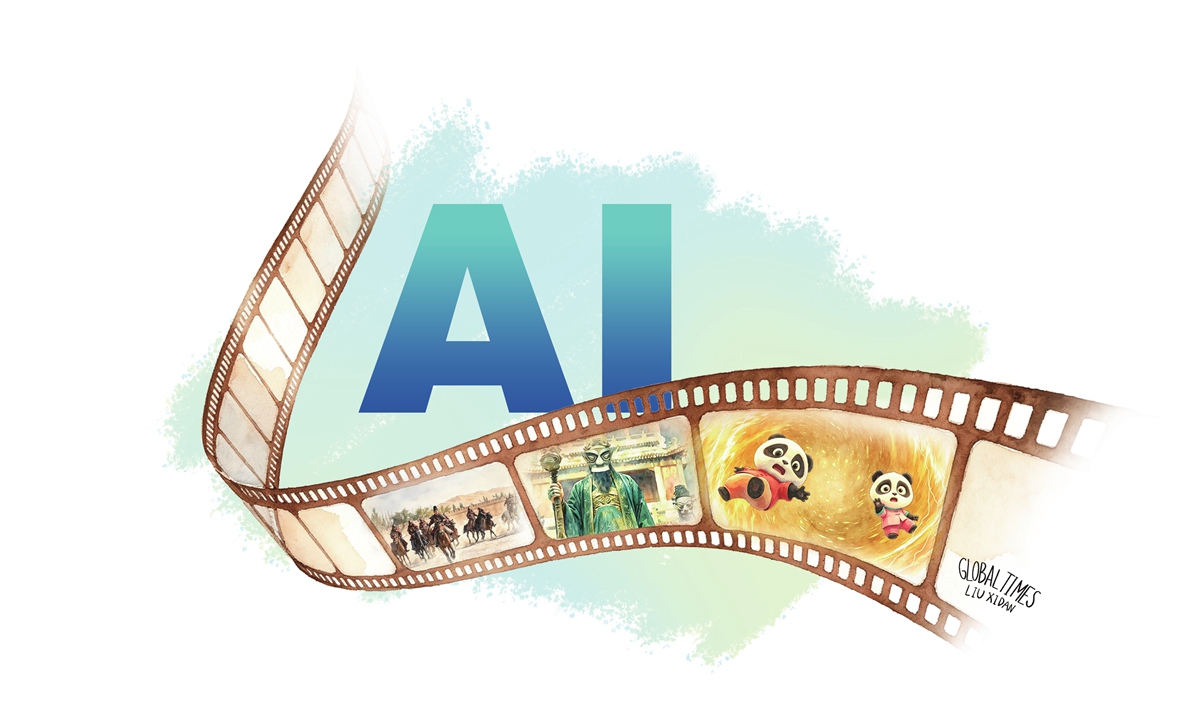
Illustration: Liu Xidan/GT
After 83-year-old Martin Scorsese announced his role as advisor to AI company Black Forest Labs in early June, committing to generative AI for film storyboarding, the reaction from Hollywood was swift and fierce. The Art Directors Guild slammed the move as "turning his back on the human artists" and "a betrayal of the collaborative nature of cinema." Once again, the US film industry finds itself locked in endless battles over whether to embrace or resist generative AI.
Across the Pacific, China has moved from debate to deployment. The release of the country's first full-process AI-generated animation film, The Reunion Journey, marks a milestone. From script and storyboard to character animation and final compositing, the entire production was completed through an end-to-end AI pipeline. This achievement signals not just technological prowess but a fundamental shift in how stories can be told and scaled in the world's second-largest film market.
In an interview with the Global Times, The Reunion Journey's chief planner and producer Li Guanyu outlined an ambitious vision. "Animated films are likely to evolve first into a 'theatrical web series' model," Li said.
With significantly lower costs and rapid iteration cycles, studios could release multiple entries in a series annually, much like binge-watching on Netflix but on the big screen. This approach would allow for exclusive premieres, split releases, and stronger IP cultivation. Crucially, it offers a path beyond China's traditional heavy reliance on box-office performance, unlocking vast potential in merchandising, cultural licensing, and global exports.
The momentum extends far beyond one project. Bonna Pictures' AI-co-created animated feature Sanxingdui has already secured a public screening permit, also known as the dragon seal. Popular dramas such as Swords Into Plowshares used AI tools to reduce virtual scene production from two months to two weeks. Productions like Flourished Peony and Small Town, Big Story leveraged AI for script polishing, slashing preparation time by two-thirds. In the micro-drama sector, AI-driven realistic human shorts have driven costs down to one-third or even one-tenth of traditional methods, with over 470 new AI comic dramas launching daily nationwide in early 2026.
Major facilities in Qingdao's Oriental Movie Metropolis and Chongqing's Yongchuan Technology Film Base are integrating LED virtual stages with AI scene generation. China Film Group's AI research institute can automatically produce storyboards and dynamic previews in minutes. This is not blind technological enthusiasm. Chinese filmmakers are acutely aware of AI's limitations and the irreplaceable role of human creators.
Director Liu Jiacheng, told the People's Daily that "AI is not that magical. It can calculate preferences, but it cannot generate resonance. That moment when a great actor delivers a smile through tears, even they don't fully understand it, can AI truly explore the human heart through data? AI will never achieve uniqueness." Beijing People's Art Theatre President Feng Yuanzheng noted that while AI images are technically flawless, they often lack the idiosyncratic brushstrokes and happy accidents of hand-drawn art. "Those unexpected extras or omissions are precisely where artistic personality emerges." China Film Group's chief engineer Lin Xiaofei acknowledged that AI dramatically boosts efficiency but cannot yet match Hollywood-level sophistication in complex content. However, the industry is building new workflows centered on AIGC while reinforcing human strengths in cross-domain storytelling, cultural insight, and professional judgment.
Concerns about job displacement are real and deserve attention. Industry insiders describe the shift as "inevitable transformation pains," comparable to the transition from 2D to 3D animation that reduced demand for certain in-between drawing roles. Major studios have established dedicated AI departments, yet full transformation takes time. The real challenge lies not in rejecting tools but in redefining human value within the creative process.
Training data copyright, protection of grassroots positions, and digital likeness rights remain unresolved issues requiring thoughtful regulation. Nevertheless, China's approach, pragmatic experimentation balanced with recognition of human centrality, stands in sharp contrast to Hollywood's entrenched resistance from established interests.
Cinema, as Scorsese noted, is a young medium, "only around 125 years old, so we have to be open to how it can evolve," and one that has repeatedly absorbed new technologies: sound, color, digital effects, and now generative AI.
AI can handle 99 percent of repetitive labor, but the precious 1 percent, the injection of soul, comes from creators' lived experience, cultural observations, and deliberate aesthetic choices that push against algorithmic predictability. AI manages efficiency; humans safeguard creativity, emotion, and ultimate judgment.
AI enables more young creators to bring authentic local stories to the screen. This process strengthens cultural confidence and diversity in global storytelling. Rather than fearing displacement, China is positioning human talent at the center of an expanded creative ecosystem, one where efficient tools free artists to focus on what machines cannot replicate: genuine human insight and narrative depth.
The results are visible. Faster production cycles, more experimental content, and scalable IP development point toward a more dynamic industry less vulnerable to single blockbuster failures.
This does not mean unchecked acceleration. Safeguards for creators' rights, ethical guidelines, and investment in human talent development remain essential. Yet the direction is clear. By embracing AI as a powerful collaborator rather than an existential threat, Chinese cinema is expanding the boundaries of what is possible while reaffirming the centrality of human experience.
The author is a reporter with the Global Times. life@globaltimes.com.cn
RELATED ARTICLES