ARTS / CULTURE & LEISURE
Japanese scholars, activists demand return of looted Chinese cultural relics, urge Japan to face history of aggression
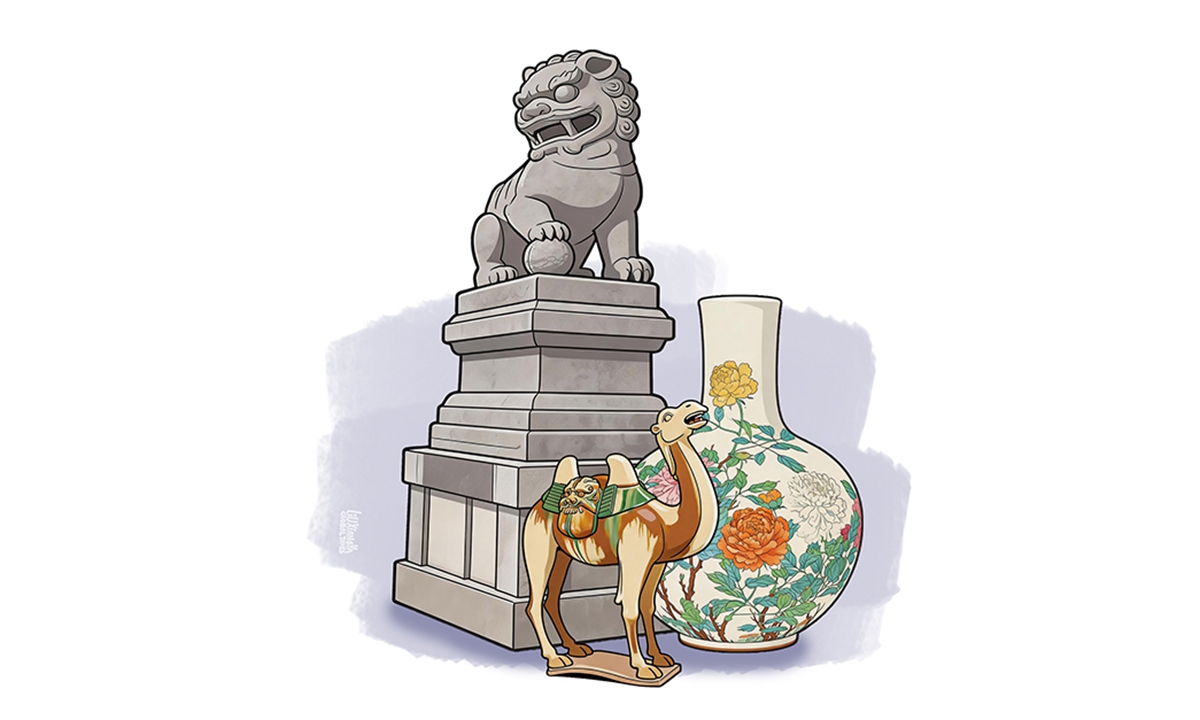
Illustration: Liu Xiangya/GT
On Saturday afternoon, a symposium organized by the Chinese Cultural Relics Return Movement Promotion Association, a Japanese civic group, was held at the Bunkyo Civic Center in Tokyo.The atmosphere was solemn, with participants ranging from white-haired historians to young citizens and university students gathering to demand historical truth and justice. The event underscored growing grass-roots pressure within Japan for the return of cultural relics looted from China during Japan's imperial aggression.
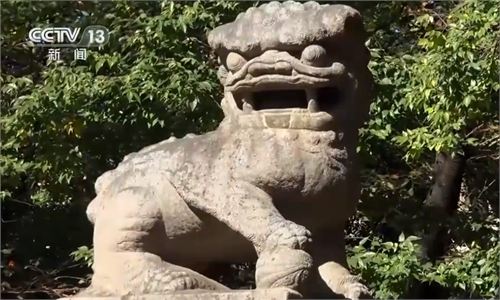
Yokohama National University lecturer Nodoka Odawara used the stone lions standing in front of the Institute for Advanced Studies on Asia at the University of Tokyo as a starting point. Through meticulous research, she traced the complete trajectory of how these and other Chinese artifacts entered Japanese collections during the era of colonial invasion and plunder. She systematically refuted Japan's repeated claims of "legal purchase," exposing their fundamental inconsistencies and lack of legitimacy. Her presentation, rich in historical documentation and rigorous in logic, prompted many attendees to take detailed notes, reflecting the serious tone of the gathering.
Akira Igarashi, a co-representative of the association, revealed that historical materials publicly released by Shanghai University in January had been formally submitted to Japan's Ministry of Foreign Affairs.
The Japanese government is fully aware of the situation. He noted that with the disclosure of evidence and rising public calls, the issue of returning looted Chinese cultural relics has transcended isolated cultural disputes and is evolving into a significant diplomatic matter drawing broad public attention.
"The significance of returning these relics goes far beyond restoring a single object to its rightful place," Igarashi emphasized. "It represents a crucial opportunity for Japan to re-examine its 20th-century history of aggression and complete historical accountability."
These looted artifacts serve as concrete evidence of Japan's war crime and constantly remind the world that Japan has yet to genuinely confront its responsibilities for the war.
The core question, he said, is when Japanese society as a whole will develop this necessary awareness.
Tsuguo Toukairin, vice president of the Tokyo Association of History Educators, addressed the current challenges in negotiations.
Civic groups are communicating with Japan's Imperial Household Agency regarding access to and the return of artifacts, but face substantial resistance. To date, the agency has provided no clear response. Comparing Japan with other countries that have proactively returned looted items based on anti-colonial and anti-aggression principles, Toukairin acknowledged that Japanese society lags far behind. Many ordinary citizens still lack basic knowledge and reflection on this period of history.
He recalled how Japan once glorified its invasion as a "sacred war," using the pretext of national interest to justify the massive plunder of artifacts and wealth shipped back to Japan.
"Facing this history squarely, admitting the mistakes committed, and returning the cultural relics to their countries of origin is the responsibility Japan should shoulder," Toukairin stated.
Directly refuting the University of Tokyo's claim that the aforementioned stone lions were "purchased from antique dealers," Toukairin pointed out the deeper injustice: Japan exploited China's turmoil to extract indemnities and used Chinese funds to establish institutions like the Institute for Advanced Studies on Asia.
"Japan inflicted profound suffering on China through aggression, then plundered its wealth and artifacts. The logic of calling this a 'purchase' is fundamentally absurd. It is merely a fig leaf. These relics originated in China and should be returned," he asserted. He further noted that the Tokyo National Museum in Ueno also holds numerous similarly looted items. "Japan even viewed war as an excellent opportunity to plunder artifacts. This erroneous mind-set itself must be corrected and all such looted relics should be returned."
The seminar represents a microcosm of self-reflection within segments of Japanese society. While the Japanese government continues to be evasive on historical issues, intellectuals and activists like Odawara, Igarashi, and Toukairin are courageously advocating for historical justice amid pressure. Their commitment to conscience deserves recognition.
This push aligns with broader momentum in Japanese civil society. Recent protests against constitutional revision and military expansion have intensified nationwide. Participants at constitutional protection rallies strongly oppose easing arms export restrictions and frequent US-Japan joint military exercises. Crowds near the Diet Building chant slogans such as "Protect the Peace Constitution" and "Oppose War," warning against a return to militarism.
An increasing number of Japanese citizens recognize that only by thoroughly settling historical debts can Japan earn trust from neighboring countries.
Strikingly, just one day after the seminar, Japan's Kyodo News reported on brutal human experiments conducted in China in 1938 by the Japanese Imperial Army, including the transfusion of animal blood into humans. This revelation once again exposes the anti-human nature of Japanese militarism and adds a grim footnote to the discussion surrounding cultural relics. The crimes of Japanese militarist aggression are undeniable and cannot be selectively forgotten or whitewashed.
Today, voices for justice from across Japanese society are converging into an undeniable civil force. Should the Japanese government continue to evade its historical responsibilities and turn a deaf ear to these domestic appeals, it will only deepen its estrangement from neighboring countries and suffer mounting moral deficits on the international stage. Only by heeding the conscience of its own people, squarely confronting the history of aggression, and formally initiating the repatriation process for looted Chinese cultural relics can Japan demonstrate the sincerity that is rightfully expected of it.
The author is a Japan-based special correspondent for the Global Times. life@globaltimes.com.cn
RELATED ARTICLES