British Prime Minister Starmer announces resignation; Orderly exit unlikely to trigger major disruption in British politics: expert
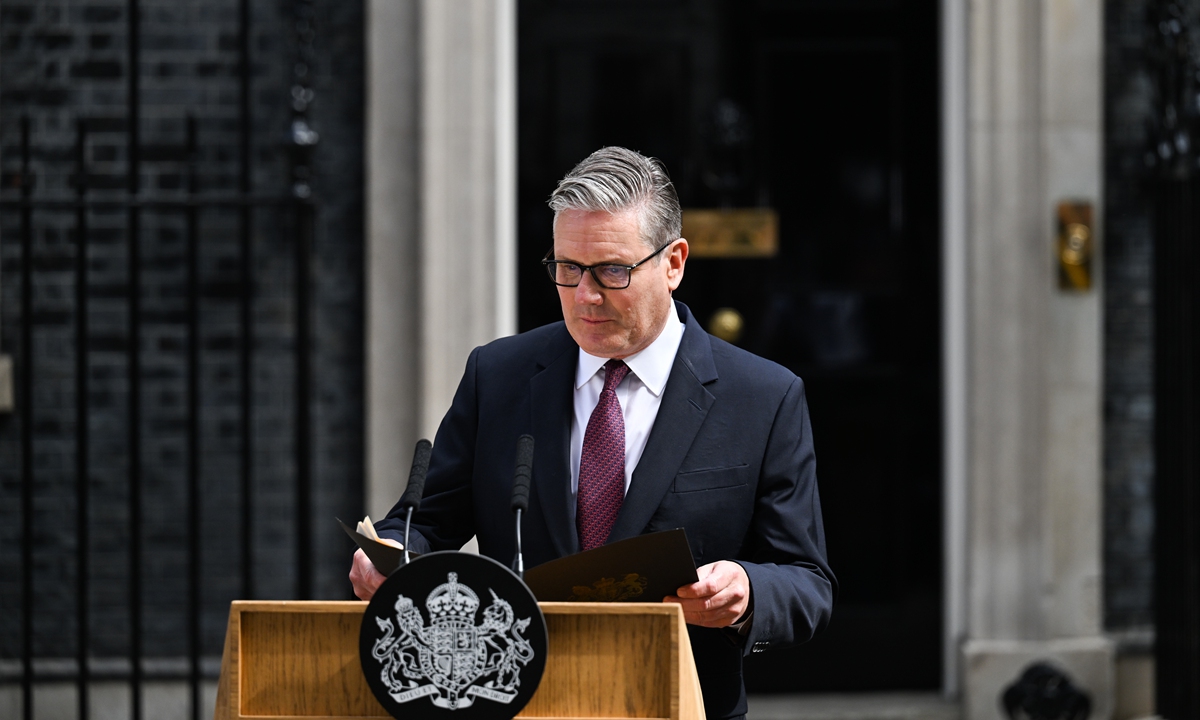
British Prime Minister Keir Starmer makes a statement outside No. 10 Downing Street in London, UK, on June 22, 2026. Starmer announced in the speech that he would resign as leader of the governing Labour Party and set out a timetable for his departure from office, according to Xinhua. Photo: VCG
British Prime Minister Keir Starmer announced Monday that he will resign, paving the way for the country's seventh leader in a decade after facing an uprising within his center-left Labour Party, according to multiple media reports.
Speaking in Downing Street, Starmer said he accepted he was not best placed to lead Labour into the next general election and he had informed the King of his decision to step down, BBC reported.
Starmer's decision to announce his departure will now start a race among Labour MPs to become the UK's seventh prime minister in 10 years, with Andy Burnham in pole position to win, the Guardian said. If he is uncontested, he could be in Downing Street within weeks, according to the media report.
A Chinese expert said that if Starmer were to step down through a normal, orderly resignation as part of an internal Labour Party leadership transition, it would likely not cause a major disruption in British politics.
In an emotional speech, Starmer said he had listened to his governing Labour Party and realized that he was no longer the man who should lead it into a national election due in 2029, Reuters reported.
He led Labour to a landslide election victory in July 2024, but since then his popularity and that of the party have plummeted, NPR said.
NPR also pointed out that his departure was triggered by Burnham's victory in a special election last week. The popular ex-mayor of Greater Manchester planned to challenge Starmer for the Labour leadership.
Starmer said he would ask Labour's ruling national executive committee to set out a timetable for a contest with nominations opening on July 9 and completed by summer recess just a week later, the Guardian said.
The prime minister said he would remain in post until parliament returns in September, meaning he will represent the UK at the next NATO summit in early July. But if his main rival, Andy Burnham, runs unchallenged, then he could take over as the Commons rises on July 16, per the Guardian.
Starmer's political fortunes have taken a hit from a series of bruising scandals, while many of his own lawmakers blamed him for policy missteps that have proved deeply unpopular with the public, NBC News said.
Calls for Starmer to quit have intensified since May, when, after just two years in power, he led his party to one of its worst-ever performances in local and regional elections, as Nigel Farage's hard-right Reform UK made historic gains, according to NBC News.
Starmer has been under sustained pressure from within the party for some time, with that pressure intensifying after the most recent local elections. Following those elections, it could be argued that he may have already realized his time as prime minister might be limited, Li Guanjie, a research fellow at the Shanghai Academy of Global Governance and Area Studies, told the Global Times on Monday.
The leader's key rival within the party is Burnham, the mayor of Greater Manchester, who had openly discussed plans to bring a leadership challenge. Burnham won a special election on Thursday for a seat in Parliament, clearing a crucial hurdle for him to mount such a challenge, per NBC News.
Starmer's resignation raises questions about the future of Britain's foreign policy. None of the leading candidates to succeed him have any real experience with foreign policy at a time of global unrest. Whoever takes over will need to confront the ongoing conflict, instability in the Middle East, a rising China and a United States that is pulling back from its decades-long commitments to Europe and NATO, The New York Times reported.
RELATED ARTICLES