SPORT / OLYMPICS
China's rhythmic gymnasts shine at home, hone skills for next Olympics
New generation, great ambitions
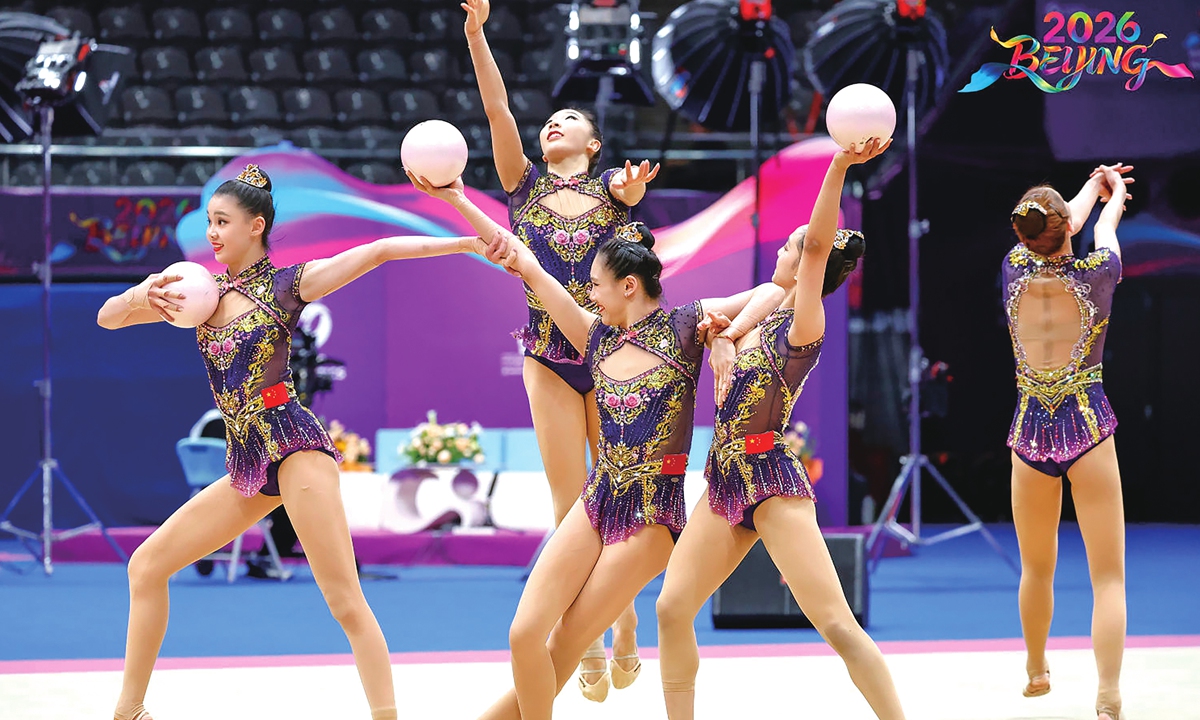
Chinese rhythmic gymnastics athletes perform in the Group 5 Balls competition on June 19, 2026 at the National Indoor Stadium in Beijing. Photos: Courtesy of the 2026 FIG Rhythmic Gymnastics World Challenge Cup
Nearly two years after making history with Olympic gold in Paris, China's rhythmic gymnastics team is already writing the next chapter.
At the 2026 FIG Rhythmic Gymnastics World Challenge Cup at the National Indoor Stadium in Beijing, a youthful Chinese squad undergoing a generational transition collected four gold and four silver medals.
China swept all three group titles and celebrated a breakthrough individual all-around victory by 15-year-old Wang Qi, sending an encouraging signal at the start of the Los Angeles Olympic cycle.
Yet beyond the medals, the three-day competition offered a glimpse into how China's rhythmic gymnastics program is attempting to remain among the world's elite while reinventing itself.
Considerable challenge
Following China's historic Olympic group all-around triumph in Paris, veterans Guo Qiqi, Huang Zhangjiayang and Hao Ting retired, leaving the national team to rebuild around Olympic champions Wang Lanjing and Ding Xinyi and a group of younger athletes.
The new lineup, featuring Wang Lanjing and Ding alongside Pu Yanzhu, Zhang Xinyi and Liu Miaoting, passed one of its biggest tests yet in Beijing.
China first secured the group all-around title before returning on the final day to claim gold in both the five-ball and three hoops-two clubs finals. The victories came against a field that included traditional powerhouses from Russia and Belarus, whose return has intensified competition in the new Olympic cycle, along with traditional contender Uzbekistan.
Despite the clean sweep, the team's focus remained firmly on improvement rather than celebration.
"These performances still had many shortcomings, and I am trying to learn from the mistakes," 19-year-old Zhang told reporters after helping China win three group gold medals.
She also credited teammates and Olympic champions Wang and Ding for helping younger teammates adapt to international game.
"My senior sisters have rich experience. Their judgment and the way they handle situations during competition are all things worth learning from," Zhang told the Global Times. "We need to review the problems that appeared in this competition, strengthen our training and prepare for the next World Cup stop in Milan."
The Chinese team's performing routines reflected the team's talent.
One program was inspired by Song Dynasty (960-1279) woman poet Li Qingzhao and incorporated elements of traditional Chinese culture. The other blended contemporary international influences with a more modern artistic style.
"We hope to better integrate Eastern culture, artistic expression and competitive techniques through our choreography, allowing the world to see the unique character of Chinese rhythmic gymnastics," said Chang Cheng, director of the gymnastics management center of the General Administration of Sport of China.
According to Chang, the team has completed a major roster adjustment for the new cycle, but has maintained strong execution and unity despite its younger composition.
Promising talent
If the group team's success highlighted China's depth, Wang Qi's emergence may have provided the competition's biggest storyline.
Competing in her first season as a senior-level athlete, the teenager captured the individual all-around title ahead of Russia's Sofiia Ilteriakova, the reigning European all-around champion.
Wang Qi then added four apparatus silver medals in hoop, ball, clubs and ribbon, finishing the tournament with five medals. For her, the achievement carried additional significance because it came against Russian competitors she had never previously faced.
"This was my first time competing against Russian athletes and also my first time beating them. I am very happy," Wang Qi told reporters.
The teenager's rapid rise has been one of the bright spots for China this season.
Having already competed in competitions including World Cups, national championships, and the Asian Championships, she is quickly adapting to the demands of senior-level competition.
"The skill level in the senior division is another step higher," Wang Qi said. "The competition is very intense, and the requirements for both difficulty and execution are much higher. It has helped me clearly see the gaps and the areas where I need to improve."
No coincidence
Chang said Wang's breakthrough is no coincidence.
"Wang Qi has just entered the senior ranks this year and was able to win a title at this level of international competition. It shows that she has strong drive and the potential to continue making breakthroughs," Chang said.
China's established individual star Wang Zilu, who finished fourth in the all-around before withdrawing from the apparatus finals due to physical discomfort, remains a key figure in the program.
Chang said that together Wang Zilu and Wang Qi have created a healthy "experienced-and-young" dynamic in the individual discipline.
The Beijing stop also offered a reminder that the road to Los Angeles will be more demanding than ever.
With Russian and Belarusian athletes returning to international competition, the global landscape is becoming increasingly crowded. For a Chinese team that has gone from challenger to reigning Olympic champion, maintaining its position will require constant evolution.
The Chinese athletes are fully aware of that challenging reality.
The next stops will come quickly, with the World Cup in Milan in July and the World Championships in Frankfurt, Germany, in August.
As competition intensifies globally and a new generation rises, China's rhythmic gymnasts know that staying at the top demands constant improvement, not rest on past glory.
For the reigning Olympic champions, the focus remains on the process rather than the pressure.
"What matters more is training well every day, continuing to improve our difficulty and execution, and striving to perform at our best on the international stage," said Wang Lanjing.
RELATED ARTICLES