
Illustration: Liu Xiangya/GT
As one of China's most authoritative television accolades, the Shanghai TV Festival's Magnolia Awards have long been a reliable barometer of the nation's television creative trends and artistic evolution.
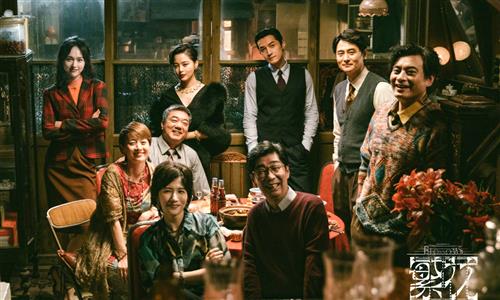
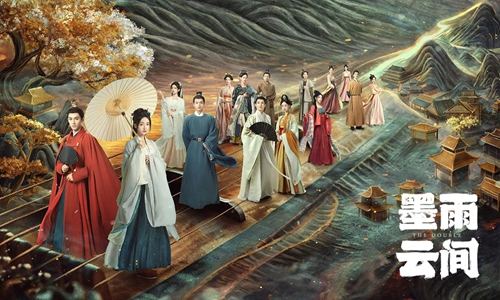
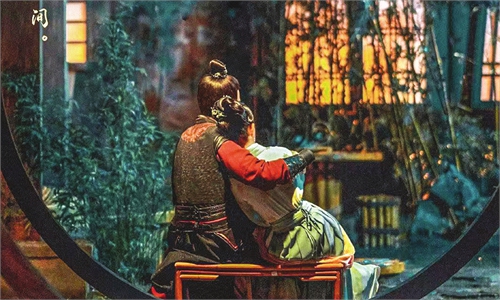
The revealed award lineup on Friday night has drawn widespread attention, with landmark long-form dramas such as Taiping Nian (Swords into Plowshares), Chenmo de Rongyao (Silent Honor), Shengming Shu (Born to be Alive) and Sheng Wanwu (This Thriving Land) sweeping core honors.
Zhang Peng, a cultural researcher and associate professor at Nanjing Normal University, told the Global Times on Sunday that amid an era dominated by fragmented short-video entertainment and a domestic film and television industry mired in traffic-driven competition, these finely crafted works mark a pivotal upgrade in Chinese television creation and a profound ecological shift. They also set a new benchmark for high-quality, people-centered artistic production in the TV industry.
A defining strength of these award-winning dramas lies in their grounded realist narrative, which anchors grand historical and societal changes in ordinary individuals' lives and restores the authentic essence of realistic storytelling.
Born to be Alive, for instance, delivers a touching tribute to grass-roots dedication through its portrayal of a female ranger safeguarding the ecological integrity of the Qinghai-Tibet Plateau. Featuring a raw, unvarnished performance by Chinese actress Yang Zi that spans 17 years of the protagonist's arduous plateau tenure, the drama seamlessly weaves ecological protection, grass-roots perseverance and human moral dilemmas into a compelling narrative, earning it the awards for Best Director and Best Actress.
This Thriving Land, which won Best Supporting Actress and Best Adapted Screenplay, traces the transformation of land in southern Shandong Province to family fate with the evolution of rural civilization, gently reconstructing the smoky intimacy of village life, showing a portrait that dismantles the static, antiquated images of the Chinese countryside often held abroad.
In a refreshing departure from conventional historical dramas that rely on didactic narration, Swords into Plowshares adopts a group-portrait approach to depict the tumultuous Five Dynasties (907-960) and Ten Kingdoms (902-979) period, tracing the unification of the Song Dynasty (960-1279) through the personal struggles and fateful decisions of historical figures. Its nuanced reproduction of historical complexities secured four major awards which include Best TV Series (China) and Best Original Screenplay.
Meanwhile, Silent Honor reinvigorates the spy genre with its understated portrayal of unsung heroes operating covertly in the Taiwan island during the Chinese Liberation War. Chinese actor Yu Hewei's restrained, immersive interpretation of General Wu Shi's unwavering faith and sacrificial spirit restores gravity and authenticity to historical espionage storytelling, winning the Grand Prix and Best Actor honor.
Against the prevailing tide of short-video and micro-drama culture, these premium long-form dramas prove they possess irreplaceable humanistic and social value in an age of fragmented entertainment.
Modern digital media has reshaped public viewing habits, with fast-paced, plot-driven short videos offering instant sensory gratification yet diluting public audiences' attention spans and marginalizing in-depth audiovisual content.
Unlike micro-dramas that rely on simplistic storylines and superficial emotional stimulation, high-quality long-form television boasts complete narrative structures, layered character development and textured depictions of life and society. It is capable of capturing the full spectrum of an era, dissecting the complexity of human nature and provoking profound cultural and societal reflection, Zhang noted.
Far beyond mere entertainment, outstanding long-form dramas undertake three vital public functions: social aesthetic education, authentic documentation of the times and cross-cultural communication.
While fleeting online content creates widespread spiritual emptiness in mass culture, these works fill the void with immersive, in-depth storytelling. This Thriving Land showcases traditional rural culture and agrarian heritage, Swords into Plowshares popularizes lesser-known yet pivotal historical chapters, Born to be Alive raises public awareness of ecological protection and grass-roots dedication, and Silent Honor honors forgotten revolutionary martyrs. Collectively, they demonstrate how long-form television sustains the depth and warmth of mainstream visual culture in a fast-consumption era.
This year's Magnolia Awards also signal the definitive end of China's television industry's traffic-driven bubble, with content quality and artistic depth firmly established as the core evaluation criteria.
Free from A-list celebrity hype and deliberate viral marketing campaigns, all award-winning works earn acclaim purely through solid scripts, sophisticated production and profound ideological connotations.
Born to be Alive, This Thriving Land and Silent Honor rely on powerful casts and well-polished storylines to resonate with audiences, while Swords into Plowshares achieved a remarkable rating surge from 7.8 to 8.6 on Douban, China's leading review platform, through rigorous historical research, exquisite costume and set design and a sophisticated narrative.
These award-winning long-form dramas represent a return to the essentials for China's television sector.
By reviving rigorous realism, discarding inflated traffic-centric logic and upholding in-depth cultural expression, they have reshaped the industry's aesthetic standards and environment.
Zhang noted that in an increasingly fragmented media age, premium long-form television remains an irreplaceable cultural carrier, faithfully recording the times, nourishing public mind-sets and serving as a credible and compelling window for global audiences to understand authentic Chinese society.
As such, it charts a sustainable high-quality development path for China's future television and cross-cultural outreach.
The author is a reporter with the Global Times. life@globaltimes.com.cn
RELATED ARTICLES