ARTS / FILM
Toy Story 5: Do toys still really matter to the digital generation?
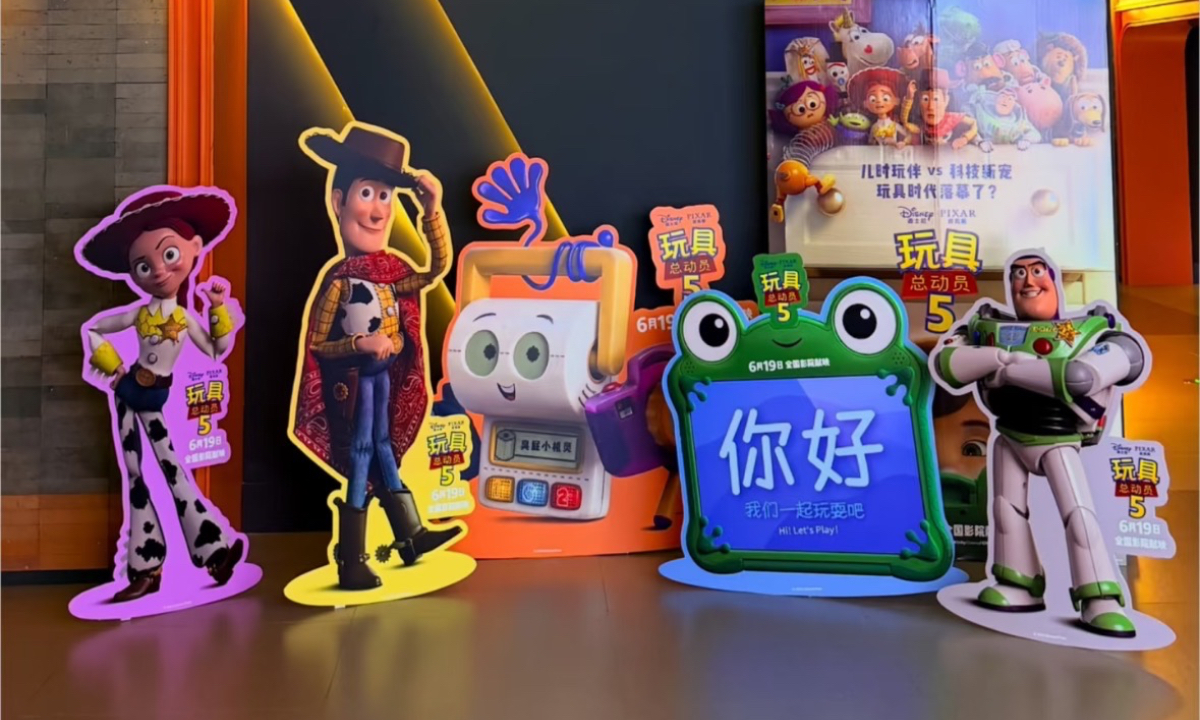
A poster of Toy Story 5 at a cinema in China Photo: Li Hang/GT
For decades, the Toy Story films have explored what gives a toy its value. Toy Story 5 returns to the idea at a time when screens occupy an ever-larger share of children's attention, asking whether traditional toys still have a place in modern childhood.
Toy Story 5 places one of Pixar's most beloved franchises in today's world. The conflict is no longer about toys competing for a child's affection. Instead, they find themselves competing with digital devices that are shaping how children spend their free time.
The film does not suggest that screens are inherently harmful or that children should reject digital devices altogether. Instead, it argues that toys offer something technology cannot fully provide: imagination and memories built through shared experiences. By the film's end, technology and toys are no longer rivals but complements.
Visually, Toy Story 5 is unmistakably Pixar. The animation is polished, and the characters remain expressive. Children can enjoy it as an adventure, while adults may reflect on growing up. Its positive reception comes as no surprise. The film currently holds an 8.1/10 rating on Chinese review platform Douban and a 7.6/10 on IMDb.
Its box-office performance, however, tells a different story. While the film has been a major success in North America, audiences in the Chinese mainland have responded far less enthusiastically. Toy Story 5 was projected to close its run at around 280 million yuan ($41 million), according to ticketing platform Maoyan. So far, it has grossed just over 190.4 million yuan (roughly $28 million) in the region, compared with $248 million in North America.
One reason is that the series had already delivered what many viewers considered a satisfying conclusion. Toy Story 3 is widely seen as a natural farewell, as Andy grows up and passes his toys on to Bonnie, bringing his childhood chapter to a close.
Toy Story 4 then follows Woody's journey of self-discovery. Against this backdrop, the fifth installment faces higher expectations. While it introduces a timely theme, its narrative still follows a familiar pattern, making it difficult to match the emotional weight of its predecessors.
Nostalgia also carries a different weight in different markets. Unlike many audiences in North America, Chinese moviegoers were not widely exposed to Toy Story 1 when it was released in 1995. For many, the series became something they discovered later rather than a defining part of childhood, making its emotional appeal less universal.
Another factor is the progress of China's animation industry. Films such as Nobody and the Ne Zha series show that domestic studios are capable of telling compelling stories rooted in Chinese culture. With more high-quality local productions reaching cinemas each year, audiences have more choices than ever.
A Pixar logo alone is no longer enough to guarantee a trip to the theater.
Tang Lin, who watched the film with her friends on Monday, told the Global Times that, for her, the film's main appeal lies in nostalgia. While it was still exciting to see a long-running franchise return to the big screen, she found the narrative somewhat underwhelming.
Perhaps that is the most interesting takeaway from Toy Story 5. The film suggests that what gives a toy meaning is not novelty but the bond it forms with its owner. The same is increasingly true for movies.
Whether they come from Pixar or a Chinese animation studio, audiences no longer buy tickets because of a famous brand. They go because a story genuinely moves them.
The author is a reporter with the Global Times. life@globaltimes.com.cn
RELATED ARTICLES