ARTS / CULTURE & LEISURE
Exhibitions across China to mark CPC's 105th anniversary
Creative curation revives revolutionary relics
By Published: Jun 28, 2026 10:19 PM

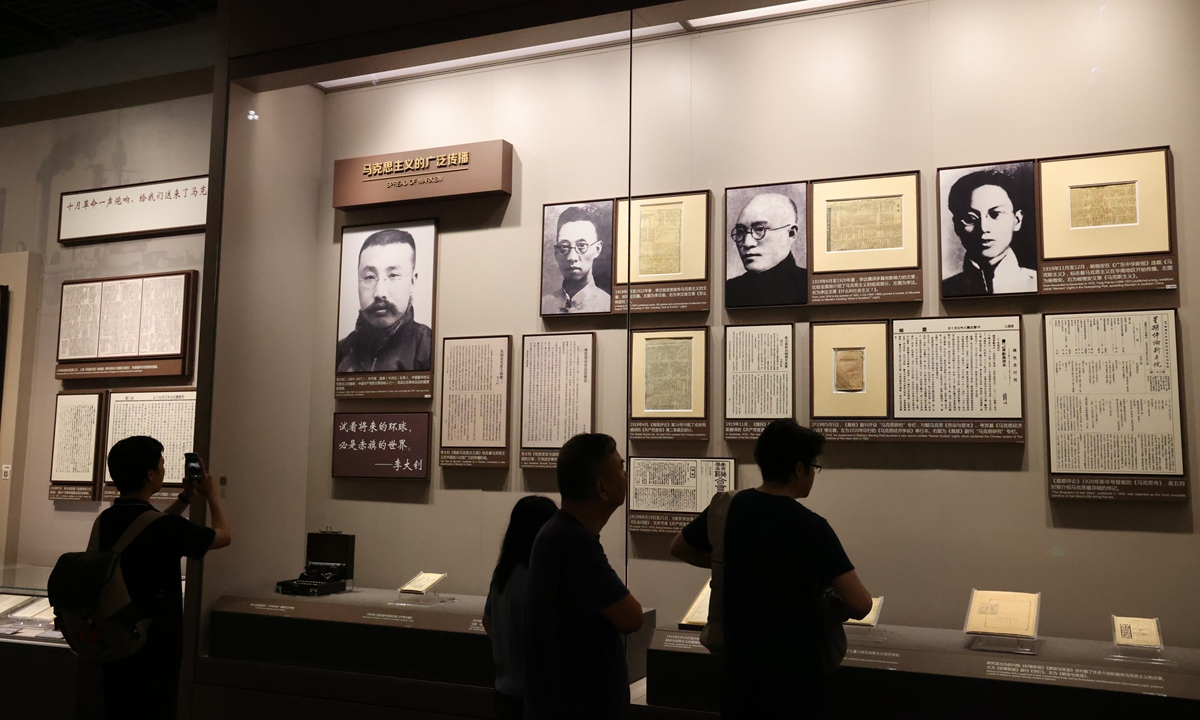
Visitors tour the exhibition halls of the Memorial Hall of the First National Congress of the Communist Party of China (CPC) on June 28, 2026, ahead of the July 1 anniversary marking the founding of the CPC. Photo: IC
On the occasion of the 105th anniversary of the founding of the Communist Party of China (CPC) and the 90th anniversary of the Long March's victory, related galleries and museums across China are seeing an increase in exhibitions.
From the Red Building of Peking University in Beijing to the Memorial Hall of the First National Congress of the CPC in Shanghai and on to the Jiaxing Art Museum in East China's Zhejiang Province, cultural institutions nationwide are deploying creative methods such as immersive scenes and interactive multimedia displays to make the history of the Party's founding more engaging, allowing red culture to truly touch people's hearts.
At the Red Building of Peking University, an exhibition about the founding of the CPC brings together revolutionary artifacts from Beijing, Shanghai and Jiaxing.
A total of 105 sets of precious cultural relics and historical materials are displayed, connecting the Party's entire founding journey, according to the institution's official sources.
Unlike exhibitions focusing on a single city, this show uses a "North-South echo" concept to tell the story of the Party's founding.
For example, early issues of New Youth magazine published in Shanghai are displayed alongside issues from when the magazine moved to Beijing.
Flyers from the May Fourth Movement in Beijing are paired with supportive documents from Shanghai.
The display of The Communist Manifesto in 15 languages and 105 different editions is one of the major highlights.
Together, these artifacts form a complete historical chain, helping visitors clearly see how the CPC grew from early revolutionary thought to the start of a new era.
The exhibition attracts visitors by using immersive settings and multimedia interactions.
Carefully presented scenic displays and tech installations, along with QR code scanning to get further information on articles and speeches by revolutionary Li Dazhao, let visitors better understand the "spark of thought" behind the artifacts, according to China Tourism News.
At the Jiaxing Art Museum, a major exhibition of Chinese paintings and oil paintings about the history of the Party opened on Thursday.
Jiaxing holds a special place in CPC history, as delegates to the Party's First National Congress completed their final meeting aboard a boat on Nanhu Lake there in 1921, marking the Party's formal founding.
After a nationwide call for submissions in June 2025, the exhibition collected 3,650 works, 105 of which were selected for display, 55 Chinese paintings and 50 oil paintings.
Some works show the magnificence of the land and harmonious homes, while others offer deep reflections on major moments in history, the Qianjiang Evening News reported.
An exhibition themed around the founding spirit of the Party, as documented in literature, will be held at the Memorial Hall of the First National Congress of the CPC.
The memorial has over 130,000 items, including more than 27,000 precious artifacts.
The first Chinese translation of The Communist Manifesto by Chen Wangdao is the collection's most prized piece, as reported by the People's Daily.
Today, many revolutionary relic exhibitions feature realistic recreations, theatrical scenes, online digital galleries, and volunteer guides.
These new forms make the Party history more accessible and help bring historic artifacts to life.
Speaking with the Global Times, Sun Jiashan, a Beijing Federation of Literary and Art Circles critic, emphasized that revolutionary relic exhibitions need to rely on the rich stories behind historical items while exploring new formats with cultural and creative industry thinking.
"These revolutionary museums can include elements such as short dramas, making the storytelling richer and more diverse. This approach also strengthens communication and engagement," Sun suggested.
To ensure that red-themed exhibitions resonate with people, cultural institutions need to further enhance interactive participation.
Through activities such as historical document decoding and oral history collection, visitors can become contributors to the ongoing story, Zhang Peng, a cultural researcher and associate professor at Nanjing Normal University, told the Global Times on Sunday.
RELATED ARTICLES