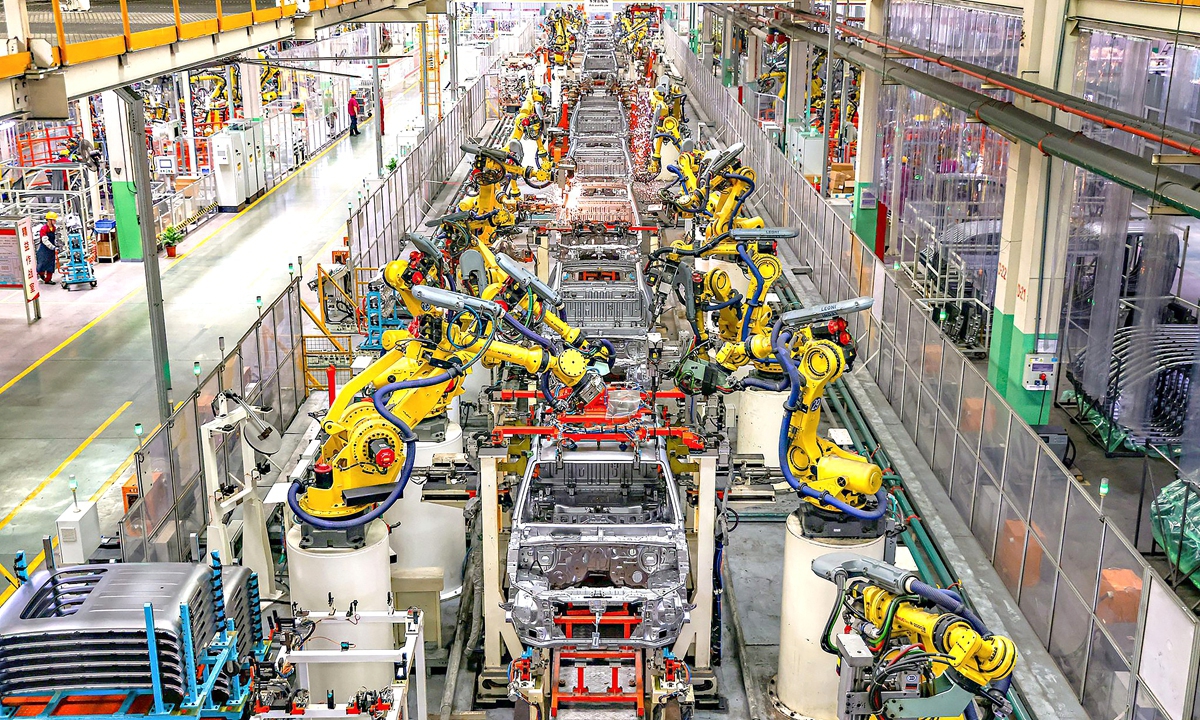
A view of an auto manufacturing line in Suzhou, East China's Jiangsu Province Photo: VCG
On a question that has drawn rising attention from global affairs observers - why global businesses cannot write off the Chinese economy - Joe Ngai, McKinsey's Greater China chair, offered an observation in an earlier interview with Fortune: "the next China is still China." In a more recent interview with CNBC, Ngai went further, describing China as the "factory for factories," where international companies are not only coming to sell to the market, but also to learn from it.Behind this are stories of competition and innovation. Ngai describes China as "the world's toughest gym," one that trains "highly competitive firms." As he puts it plainly: "If you have a better thing, the (Chinese) market will respond." For many companies operating in China, that observation may strongly resonate.
In China's "tough gym," one of the more visible outcomes of intense market competition is non-stop technological progress.
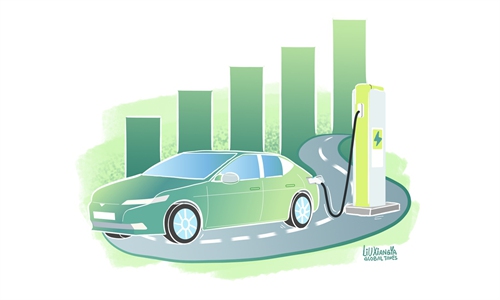
A small but illustrative example can be seen in the evolution of electric vehicle (EV) charging infrastructure. Beyond the fast-charge innovations that often attract public attention, some parts of Hangzhou, Zhejiang Province, are beginning to experiment with AI-enabled robotic EV charging. According to local media reports, owners of EVs can park in any available bay, while AI-powered robots complete the entire charging process automatically.
This offers a glimpse into a broader process: the increasingly complex upgrading of EV charging technology. To put it into perspective, these developments form an integral part of China's ongoing wave of tech innovation.
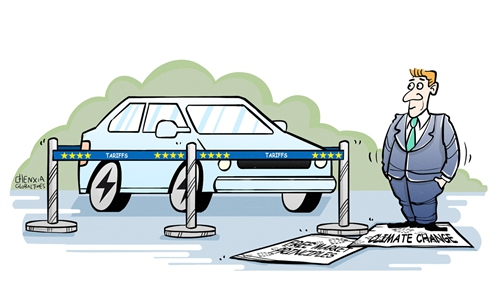
Till today, some Western commentators still portray China's sizzling EV industry as one driven by low-cost, low-quality capacity replication or "overcapacity," framed through their lens of "China shock" - a cliché. In reality, the EV sector is generating system-wide, revolutionary innovations - from new batteries to new charging technology, new material science and beyond.
Whether the new technologies prove useful is ultimately determined by China's massive EV buyers and drivers. As Ngai puts it, the Chinese market will respond. EV is just one segment of a much broader industrial landscape, where market competition leads to constant innovation.
History suggests that technological innovation is closely linked to the creation of new opportunities. Innovation drives the emergence of new industries, generates new market demand, and enables new business models. Over time, through market selection, these dynamics translate into commercial opportunities and tangible profits.
This is why many multinational companies have kept integrating with China's industrial ecosystem in order to get their share of the evolving opportunities in the massive Chinese market. Many observers in the world have come to the conclusion that "the next China is still China."
China is the world's second-largest consumer market, which helps explain why multinational companies are looking to move closer to Chinese consumers to expand their customer base, and many multinational firms have increased their investment in China. Speaking to CNBC, Ngai said that China is widely seen as the next frontier of technological innovation, with its lead in factory automation and intelligent robotics, and more fields.
Beyond investment, trade is another important frontier. This helps explain why China is increasingly moving from what was once described as the "world's factory" toward a "factory for factories."
China's exports now include large volumes of intermediate goods, including machinery, equipment and components, which allow foreign businesses to operate more efficiently and better integrate into the global value chain. Media reports, citing the UN Conference on Trade and Development, note that trade in intermediate goods with China has increased the number of developing countries as key global trading hubs - from 6 in 2007 to 11 in 2024. This suggests that China, as a "factory for factories," is contributing no "shock" but real opportunities to aid global economic growth.
In addition to ratcheting up investment and trade, engagement between multinational companies and China's industrial ecosystem is continuing to broaden, with new forms of interaction likely to emerge and deepen in the years to come. In that sense, phrases such as "the next China is still China" and the "factory for factories" are likely to be joined by more metaphors and interpretations.
These observations point to the pace of technological innovation in China and the opportunities it will keep to create. The "China shock" narrative is outdated and should be thrown to the dustbin. Multinational companies will continue to embrace even greater opportunities that the Chinese market continues to offer.
RELATED ARTICLES