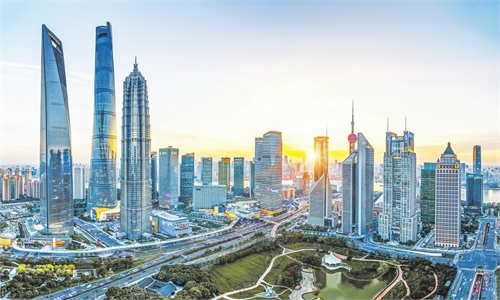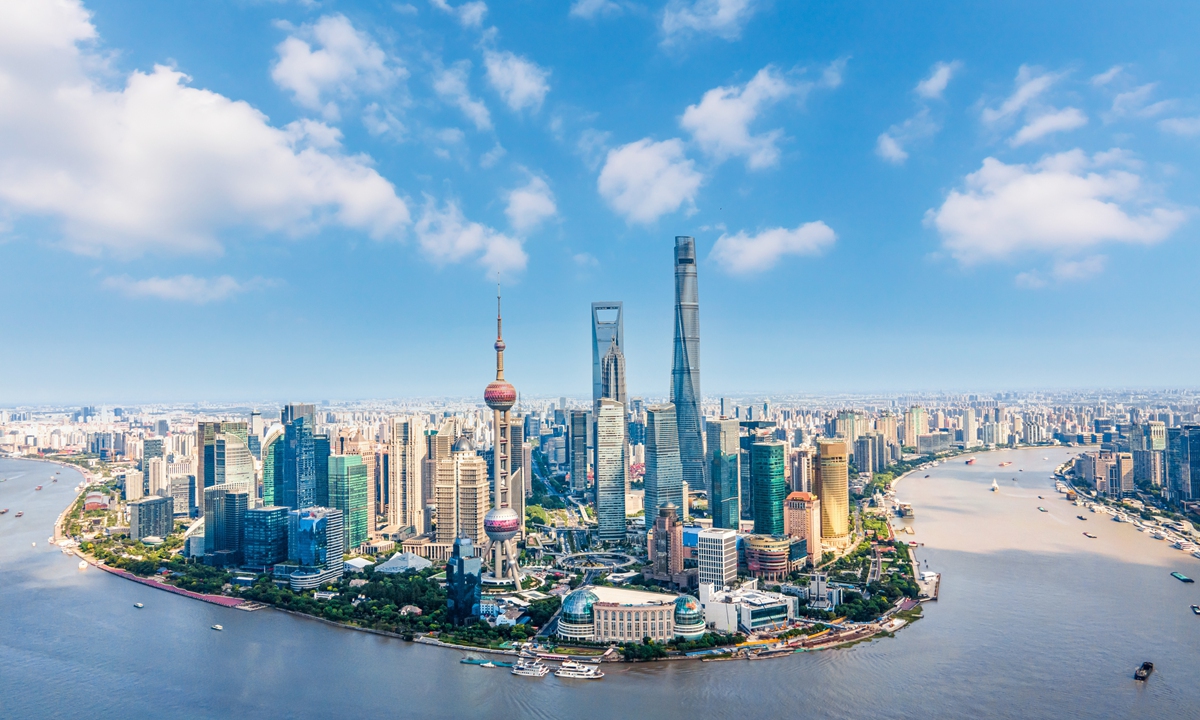
A view of the Lujiazui area in Shanghai Photo: VCG
Foreign businesses remain upbeat about China's market prospects, with a majority of American, European and Japanese companies reporting profits or planning to expand local operations, underscoring the enduring appeal and resilience of China's industrial and supply chain ecosystem, the China Council for the Promotion of International Trade (CCPIT) said on Tuesday.
Multiple overseas business chambers have expressed positive views about China's business environment in their newly released reports, a spokesperson from the CCPIT announced at its monthly press conference.
According to the US-China Business Council's annual survey, 92 percent of surveyed US companies reported profitable operations in China in 2025, the CCPIT spokesperson said.
"For US companies, China is not optional. For a resounding 95 percent of respondents, China operations are somewhat to very important for staying competitive globally," the survey noted.
Separately, 75 percent of European companies said that their production efficiency in China outpaces that in other regions, based on the European Union Chamber of Commerce in China's 2026 Business Confidence Survey.
In Japan's case, 85.6 percent of Japanese firms will either expand or maintain their business presence in China, as highlighted in a 2026 White Paper on the Chinese Economy and Japanese Enterprises released by the Japanese Chamber of Commerce and Industry in China.
The recently concluded fourth China International Supply Chain Expo (CISCE) in Beijing showcased China's economic vitality and innovation-driven growth momentum to global investors.
Aligned with the goals of building a modern industrial system and advancing high-level opening-up outlined in China's 15th Five-Year Plan (2026-30), this year's CISCE highlighted digital and intelligent upgrading.
Foreign companies were active at the exhibition, with overseas enterprises and institutions making up 36.5 percent of all exhibitors. A total of 223 overseas delegations traveled to China for on-site visits and business negotiations, a year-on-year increase of nearly 30 percent, according to the CCPIT.
The upbeat business sentiment reflected in the surveys and expo turnout is further backed by tangible investment expansions by multinational firms across sectors in 2026.
In the chemical sector, global industrial giant BASF fully commissioned its integrated complex in Zhanjiang, South China's Guangdong Province in March. The complex ranks as BASF's third-largest site worldwide, fully demonstrating the company's strong confidence in China, which is the world's largest chemical market, the Global Times learned from the company.
In healthcare, US drug maker Eli Lilly said it plans to invest $3 billion in China over the next decade, which will help build supply-chain and production capacity in China, a move that represents its deep commitment to the Chinese market, the company said in a statement on its official WeChat account.
Foreign investors are also scaling up their presence in China's booming service and cultural tourism market. Merlin Entertainments, a leading global entertainment operator, is ramping up operational upgrades at Shanghai LEGOLAND Resort, its largest LEGOLAND project worldwide. To mark its first anniversary since opening, the resort launched a series of upgraded summer offerings, including extended night operating hours, a themed high-speed train route, 1,000-drone night shows and cross-scenic spot joint tickets, enriching China's summer consumption scenarios, the Global Times learned from the resort on Tuesday.
TCP Group made its second consecutive appearance at the just closed 4th China International Supply Chain Expo held in Beijing. Saravoot Yoovidhya, CEO of TCP Group told the Global Times that an ever-improving business environment, steadily liberalizing policies, increasingly sophisticated supply chain infrastructure, coupled with the vast market space unlocked by consumption upgrading, have made China a fertile ground for multinational companies to achieve steady and vibrant growth.
In his view, as global industrial and supply chains undergo profound restructuring, China, with its comprehensive industrial system, efficient industrial coordination capabilities, and the advantages of its mega-market, has demonstrated strong resilience and risk-resistance capacity.
China's solid opening-up efforts further underpin robust foreign business confidence and active market participation.
China's Ministry of Commerce (MOFCOM), alongside other government departments, released an action plan on June 22 to stabilize and optimize the utilization of foreign investment.
The plan prioritizes expanding market access in services, finance and pharmaceuticals, among other sectors, while streamlining processes for cross-border mergers and acquisitions, data flows and domestic reinvestment by foreign firms. It also outlines concrete measures to promote the "Invest China" initiative and fully ensure national treatment for foreign-funded enterprises.
China saw 25,297 newly established foreign-invested firms in the first five months of 2026, a year-on-year increase of 5.3 percent, according to MOFCOM. Foreign direct investment in May alone rose 5.9 percent year-on-year, the data showed.
RELATED ARTICLES