US Supreme Court rejects Trump’s birthright citizenship restrictions; controversy may continue to deepen divisions: Chinese expert
By Published: Jul 01, 2026 01:34 PM

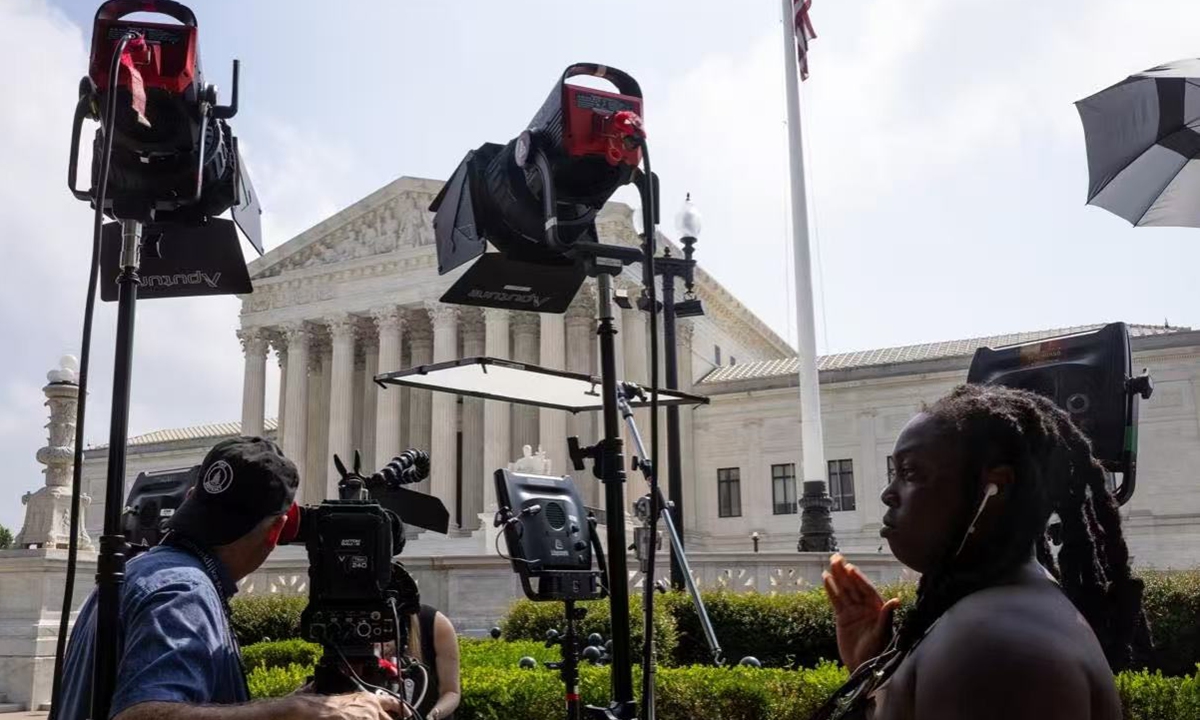
Journalists gather outside the US Supreme Court building as the court announced decisions in Washington, D.C. on June 29, 2026. Photo: VCG
The US Supreme Court on Tuesday rejected President Donald Trump's bid to restrict birthright citizenship, reaffirming that children born in the US to undocumented migrants or temporary visitors are American citizens, according to media reports. Although the Supreme Court blocked the order, the controversy surrounding the birthright citizenship is likely to persist, continuing to unsettle immigrant and foreign talent communities, tarnishing America's image as an open society and exacerbating domestic divisions, said a Chinese expert.
By a 6-3 vote, the court struck down Trump's order. A bare majority of five justices, in an opinion written by Chief Justice John Roberts, held that the long-settled understanding of the 14th Amendment, adopted after the Civil War, makes a citizen of anyone born in the country, with very limited exceptions, according to a report from the Associated Press.
"Citizenship, then and now, was the right to have rights — to freely participate in our political community. The Framers of the Fourteenth Amendment extended that promise to 'every free-born person in this land,'" Roberts wrote for the court, citing congressional debate over the amendment, "We keep that promise today."
The birthright citizenship order, which Trump signed on the first day of his second term, is part of his administration's broad immigration crackdown, per AP.
While Trump and some of his congressional allies quickly said they weren't fully giving up the fight, saying they believed a path forward was to pass a law containing the same provisions as his defeated order. But with the current makeup of Congress, that legislation would be dead on arrival, according to the NBC News.
"The Supreme Court upheld Birthright Citizenship, which is too bad for our Country, but we can easily make it up in Congress through Legislation, with the support of the President, that has now been determined during this process," Trump posted to his Truth Social platform.
The ruling shows that a conservative-leaning Supreme Court does not automatically mean unconditional support for the US leader's expansion of executive power. The decision reaffirms the role of checks and balances in the US system, but it also exposes a deeper problem: Amid intensifying political polarization, the Supreme Court is increasingly becoming the final arbiter of major policy disputes as the normal legislative process struggles to resolve fundamental divisions,Sun Chenghao, a research fellow with the Center for International Security and Strategy at Tsinghua University, told the Global Times.
Trump's attempt to restrict birthright citizenship could have consequences far beyond undocumented immigrants. By linking birthright citizenship to illegal immigration, national security and welfare burdens, he has turned a constitutional right into a politicized identity issue. Sun said that although the Supreme Court blocked the executive order, the controversy may continue to unsettle immigrants, minorities, international students and skilled foreign workers, while tarnishing America's image as an open society and further deepening its domestic divisions.
Some US media called the Supreme Court's rejection a "blow" to Trump. For example, a CNN report said that the conservative Supreme Court dealt a significant blow to President Trump's immigration agenda Tuesday and "the decision is a huge loss for a president who ran for a second White House term in part on ending "birth tourism" and whose administration has been defined by a push to crackdown on illegal and legal immigration."
A report from the NBC also noted that that the Supreme Court's decision delivers "a major blow to his agenda."
An AP report said that Birthright citizenship was the first Trump immigration-related policy to reach the court for a final ruling. The justices previously struck down global tariffs Trump had imposed under an emergency powers law that had never been used that way. Trump reacted furiously to the late February tariffs decision, saying he was ashamed of the justices who ruled against him and calling them unpatriotic.
The New York Times reported that after attempting to downplay his Supreme Court loss on birthright citizenship, President Trump mentioned China on social media — "an apparent reference" to his recent claim that "Chinese billionaires" have abused a right created for the "babies of slaves."
Trump's attempt to link this US immigration dispute to China is primarily a political narrative strategy. This rhetoric may serve to externalize a domestic judicial setback by framing the Supreme Court's ruling as a result that benefits America's competitors, while using the China issue to mobilize his political base by tying together immigration, national security and great-power competition, said Sun.
Sun noted that following Tuesday's ruling, the White House may adopt a more cautious approach in drafting executive orders, seeking firmer legal grounds while seeking to channel more disputes to Congress in an effort to codify Trump's policy agenda into law. At the same time, US domestic politics is likely to grow increasingly judicialized and election-driven.
While the rulings may restrain executive power in the short term, they could also intensify political confrontation over the boundaries of authority among the courts, Congress and the presidency, said the expert.
RELATED ARTICLES