ARTS / CULTURE & LEISURE
CPC leadership drives rural vitalization in Yan'an
A tale of two villages
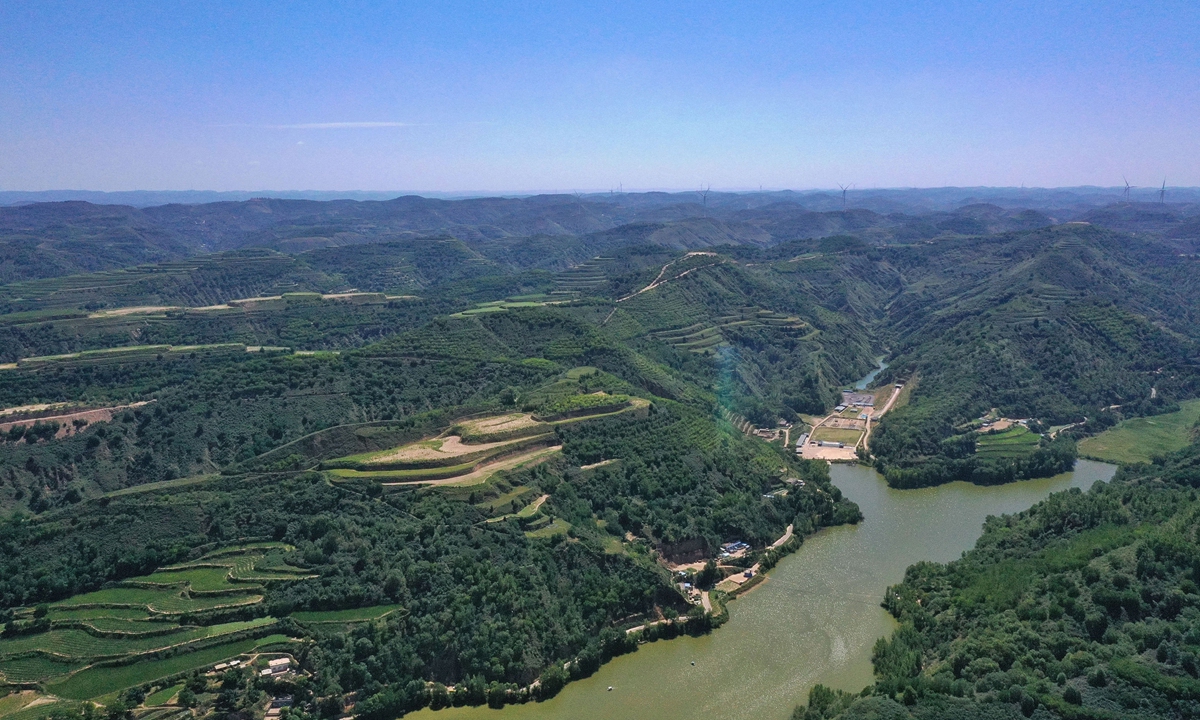
Nangou village in Wuqi county in Yan'an, Northwest China's Shaanxi Province Photo: Courtesy of Wuqi County Integrated Media Center
In Yan'an, Northwest China's Shaanxi Province, there are two villages bearing the same name Nangou.Setting off from the urban area and driving west along the Yanhe River for 40 minutes through mountain valleys and winding mountain roads, visitors will arrive at the Nangou village located in the city's Ansai district.
Another 100 kilometers or so further west lies the second Nangou village, located in Wuqi county. Thriving afforestation has turned the local land into a source of wealth, making it widely renowned for its ecological tourism.
The two villages once suffered from identical hardships. Both were remote mountain enclaves trapped in valleys. While today, both Nangou villages have witnessed tremendous transformations.
Effective grassroots governance
The transformation of Nangou village in Wuqi county began with "a single tree." Upon entering the village history museum, the first photo on display captures a desolate cliffside with only one lonely tree standing alone. The photo was taken in 2001. Five years prior to that, Yan Zhixiong was elected secretary of the village branch of the Communist Party of China (CPC).
Not far to the north stretches the Mu Us Desert. Surrounded by dry land, the village fell into a vicious cycle: Poverty drove reckless land reclamation, which in turn worsened poverty.
"The per capita annual income was merely over 600 yuan ($88), leaving everyone deeply distressed," Yan said.
In 1998, the Grain for Green Program was launched, and Wuqi county took the lead in piloting the initiative across northern Shaanxi. Seizing the opportunity, Nangou village became a pioneer in the campaign. "I became a secretary dedicated to growing trees!" Yan recalled.
For Nangou village in Ansai, a devastating rainstorm remains etched in every villager's memory.
The village was once notoriously known as the "three hardships village," as it was plagued by a lack in road connectivity, difficulty in arranging marriages for young men, and obstacles for village officials in carrying out various efforts.
In the summer of 2013, a once-in-50-years torrential rainstorm destroyed most of the village's cave dwellings, exacerbating its plight.
Faced with the crisis, Zhang Guanghong, a village liaison official, thought of Zhang Runsheng, a capable local who had left the village. Guanghong made repeated trips to the city to invite Runsheng back. Moved by Guanghong's sincerity and the village's plight, Runsheng agreed.
The top priority upon returning was to solve the villagers' housing problem. Taking the lead, village officials rallied the whole village, with residents contributing money and labor. After 10 months of arduous work, more than 100 houses in 39 courtyards were built from scratch.
The heavy rainstorm made villagers realize that to resolve the three major hardships, the key was to tackle the core difficulty of ineffective grassroots governance. Runsheng was elected secretary of the Party branch of Nangou village at the end of 2014.
Renewing mind-sets
Poverty breeds a desire for change. Yet a shift in mind-set is the most difficult and crucial step of all.
From shaking off poverty to advancing comprehensive rural revitalization, the two Nangou villages have continued updating their development concepts time and again.
When the policies of "mountain closure and grazing prohibition" and the Grain for Green Program were first introduced in Nangou, Wuqi, elderly farmers who had made a living from farming and shepherding all their lives were confused.
The promotion of captive sheep breeding was particularly tough. Village officials visited every household and explained national policies, gradually winning public recognition.
People came to understand that tree planting brings opportunities and green development holds hope. Eventually, more than 1,000 free-grazing sheep in the village were all raised in captivity.
With the Party branch acting as the locomotive, all villagers united as one for development.
Secretary Yan Zhixiong took the lead, carrying saplings up the mountains. Men, women and children followed with shovels and dry rations, heading uphill together to plant trees under the secretary's leadership.
Meanwhile, the new village leadership of Nangou in Ansai rolled out new development plans.
Land transfer was the biggest hurdle. The village held 49 special meetings to discuss the issue. In the end, all households except two agreed to land transfers.
The village planted 2,100 mu (1.4 million square meters) of apple orchards with joint efforts from all villagers. Three years later, the orchard was covered with ripe red apples.
By the end of 2017, the village's per capita net income exceeded 10,000 yuan. In March 2018, the village distributed its first collective dividend of 62,000 yuan.
"With the village thriving and life full of promise, we have the confidence and drive to do solid work," said Runsheng.
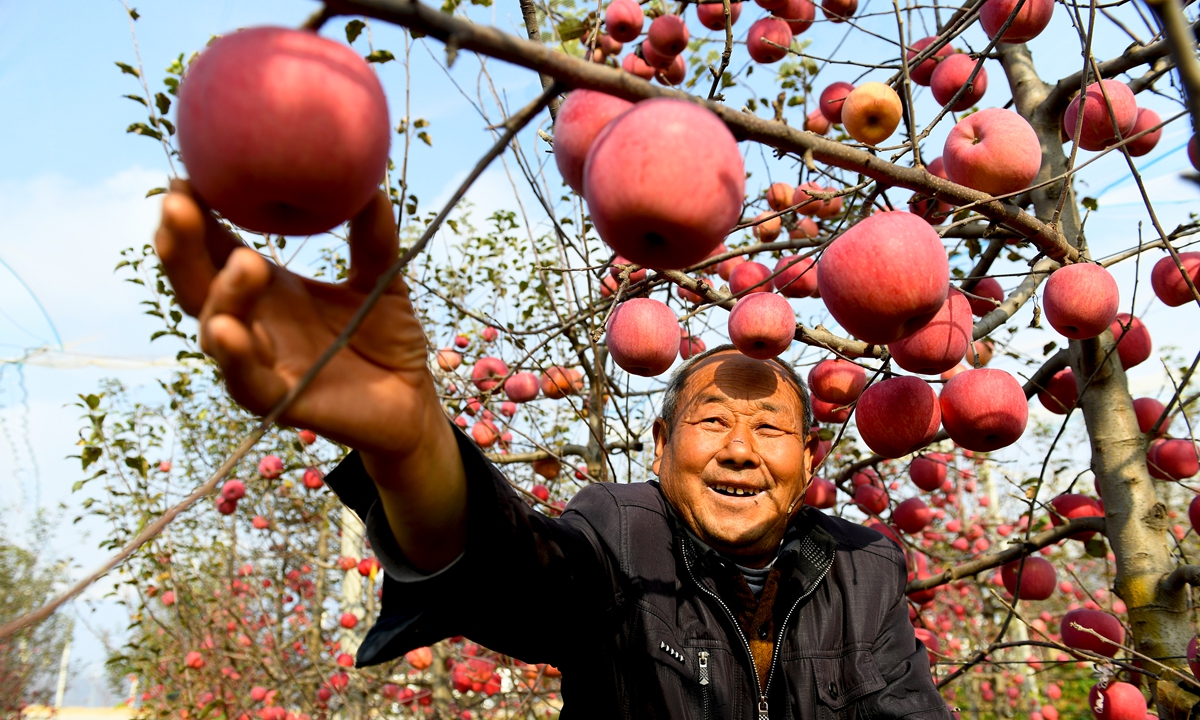
A farmer picks an apple in Nangou village, the Ansai district, Yan'an in Shaanxi. Photo: Courtesy of Qi Xiaojun/Yan'an Integrated Media Center
Passing the torchThirteen years have passed since the devastating rainstorm struck Nangou village in Ansai.
Four successive terms of village Party branch committees have taken over the baton of development. Boasting modern agriculture, ecological sightseeing and rural tourism, the village's 3,160-mu fruit orchard has become a golden pillar supporting its modernization drive.
In 2025, the village's per capita annual income exceeded 24,000 yuan, and the collective revenue reached 690,000 yuan.
In the village Party organization re-election earlier this year, Li Jinliang was elected secretary of the Party branch of Ansai's Nangou. Faced with a multitude of tasks, he stuck to one fundamental principle: "We must always deliver solid services for the people."
Recently, Wuqi's Nangou also completed its Party branch re-election, with Kuang Xiaofeng taking office as the new village Party secretary.
The two newly appointed secretaries smiled when talking about their fellow "namesake village."
"We learn from, compete with and help each other, all striving to make the two Nangous no longer villages faced with difficulties," said Kuang.
"As good partners, we must forge ahead side by side," Li added.
Currently, Ansai's Nangou village has been honored as a national beautiful leisure village and a model village for standardized grassroots Party building in Shaanxi Province.
Wuqi's Nangou is accredited as a national forest village and a national model pilot village for the Grain for Green Program, with its per capita annual income approaching 20,000 yuan in 2025.
This was compiled and translated by the Global Times based on an article originally published on Page 2 of the People's Daily on July 1, 2026.
RELATED ARTICLES