ARTS / CULTURE & LEISURE
‘Tianwen’ exhibition explores China’s cosmic worldview
Ancient relics chart journey from myth to space
By Li Hang and Published: Jul 02, 2026 11:08 PM

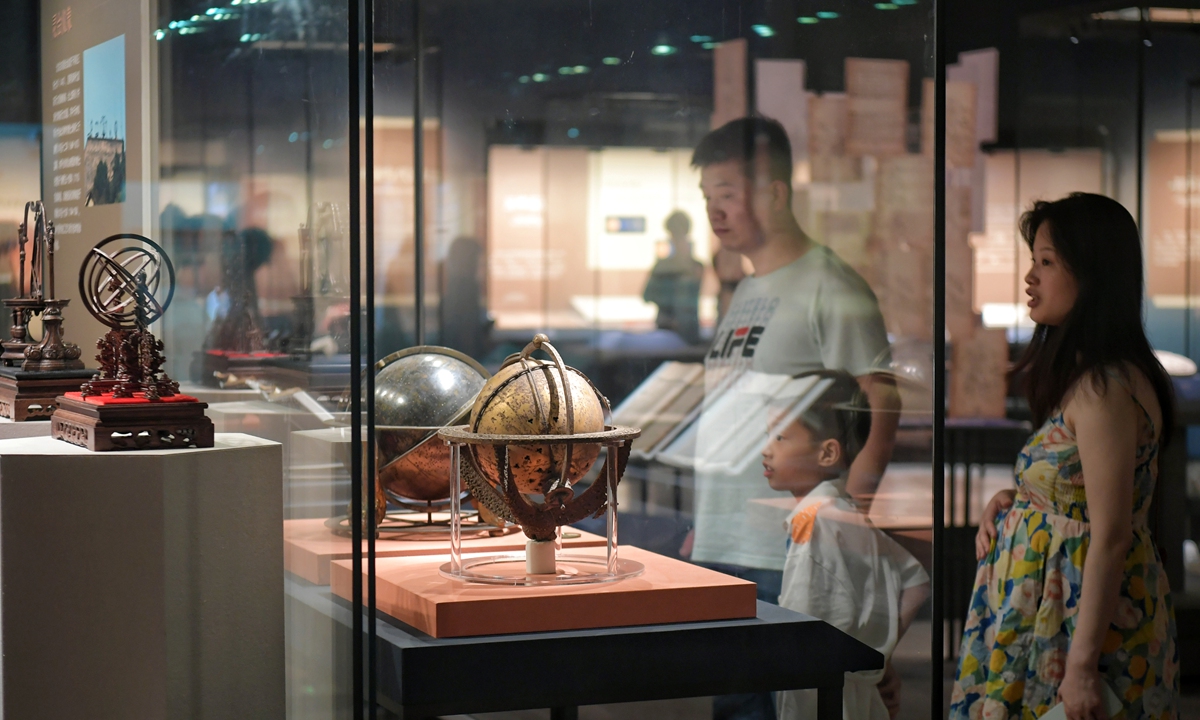
Visitors view astronomical instruments and cultural relics during the Heavenly Questions: The Cosmological Vision of Chinese Civilization exhibition at the Anhui Museum in Hefei, East China's Anhui Province on July 2, 2026. Photo: VCG
Titled Heavenly Questions: The Cosmological Vision of Chinese Civilization, the exhibition opened on Wednesday at the Anhui Museum after a year of preparation and collaboration among 48 museums and research institutions nationwide.
It is the first major curated show in China focused specifically on presenting the country's "cosmic worldview" through cultural relics, according to Anhui Museum.
Drawing inspiration from ancient classical poem Tianwen, or Heavenly Questions by renowned poet Qu Yuan (about 340-278 BC), the exhibition is structured around a thematic journey of "observing the sky, measuring the sky, responding to the sky, and exploring the sky."
Tianwen, also names for China's deep-space planetary probe mission, poses profound questions about the universe, nature, and human existence. This name encapsulates the Chinese nation's lofty aspirations for the cosmos, signifying an eternal quest for scientific truth and a boundless pursuit of innovation, fueled by tenacity and resolve, cultural researcher and associate professor Zhang Peng at Nanjing Normal University told the Global Times.
The exhibition opens with artifacts illustrating early mythological interpretations of the heavens, including Han Dynasty (206BC-AD25) stone reliefs depicting creation figures Fuxi and Nüwa (the early primogenitors of the Chinese in mythology), alongside animal symbols.
Other early objects include a gold foil frog from the Shang Dynasty (c.1600BC-1046BC) from the Jinsha Site Museum in Chengdu, Southwest China's Sichuan Province.
It may have originally formed part of a paired assemblage with the gold foil of the Sun and Immortal Bird, together symbolizing the ancient Shu people's reverence for the sun and the moon.
A central section of the exhibition focuses on historical instruments used for timekeeping and celestial measurement. Among the highlights is a Western Han-era star chart disk, considered one of the earliest surviving examples of a dual-plate celestial system in China.
Another key object is a copper water clock from the same period, demonstrating early mechanical approaches to time measurement.
A Qing Dynasty (1644-1911) armillary sphere crafted by astronomer Qi Yanhui is also on display. The device integrates multiple rings representing celestial coordinates and is designed to rotate automatically, combining timekeeping with astronomical simulation.
Curators also highlight how ancient astronomical observation was closely tied to governance and agricultural life. The 24 solar terms, consisting of 12 major solar terms and 12 minor solar terms which are still in use today, were created thousands of years ago by the ancient Chinese to guide agricultural production.
The exhibition explores how cosmological thinking became embedded in rituals, writing systems and material culture. Bronze ritual vessels, oracle bone inscriptions, and Neolithic ceramics are presented as evidence of how early Chinese societies linked celestial patterns with symbolic systems of order and belief.
One example includes a Western Zhou (1046BC-771BC) bronze vessel whose design incorporates spatial and temporal symbolism, reflecting ancient attempts to integrate cosmology into ritual architecture.
Oracle bone inscriptions featuring the Chinese character for "dragon" are displayed alongside interpretations linking early writing systems to star constellations.
In its final section, the exhibition turns to modern space exploration, placing ancient instruments alongside contemporary achievements.
At the opening, the museum also announced a series of public programs, including expert lectures, youth education activities, and a partnership agreement with a deep-space exploration laboratory to promote future research and outreach.
Professor Zhang pointed out that, based on the display of ancient artifacts, the exhibition also incorporates the spirit of manned spaceflight, lunar exploration, and the modern Beidou program, connecting the ancient Chinese pursuit of the heavens with today''s achievements in space exploration.
This showcases China''s long-standing spirit of scientific inquiry.
"These exhibits show that ancient Chinese not only had romantic visions of the sky but also made rational observations," Zhang said.
He added that by tracing back the development of the Chinese outlook on the universe and building a narrative linking ancient wisdom to modern innovation, the curatorial approach helps visitors deeply understand that the spirit of space exploration in the new era is deeply rooted in traditional Chinese culture.
At the same time, it shows that ancient concepts of the universe can inspire new vitality in today''s scientific and technological innovation.
RELATED ARTICLES