Ex-Indian intel chief: US official admits to cap India’s growth to China-like rise; Chinese expert says US containment deepening rifts
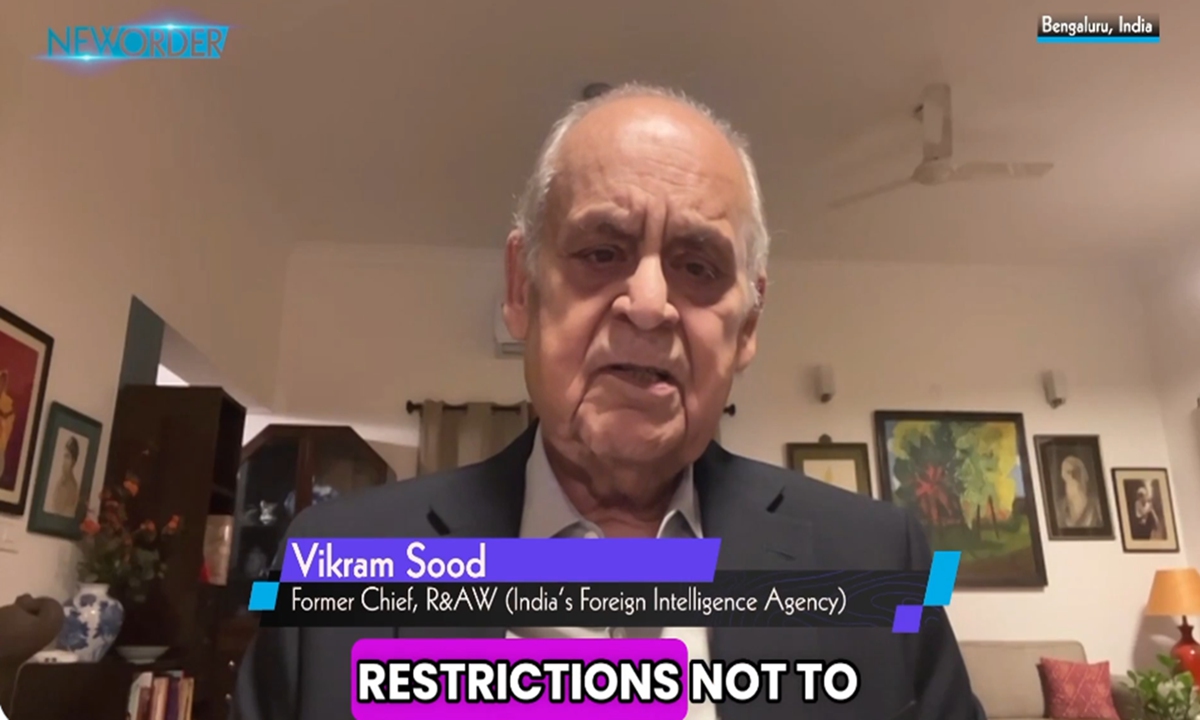
Former Indian intelligence official Vikram Sood speaks during an interview on the British current affairs program New Order on July 5, 2026. Photo: Screenshot from a video posted on New Order's X account
Former Indian intelligence official Vikram Sood cited on Sunday a statement by US Deputy Secretary of State Landau who said during his March 2026 visit to India that Washington will use tariffs, sanctions and other tools to curb India's rapid economic growth and will not allow it to emerge as a major power competing with the US.
Sood made the remarks in an interview on the British current affairs program New Order, which the host later shared on social media along with the original video of Landau's comments, triggering wider attention and discussions on relations of the "partners."
Chinese observers described Washington's approach toward New Delhi as a dual strategy of "limited engagement and ceiling control." They argued that deep-rooted structural contradictions arising from differing national ambitions, visions of global order, geopolitical interests, industrial competition and diplomatic traditions could not be fundamentally resolved through diplomatic engagement or economic cooperation between India and the US.
In the interview aired on Sunday, Sood quoted Landau as saying: there will be all sorts of restrictions "NOT to let India's economy grow." According to Sood, Landau said at a meeting in New Delhi: "We made a mistake by helping China become a major economic power. We're not going to do that with India. We'll not make that mistake again… It's an official talking openly at a conference. It's not even a threat or a warning or a suggestion behind closed doors."
The host of New Order, Afshin Rattansi, amplified the clip on his own X account, attaching footage from Landau's March appearance. Rattansi summarized: "As the multipolar world deepens, expect the US to throttle India's development more openly and forcefully."
Although the US Embassy in India has repeatedly claimed that the US-India economic partnership is "strong and growing," several signals have reignited debate over India's weight in Washington's broader Asia strategy.
The Times of India, citing its Washington correspondent, claimed that eight years after the US administration renamed the US Pacific Command as the Indo-Pacific Command to underscore New Delhi's growing strategic importance in US efforts to counter China, the Pentagon has quietly reversed course.
According to the report, US-India relations are increasingly overshadowed by tariff disputes, disagreements over India's purchases of Russian energy, visa and mobility restrictions affecting Indian professionals, renewed US engagement with Pakistan, and New Delhi's unease over US military operations in the Gulf that resulted in the deaths of Indian sailors.
Qian Feng, director of the Research Department at Tsinghua University's National Strategy Institute, told the Global Times on Monday that the rapid expansion of US-India relations over the past two decades is reaching a ceiling, as the two countries face structural contradictions that are difficult to reconcile. These differences stem from their differing stages of development, strategic cultures, geopolitical positions, diplomatic traditions and the foreign policy orientations of their leadership.
Qian said India's long-standing commitment to strategic autonomy fundamentally differs from Washington's alliance-based approach. New Delhi has consistently pursued an independent foreign policy based on its own national interests rather than aligning fully with US strategic objectives. Even within frameworks such as the Quad and the Indo-Pacific Strategy, India seeks to engage the US as an equal partner rather than as a formal ally or subordinate security partner.
The two countries also maintain significant differences over Russia. India has preserved close strategic ties with Moscow, while the US continues to expand sanctions against Russia, creating an enduring source of friction between the two sides, Qian noted.
Economic disagreements have also become increasingly prominent. Washington has placed greater emphasis on its "America First" agenda, seeking broader concessions from trading partners in areas including tariffs, agriculture and market access, while India has remained determined to protect its domestic industries and farmers, leading to more frequent trade disputes, Qian added.
Regarding Landau's characterization in the video that helping China become a major economic power had been a US strategic mistake, Qian also rejected the claim.
China's development was driven primarily by its own reform and opening-up, industrial capacity and innovation, rather than by US' "assistance," Qian said. He added that economic engagement with China had generated substantial benefits for both countries, making bilateral cooperation a mutually beneficial process instead of a one-sided concession by Washington.
Landau's remarks reflected Washington's broader approach toward India - seeking New Delhi's support in geopolitical competition while locking it at a lower end of the industrial chain. Such a strategy, he argued, runs counter to India's strategic goals.
"Industrialization is a legitimate right of all developing countries. Guided by a zero-sum mindset, the US seeks to impose a ceiling on other countries' development. By carving up global supply chains through tariffs and technical barriers, it will only push India to deepen cooperation within the BRICS framework as well as with China and Russia, accelerating the diversification of industrial chains," Qian added.
RELATED ARTICLES