ARTS / CULTURE & LEISURE
Two volumes of 'world's largest encyclopedia' return to China after century abroad
Pages across time
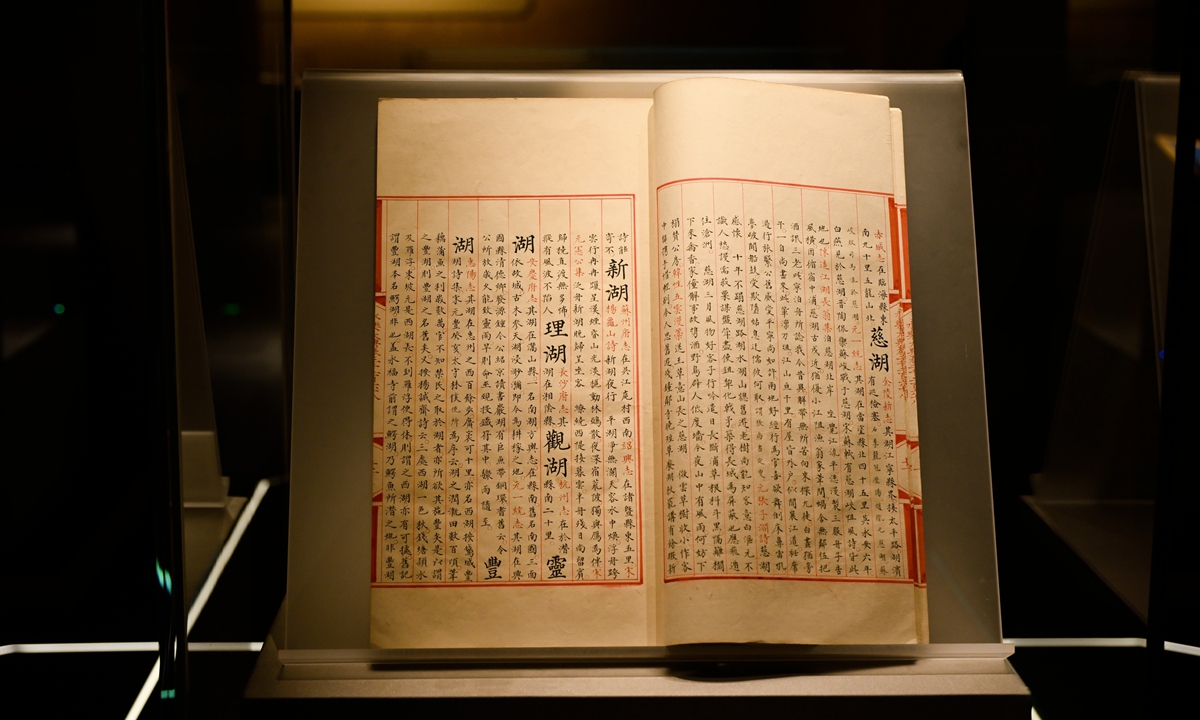
Text from the Hu volume of Yongle Dadian Photo: Courtesy of Jin Liang
Two rare handwritten volumes of the Yongle Dadian, dating to the Ming Dynasty (1368-1644), have been donated to the Hangzhou branch of the China National Archives of Publications and Culture (CNAPC), marking another milestone in the country's long-running efforts to recover and preserve cultural treasures scattered overseas.
The Yongle Dadian, commissioned by Emperor Yongle of the Ming Dynasty in 1403, collected more than 7,000 kinds of ancient Chinese books and records, covering literature, art, history, geography, philosophy and religion from the pre-Qin Dynasty period (pre-221BC) to the early Ming Dynasty.
With a total of 11,095 volumes entirely handwritten and about 370 million characters, the Yongle Dadian was lauded as the "largest encyclopedia in the world" by the Encyclopedia Britannica.
In an effort to protect this world-renowned compilation, the Jiajing Emperor of the Ming Dynasty ordered a reproduction of the classic. Copying the work took five years to complete.
For historical reasons, of the surviving volumes, only 241 volumes remain in China today, while the rest are held overseas.
The newly acquired volumes are the Hu (lake) volume, covering chapters 2,268 and 2,269, and the Sang (funeral) volume, covering chapters 7,391 and 7,392.
The Hu volume centers on geographical names, recording 436 lakes and featuring extensive excerpts from local gazetteers and classical poetry. The Sang volume deals with the official mourning rites observed following the deaths of emperors and empresses.
"The greatest value of the Yongle Dadian lies in 'preserving books.' It contains a large number of ancient works that had already been lost by the late Yongle period," said Weng Lianxi, a rare books specialist and research fellow at Beijing's Palace Museum.
The acquisition of the Hu volume reconnects a complete sequence of surviving Hu chapters, numbered 2,260 through 2,283, which had previously been separated, filling an important gap in the historical record and opening new avenues for academic research, noted Weng, according to the Xinhua News Agency.
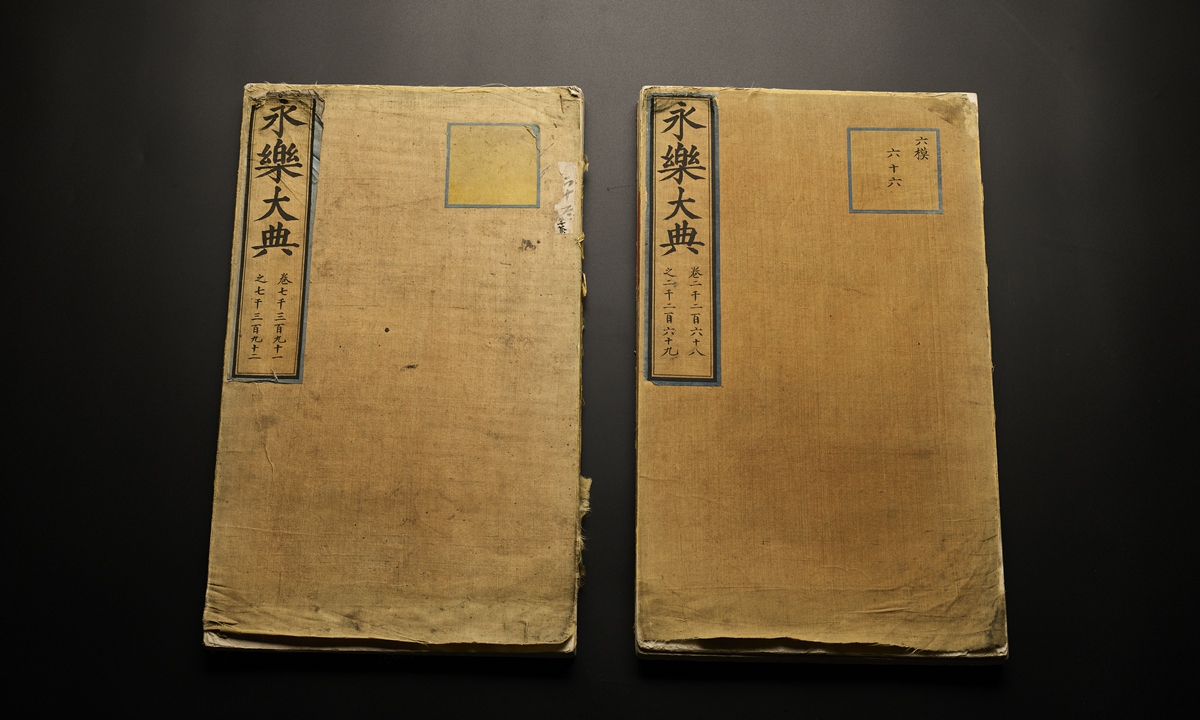
The cover of a Yongle Dadian volume Photo: Courtesy of the Hangzhou branch of the China National Archives of Publications and Culture
Long way back
Bringing these two rare volumes home was no simple feat. In May 2020, the two volumes surfaced at an auction house in France. As Chinese public institutions are unable to bid, Jin Liang, a private collector and now serves as president of the Zhejiang Society for Classical Textual Studies, stepped in after learning about the auction.
Jin purchased the books and worked with scholars and other organizations to facilitate their return to China.
The return journey of the two volumes involved multiple hurdles, from complex export approvals in France and customs procedures to carefully controlled international transport and long-term preservation. Besides, the fragile manuscripts require strict temperature and humidity control during transit, as well as coordinated handling across borders.
Upon arrival, the volumes were cleared through a "green channel" that combined customs, inspection and conservation in one streamlined process, reducing unnecessary handling. The next challenge was long-term preservation, which demands tightly controlled storage conditions. The books arrived in China in early 2022.
"I have always recognized in the limits of private collecting," Jin told the Global Times. "The Hangzhou branch of the CNAPC has professional teams for preservation, restoration and research. Donating the Yongle Dadian volumes here means they are no longer a private collection, but part of the public cultural heritage preserved for the long term and accessible to scholars and the public alike."
For over three decades, Jin has devoted himself to collecting rare Chinese books and helping bring lost cultural relics back to China. To date, he has donated more than 3,300 items to the CNAPC Hangzhou branch - a contribution that has greatly enriched the institution's holdings.
"Seeing these two volumes officially enter the museum fulfills my long-held wish of bringing this national treasure safely home," Jin said. He hopes visitors will appreciate both the richness of Chinese civilization and the generations of guardians who made its preservation possible.
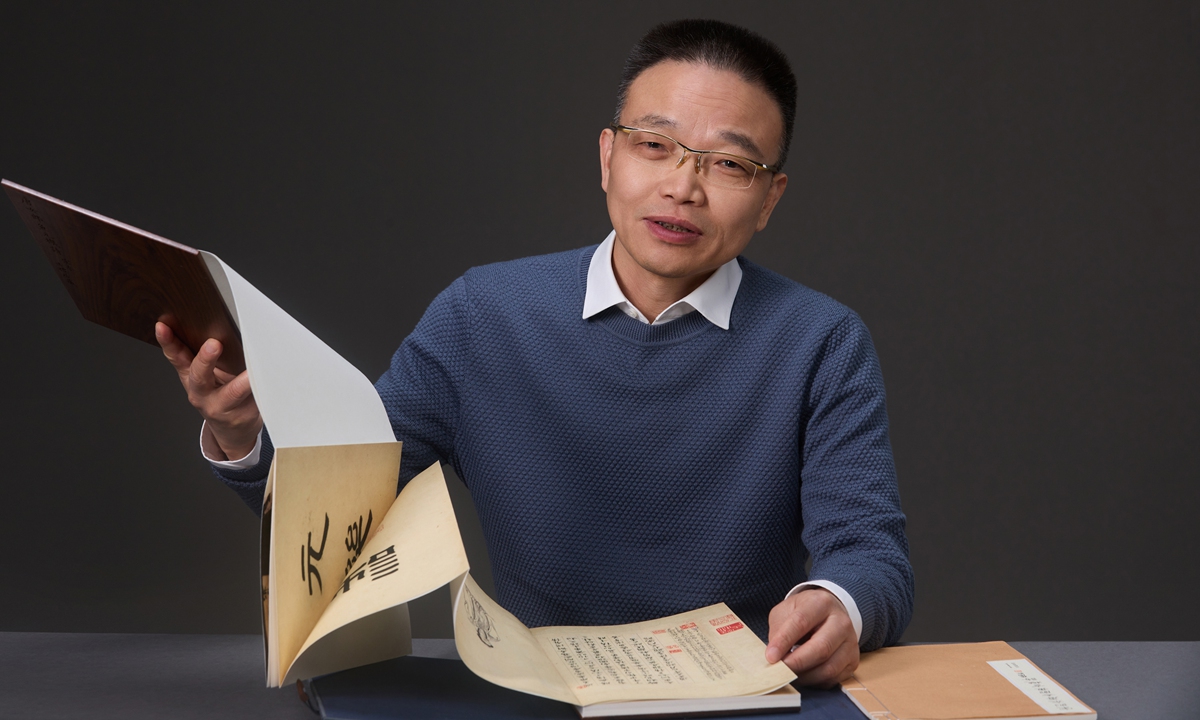
Jin Liang Photo: Courtesy of Jin Liang
A scattered legacy
The Yongle Dadian project was completed in 1408, producing the original manuscript copy known as the master edition. The work also included finely illustrated pages.
During the reign of the Emperor Jiajing, officials were ordered to produce a copy of the Yongle Dadian as a safeguard against the possible loss of the original manuscript.
Since then, the whereabouts of the original manuscript have remained unknown. By 1794, during the Qing Dynasty (1644-1911), more than 1,000 original volumes had already gone missing.
In 1860, when Anglo-French forces occupied Beijing during the Second Opium War, numerous volumes of the Yongle Dadian were looted or destroyed. Historical accounts describe some surviving copies being burned or even used as makeshift building materials.
Further losses followed in the late Qing period as political turmoil and foreign intervention fueled the dispersal of Chinese cultural relics overseas.
Today, just over 400 volumes of that copy survive worldwide, less than 4 percent of the original work. Only 241 volumes remain in China, with the rest scattered overseas.
Each surviving volume is considered a national treasure and an irreplaceable piece of China's documentary heritage, according to Xinhua.
For museum officials, the latest donation also represents a new model for recovering cultural heritage through cooperation among government agencies, scholars and private collectors. Chu Beibei, director of the CNAPC Hangzhou branch, called the acquisition a historic addition to the museum's collection.
"It has become one of the museum's most important treasures," Chu said. "It demonstrates a collaborative approach involving government guidance, social participation and academic expertise that may help bring more lost cultural relics back to China."
RELATED ARTICLES