SPORT / FOOTBALL
Belgium routs US 4-1 to reach World Cup quarterfinals despite US team's red card 'privilege'
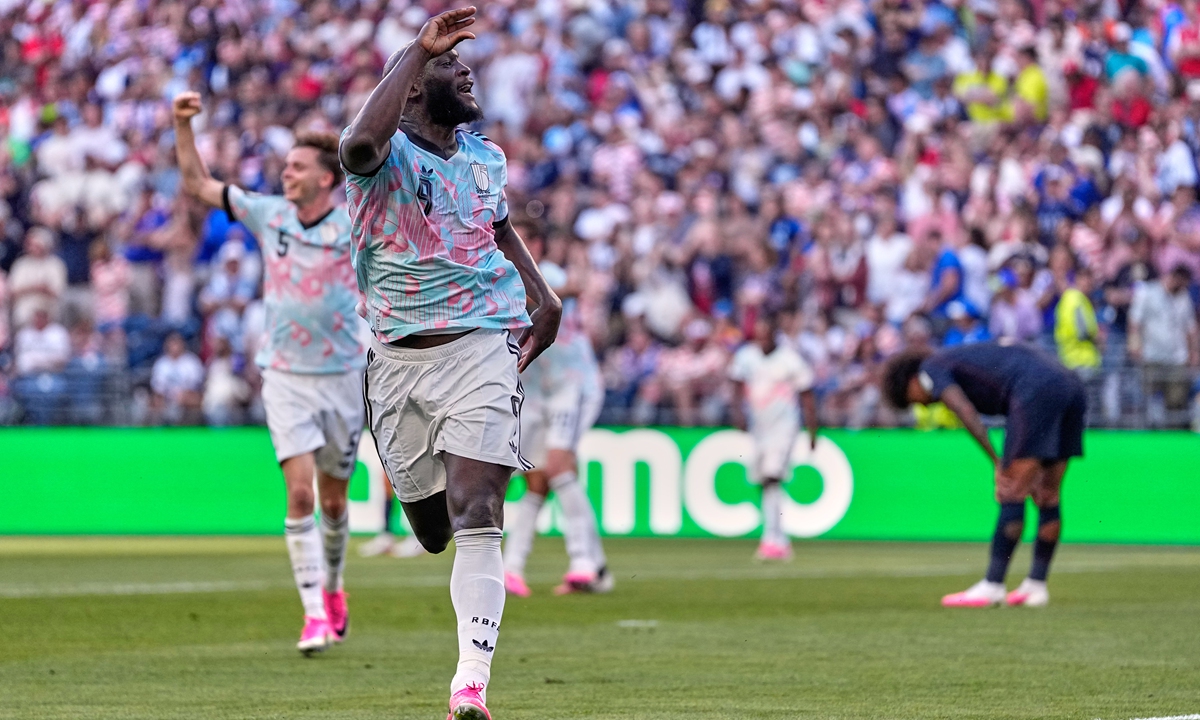
Belgium's Romelu Lukaku celebrates after scoring his team's fourth goal during the World Cup round of 16 match between the US and Belgium in Seattle, on July 6, 2026. Photo: VCG
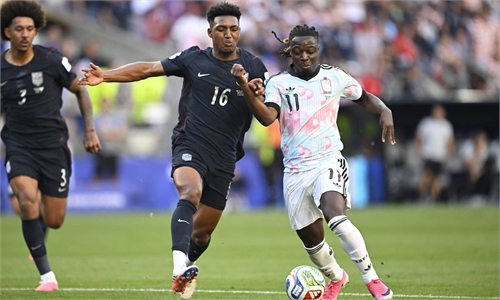
Belgium booked a place in the quarterfinals of the FIFA World Cup with a convincing 4-1 victory over the United States on Monday, eliminating the co-hosts in Seattle in a match that was overshadowed by the controversy surrounding US striker Folarin Balogun's eligibility.
Belgium seized the initiative through Charles de Ketelaere's early opener before the United States briefly leveled on Malik Tillman's deflected free kick. De Ketelaere restored Belgium's lead almost immediately, and Hans Vanaken capitalized on a costly US goalkeeping error after the break before Romelu Lukaku sealed a commanding 4-1 victory in stoppage time.
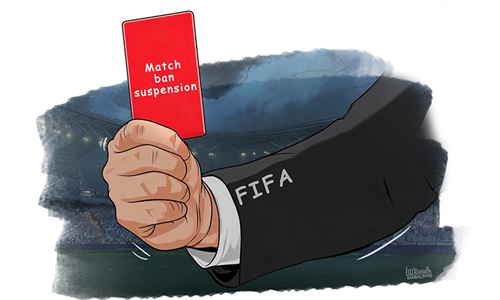
But much of the attention before kickoff centered not on the sport itself, but on FIFA's highly controversial decision to allow Balogun to play despite receiving a straight red card in the previous round against Bosnia and Herzegovina.
Balogun had originally been subject to the automatic one-match suspension that normally follows a straight red card. FIFA's disciplinary committee instead suspended the implementation of the ban for a one-year probationary period after US President Donal Trump made a phone call with FIFA President Gianni Infantino, allowing the striker to feature against Belgium. The red card itself was not rescinded.
The Belgian football association had challenged Balogun's eligibility before kickoff, arguing that FIFA's decision undermined the integrity of the competition. FIFA rejected the challenge, ruling that Belgium had no standing to appeal because it was not a party to the disciplinary proceedings.
The decision has triggered one of the biggest governance controversies of the tournament.
FIFA President Gianni Infantino insisted the governing body's judicial process remained independent despite acknowledging he had spoken with US President Donald Trump, who publicly admitted asking him to review Balogun's case.
"During our conversation I explained that there was an ongoing legal process involving FIFA's independent judicial bodies and that the case would be decided in due course by the competent bodies," Infantino said in a statement posted by FIFA Media on X.
"That is how FIFA's system works, and it is a principle that I will always uphold."
European football governing body UEFA issued an unusually strong rebuke on Monday, saying FIFA had "crossed a red line."
"We express our disbelief at such an unprecedented, incomprehensible and unjustifiable decision," UEFA said.
"When the certainty of rules is no longer guaranteed by its guardians, the integrity of the game is at stake and the credibility of a competition is undermined.
The controversy has also raised broader questions over whether other teams could seek similar treatment.
Following England defender Jarell Quansah's straight red card against Mexico, a member of the British Parliament publicly called on FIFA to apply the same disciplinary approach used in Balogun's case.
The controversy also sparked a wide-ranging debate in China, as many fans accused FIFA's decision of giving the host team a blatant privilege. A Chinese football fan commented that Belgium's victory was "satisfying" but did not amount to "justice prevailing" as some other Chinese fans have argued.
"FIFA still hasn't admitted its decision was wrong," a football fan wrote, arguing that true justice requires not only an unfavorable outcome for the beneficiary but also an acknowledgment and correction of the original mistake.
Football commentator Sun Yuxuan argues the decision to suspend Balogun's ban is "the biggest scandal" in the history of world football.
"Fair play and rules in sport should not become worthless in front of political power," Sun said in a post on Douyin.
Belgium's victory also changed the post-match narrative in the US. While FIFA's unprecedented decision to allow Balogun to play had dominated headlines before kickoff, several major US media outlets concluded that the controversy ultimately had little bearing on the result.
The Wall Street Journal wrote that Belgium's 4-1 victory rendered the debate largely moot, saying the Americans "came into this World Cup with every conceivable home advantage," including home support and, controversially, "assistance from the Oval Office," but still could not match Belgium on the field.
The New York Post likewise concluded that the US was "outclassed" by Belgium. It noted that despite the intense attention surrounding Balogun's eligibility, the striker failed to score or significantly influence the match, while defensive errors and Belgium's superior quality proved decisive.
ESPN said "nobody benefits" from FIFA's decision to suspend Balogun's automatic ban, arguing that the move created an unnecessary governance controversy that overshadowed both the tournament and the US team's campaign. It said the episode was "a bad look" for FIFA, regardless of whether Balogun's original red card was deserved.
Belgium's official X account celebrated the team's victory with a post reading "It's called
Belgium will go on Spain in the quarterfinals, while FIFA is likely to continue facing scrutiny over the red card suspension decision that has become one of the defining controversies of the tournament.
RELATED ARTICLES