As NATO leaders meet in Ankara, US-Europe rifts take center stage from defense spending to football row
By Published: Jul 07, 2026 05:04 PM

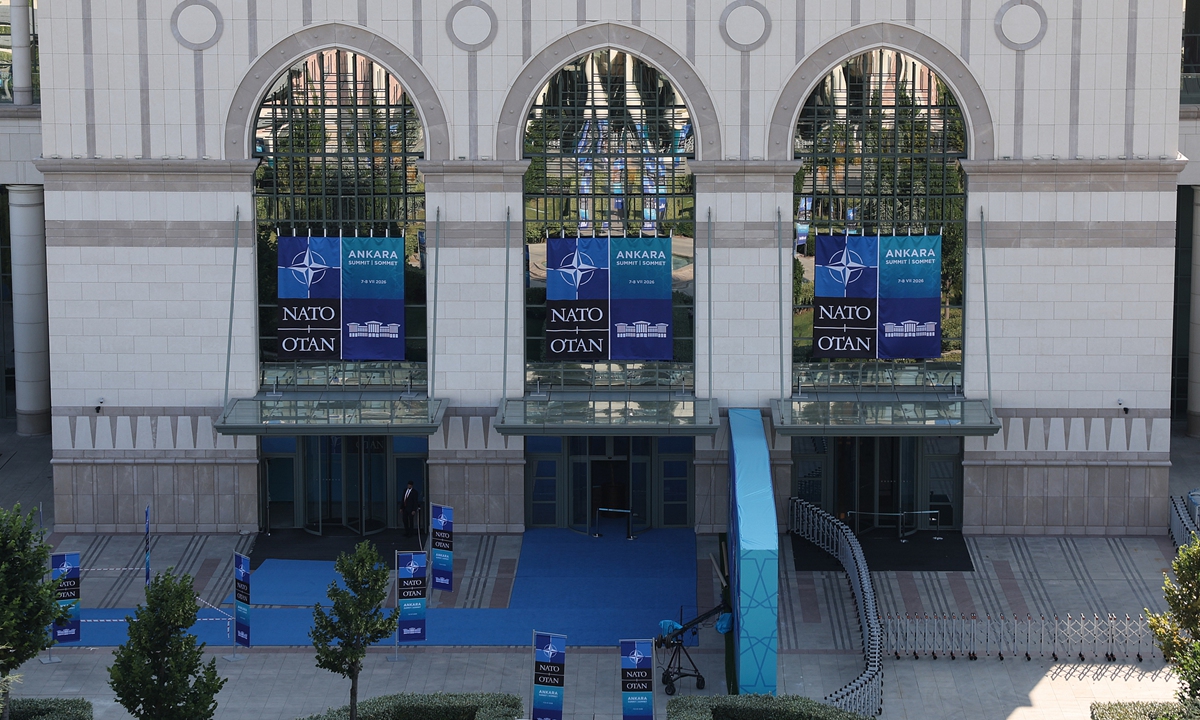
A view of the venue of the NATO Summit in Ankara, Turkey on July 7, 2026. Photo: VCG
NATO leaders are set to gather for a two-day summit in Ankara on Tuesday with tensions and differences between the US and Europe already becoming a major focus of attention among Western media. Most notably, recent outrage among Belgian politicians and football officials over FIFA's yielding to US President's demand to reinstate American striker Folarin Balogun has further aggravated transatlantic frictions, some media outlets said.
Some Chinese observers noted on Tuesday that the controversy on the football pitch is merely a microcosm of the current rifts in transatlantic relations.
NATO leaders plan to unveil arms deals worth tens of billions of dollars in Ankara on Tuesday to show they are heeding US calls to spend more to defend Europe before joining US President Donald Trump for a summit, Reuters reported.
Trump has long accused European governments of over-relying on the US to defend them through the NATO, Reuters said.
The Guardian said in a story headline on Tuesday that "NATO braces for difficult summit as Trump puts pressure on spending."
Besides the defense spending, the US leader has continued to strain relations with US allies since the start of 2026 when he threatened to take control of Greenland and failed to consult European leaders before the US and Israel launched attack on Iran, the Guardian noted.
"Greenland, Tariffs, NATO and Now Soccer. Trump Creates a New Clash With Europe," the New York Times (NYT) said in a headline on Monday.
Tensions between the US and Europe took a new turn on Monday as Belgian officials and European soccer figures expressed outrage over the reinstatement of a banned American player before an evening World Cup game against Belgium, NYT said.
Trump intervened on behalf of star US forward Folarin Balogun, whose red-card suspension was lifted in a decision that allows him to play in a World Cup match against Belgium on Monday, according to media reports.
However, Balogun's presence on the field for the US against Belgium had a seismic impact on the world of soccer, but he ultimately played a forgettable role in the Americans' 4-1 loss in the World Cup round of 16 on Monday, according to the AP News.
FIFA's decision prompted soccer leaders to question the integrity of the World Cup, with European soccer body UEFA saying FIFA "crossed a red line" and Belgium's soccer federation contesting Balogun's eligibility, the AP News said.
"In handling the football controversy involving Belgium, the US did not appear to rely on established rules, but rather demonstrated the influence of power dynamics. The incident on the football pitch reflects an attempt by the US to use its own leverage to shape the application of rules," a Beijing-based expert on the international affairs who preferred not to be named told the Global Times on Tuesday.
A similar approach can also be seen in the US President's handling of alliance relations. He has repeatedly pressured US allies to take on greater responsibilities, a stance underpinned by the belief that the US possesses overwhelming strength, the expert said, noting that the notions of "America First" and "might makes right" have been evident across many of the US government's policies and actions.
Before the NATO summit, the Wall Street Journal reported last week that the US Defense Secretary Pete Hegseth planned to announce additional US troops cuts in Europe, however, such proposal was nixed after it was shared with other US senior officials. Instead, Hegseth said the US would conduct a review of its force posture in Europe that could last as long as six months, the WSJ said.
Ahead of the NATO summit, the US magazine Foreign Affairs published an article on Monday saying that "the transatlantic alliance can't survive without trust."
"The irony is that just as Europe becomes the kind of partner the US should want on its side, Washington's behavior has created a crisis of trust within the alliance. Now, if Washington cannot repair the damage it has done, it risks losing this ever more valuable ally altogether," the article said.
"The disagreements between the US and Europe are no longer limited to economic interests, but also extend to geopolitics, security strategies, and cultural values," Dong Yifan, an associate research fellow at the Belt and Road Academy of Beijing Language and Culture University, told the Global Times on Tuesday.
Against the backdrop of growing influence of conservative forces in the US, tensions between Washington and Brussels may become a more normalized feature of their relationship, repeatedly resurfacing as new issues emerge, some observers noted.
"In the future, Europe's approach to dealing with the US may become more cautious - seeking to avoid direct confrontation with Washington while at the same time striving to uphold its own positions and strategic autonomy," Dong said.
RELATED ARTICLES