ARTS / ART
A craft artist nourishes artistic inheritance through searching traditional texts
Drawing from classics
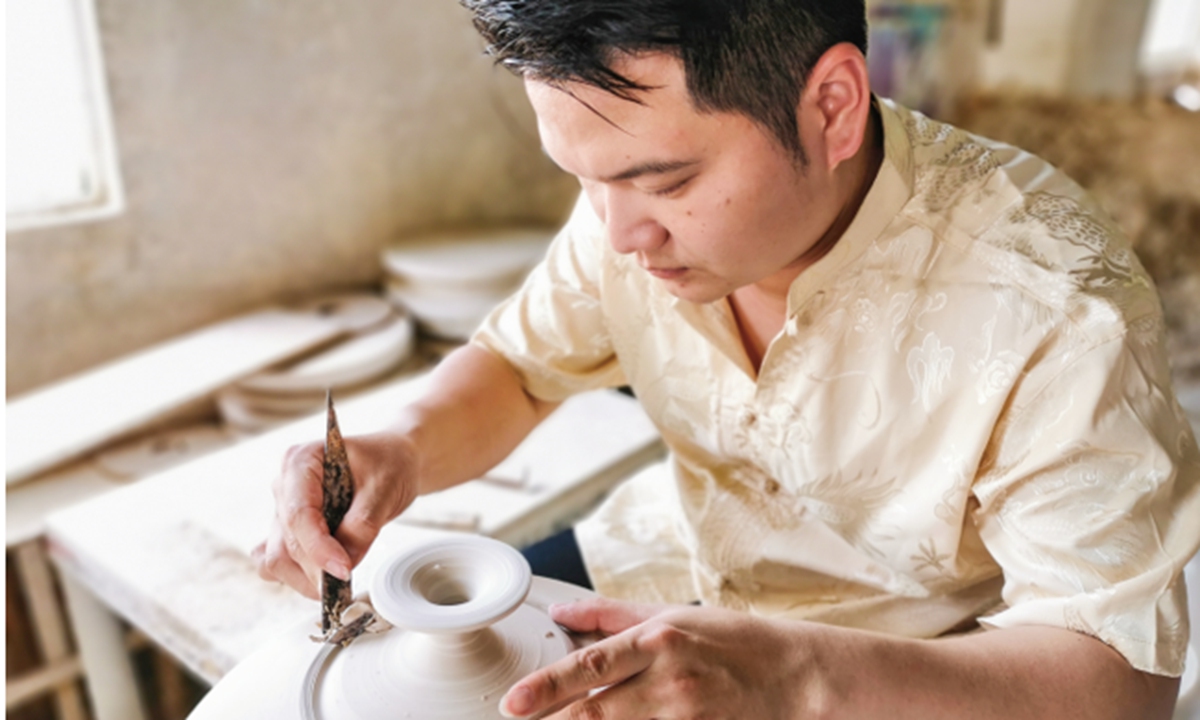
Ceramic artist Xu Zerong Photo: Courtesy of Xu Zerong
Editor's Note:In an age of information overload, reading remains a necessary channel to invigorate the mind, provide inspiration and cultivate virtue. Whether it is childhood enlightenment or the pursuits of adulthood, everyone's reading journey carries unique emotions and life experiences. The Global Times has specially launched the "100 Avid Readers" series, inviting guests from various fields to share their connections with books, stories of growth and sparks of thought.
In this installment, we meet ceramic artist Xu Zerong, who found inspiration for how to innovate within craftsmanship through books on traditional Chinese aesthetics.
At an art gallery in Beijing, a collection of ceramics sits on display, each piece transformed by the kiln's firing process. Unlike traditional ceramics with their predictable colors, these works bear the kiln's unmistakable signature - unpredictable textures and hues that make every piece one of a kind.
The artworks were created by Xu Zerong, a deputy of the 14th National People's Congress and a leading craft artist. Behind his distinctive artistic style lies a journey that has time and again driven him to books; when hands-on experience fell short of providing answers, he turned to reading for new directions.
"Many artisans focus solely on practical skills, but I believe reading is what sets true artists apart from mere craftsmen," Xu told the Global Times.
From skills to aesthetics
Xu's reading journey has evolved in tandem with his artistic growth.
In his early years of learning kiln-transmutation techniques, Xu found himself stuck in repeated trials with glaze formulations, unable to make a breakthrough. Seeking solutions, he turned to the library, poring over ancient ceramic classics and specialized materials.
As his artistic practice entered a new phase, he expanded his reading to encompass traditional culture and aesthetics. Kao Gong Ji (The artificers' record) and An Outline of Chinese Aesthetic History had the greatest impact on him.
According to Xu, the former documents ancient craftsmanship and embodies the traditional Chinese understanding of the relationship between materials, techniques, and aesthetics. The latter helped him situate art within a broader cultural and historical context.
"Traditional craftsmanship is not merely an accumulation of technical skills; it also carries the Chinese people's understanding of nature, aesthetics, and ways of life," Xu said.
Later, as his focus deepened toward intangible cultural heritage preservation and cultural inheritance, he began reading local chronicles, monographs on intangible heritage protection, and other materials, tracing the thousand-year history of ceramics in the region.
Reinventing tradition
As Xu's engagement with artistic creation deepened, reading reshaped his view of intangible cultural heritage preservation.
In his early years of studying ceramics, Xu believed that preserving tradition meant keeping to conventional forms as closely as possible. But as his reading expanded, he came to realize that the history of Chinese ceramics is itself a history of constant change and innovation.
This realization, in turn, informed his creative philosophy. Today, Xu advocates what he calls "rooted innovation" - creating works that preserve traditional ceramic techniques while incorporating his own modern temperature-controlled kilns and aesthetics that appeal to younger generations. The goal is to ensure that kiln-transmutation ceramics retain their cultural roots while meeting contemporary tastes.
"My reading has been a constant source of enlightenment," Xu said.
Xu notes that in recent years, as a deputy to the National People's Congress, he has helped promote public-interest study programs and the development of university-based training facilities, hoping to take kiln-transmutation culture beyond individual craftsmanship and into broader social inheritance.
Lasting value
As Xu pursues this path of social inheritance, he has observed the impact brought by the rapid rise of short videos and digital platforms.
"New media provide fresh channels for promoting traditional culture, but fragmented content cannot replace deep thinking," he noted.
"Short videos can serve as a window - but if you truly want to excel at original craftsmanship and understand traditional culture, watching clips alone is far from enough," he added.
In Xu's view, the value of reading lies not in obtaining any single, immediate answer, but in building a complete knowledge system and a coherent way of thinking through long-term accumulation.
Xu believes that for young creators to master a traditional craft genuinely, they need more than just an appreciation of the finished work's outward form; they must also understand the history, culture, and spirit behind it.
He recommends that young people read books such as Kao Gong Ji, and History of Chinese Ceramics, and An Introduction to Intangible Cultural Heritage.
"Kao Gong Ji helps one understand the craftsmanship ethos in traditional techniques; History of Chinese Ceramics helps establish a cultural foundation; and books on intangible heritage allow young people to approach inheritance from a more comprehensive perspective," he said.
Today, reading remains a steadfast habit in Xu Zerong's daily life.
Whether he is creating, researching, or fulfilling his duties as a deputy to the National People's Congress, he turns to books for fresh inspiration.
"Reading won't produce a great work of art overnight - but the broadened vision and perspective it cultivates over time will ultimately shape the way you create, research, and make judgments," he said.
According to Xu, transformation in the kiln takes time, and so does the deepening of human understanding. What accumulates through the pages of books will eventually find its way back into the artwork itself, helping traditional craftsmanship to find new forms of expression in an ever-changing era.
RELATED ARTICLES