ARTS / CULTURE & LEISURE
Xiong’an Library’s global recognition shows strength of China’s innovative public cultural services
By Published: Jul 12, 2026 10:06 PM

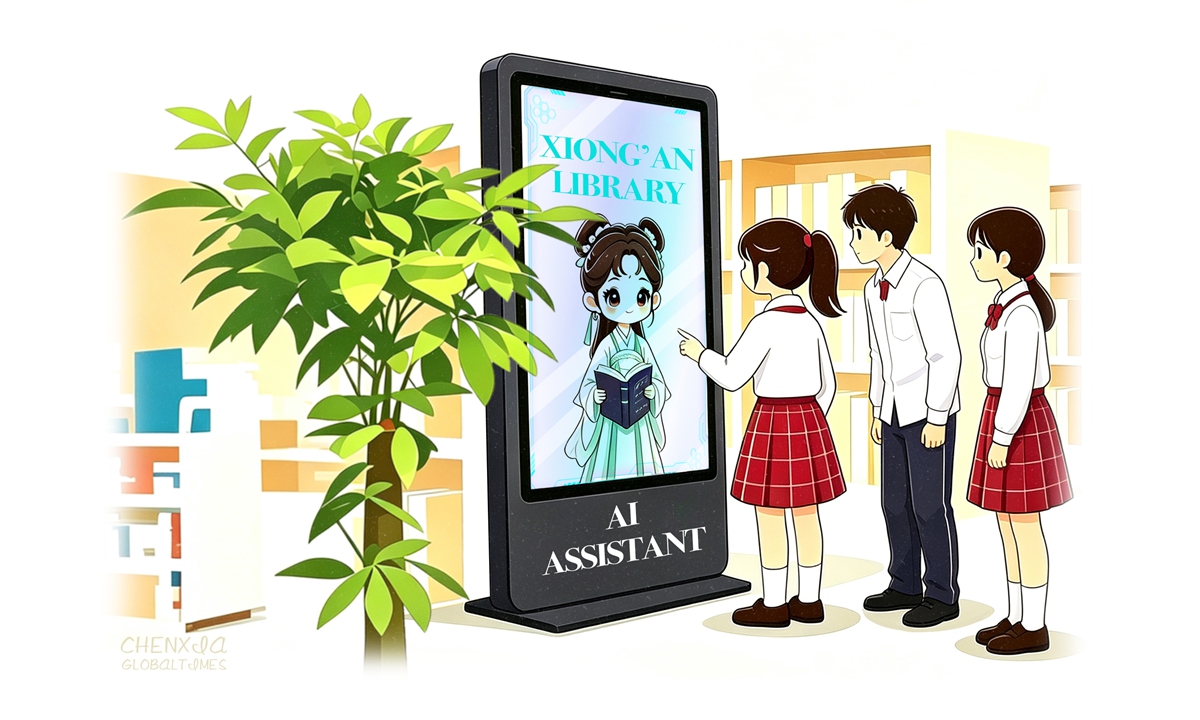
Illustration: Chen Xia/GT
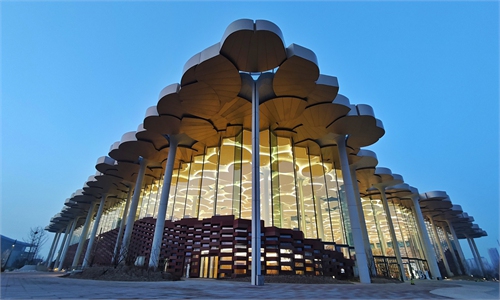
In the heart of China's "future city," the Xiong'an New Area, a striking new landmark is rewriting what a public library can be. The Xiong'an Library has just entered the final four for the International Federation of Library Associations and Institutions (IFLA) 2026 Public Library of the Year Award. Coming on the heels of the Beijing Library's triumph in 2024, this is no fleeting success. This is the latest evidence that China's public cultural infrastructure is not merely keeping pace with the world; it is redefining the standards.If you walk into the library's soaring 45-meter atrium, the first thing you notice is the light. Natural daylight floods a space whose facade draws inspiration from ancient Chinese bamboo slips, jiandu, symbolizing the unbroken thread of Chinese civilization. Yet this is no museum piece. A friendly humanoid robot named "Xiong Tu" greets visitors at the entrance, offering to hunt down books, connecting ideas, and even monitoring reading comfort like a thoughtful companion. Behind the scenes, an intelligent system of 30 orbital carts and automated sorting lines moves up to 2,000 books per hour across underground and above-ground floors. Every volume has its own digital "highway," making retrieval seamless regardless of collection size or location.
For local resident and researcher surnamed Liu, the library has become part of daily life. "I come for technical materials during the day and stay to recharge myself in the evening," he said. The building deliberately blends quiet study zones with lively community spaces and children's areas with rooftop gardens - a "dynamic-static separation" that serves all ages. It is less a warehouse of books than a vibrant "urban living room" where returning residents, relocated workers, and young people all find their place.
This people-centered philosophy is precisely why international judges noticed the library. IFLA's criteria are notoriously demanding: architectural excellence, local cultural resonance, spatial adaptability, sustainability, social connectivity, and intelligent digital solutions. The Xiong'an Library scores strongly across the board. Its design respects Chinese traditions of halls, corridors, and courtyards while embracing cutting-edge automation. Services extend beyond the walls through self-service stations, mobile book vans, and coordinated delivery networks that help create a genuine "15-minute high-quality reading circle."
Xiong'an is not an isolated story. Across China, public libraries are undergoing a quiet but profound transformation that is earning global applause. In Shanghai, the Shanghai Library's East Branch leverages the domestically developed "Yunhan" cloud platform, deploying robot librarians, smart shelves, indoor navigation, and city-wide borrowing via the "Shanghai QR Code," known as "suishenma." Readers enjoy true one-stop access: borrow anywhere, return anywhere, or have books delivered home.
This journey from "shelf to self" is grounded in deep insight, strategically executed, rigorously measured, and delivers outstanding results. Overall, it represents an exceptionally strong initiative. It compellingly demonstrates how libraries can regain public relevance and appeal in the digital age.
Further south in China's Greater Bay Area, the innovation continues. Shenzhen Library's "Under Library" project takes visitors into one of China's largest underground intelligent book vaults - three stories deep, holding millions of volumes, with retrieval in about 10 minutes. It secured second place globally in IFLA's PressReader International Marketing Awards. Other efforts are just as impressive.
What unites these efforts is a shared insight that libraries today must be far more than repositories of knowledge. They are social connectors, community anchors, and engines of lifelong learning.
Chinese libraries are delivering exactly that: not flashy tech for its own sake, but technology deployed thoughtfully to serve real human needs. The emphasis is on "using it cleverly," not simply "filling it fully."
This matters beyond cultural statistics. In an era when many societies struggle with social changes, digital divides, and aging populations, China's approach offers a compelling model. By treating libraries as living infrastructure - woven into urban planning from the outset - cities create spaces where innovation meets tradition, efficiency serves warmth, and technology enhances rather than replaces human connection.
Residents actually use these spaces - for research, relaxation, family time, and community engagement. The high-speed sorting systems and AI assistants free librarians to focus on programs, outreach, and personalized services.
The international recognition is gratifying, but the real victory lies in domestic impact. When a robot helps an elderly reader discover new stories, when a researcher finds obscure materials within minutes, when children and grandparents share picture books together - these small moments accumulate into something profound. They represent a vision of public culture that is inclusive, intelligent, and deeply rooted in serving the people.
China's public libraries are not merely winning awards; they are illuminating paths toward higher-quality urban life. In Xiong'an and beyond, the light is shining brighter - not just for China, but as an invitation for the world to rethink what cultural infrastructure can achieve in the future.
The author is a reporter with the Global Times. life@globaltimes.com.cn
RELATED ARTICLES