SPORT / MISCELLANY
Veteran paddlers’ win points way for China to uphold men’s doubles world supremacy
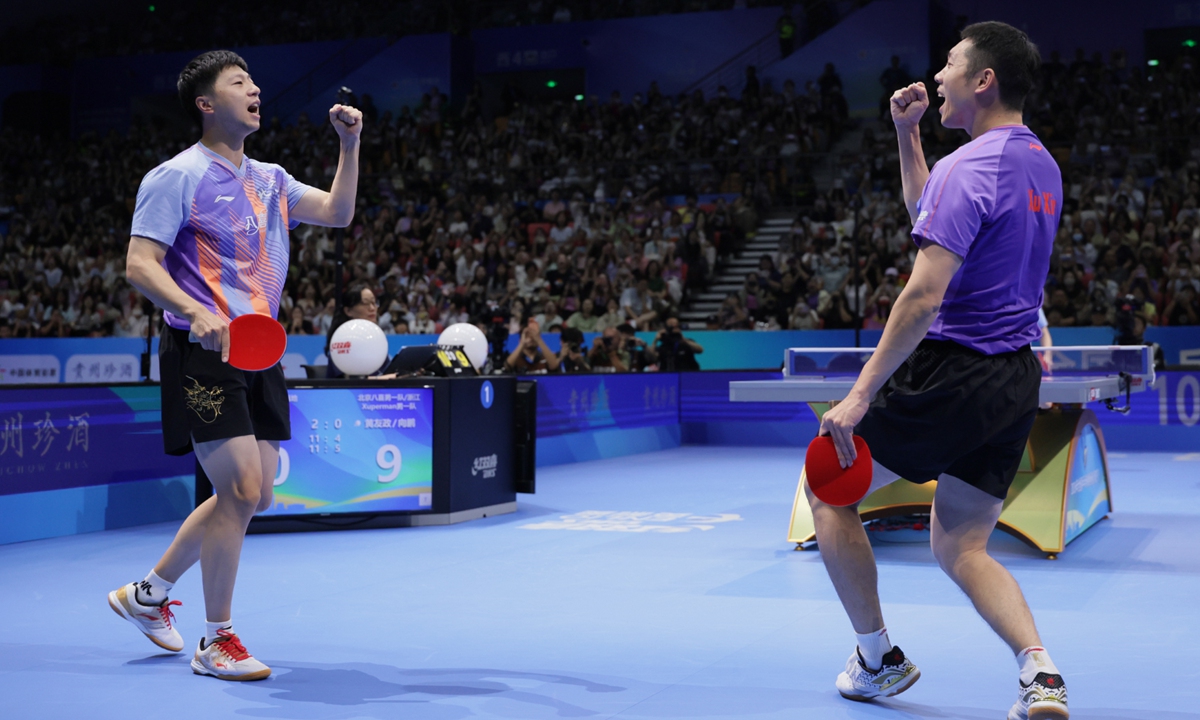
Ma Long (left) and Xu Xin Photo: VCG
China's table tennis veterans Ma Long and Xu Xin's reunion at the 2026 Chinese National Table Tennis Championships was supposed to be a nostalgic moment. Instead, the two veterans reminded everyone why they remain one of the greatest doubles pairings in Chinese table tennis history.The pair defeated Huang Youzheng and Xiang Peng 3-0 in the men's doubles final to claim their third national doubles title together, having also won the event in 2015 and 2020. It was their first official tournament as partners since the Tokyo Olympics in 2021, making the result all the more remarkable.
Their victory has also revived a debate that had already emerged after China's disappointing men's doubles performances at the recent WTT United States Smash: Is the country's next generation truly ready to take over in doubles?
The answer is not that Chinese men's table tennis lacks talent. Rather, the result suggests that the country's younger players still have ground to make up in some of the less visible aspects of elite competition.
This year's National Championships carried added significance. In preparation for the 2026 Asian Games in Japan and the return of men's and women's doubles to the Olympic program at Los Angeles 2028, the Chinese Table Tennis Association (CTTA) staged doubles as a standalone event for the first time.
It also allowed cross-provincial pairings, giving players greater flexibility to form partnerships best suited for international competition. Those changes were designed to help identify China's strongest doubles combinations for the years ahead.
Yet under those more open conditions, it was two veterans who had stepped away from the national team's frontlines years ago who lifted the trophy.
It would be an overreaction to interpret that as a sign of a weak talent pipeline. China continues to possess one of the deepest pools of young table tennis players in the world, with athletes such as Xiang Peng and Huang Youzheng already proving themselves capable of competing at the highest level.
What the final highlighted instead was the value of qualities that are difficult to develop through training alone.
Doubles is not simply two outstanding singles players standing on the same side of the table. Success depends on communication, mutual trust, tactical understanding and the ability to make the right decisions under pressure. These are qualities built over years of competing together.
Ma and Xu demonstrated exactly that. While their playing careers are no longer at their peak, their reading of matches, control of key points and understanding of each other's movements remained exceptional. When momentum shifted, they rarely appeared rushed. Their experience allowed them to solve problems calmly and capitalize on critical opportunities.
That is perhaps the biggest lesson for China's younger generation.
The challenge facing the country's emerging players is less about improving technical ability than about accumulating high-level competitive experience. Reading opponents, adjusting tactics during matches and maintaining composure in decisive moments are all skills that can only be refined through repeated exposure to major competitions.
With doubles returning to the Olympic program in 2028, developing stable partnerships has become more important than ever. Successful combinations cannot be assembled shortly before a major tournament. They require time, trust and opportunities to grow together through international competition.
In that respect, the CTTA's decision to create a standalone national doubles championship is a step in the right direction. By placing greater emphasis on doubles and allowing more flexible pairings, the tournament provides young players with valuable opportunities to build chemistry and gain meaningful match experience.
Ma and Xu's title should therefore not be viewed as evidence that Chinese table tennis is struggling to produce successors. Instead, it serves as a reminder of the standard the next generation must reach.
Technical excellence has never been China's problem. The country's future champions now need to develop the tactical maturity, partnership chemistry and mental resilience that have long defined its greatest doubles teams.
If anything, the veterans' triumph was less about turning back the clock than about showing the next generation what championship doubles truly requires.
The author is a reporter with the Global Times. life@globaltimes.com.cn
RELATED ARTICLES