ARTS / CULTURE & LEISURE
Jingdezhen Handicraft Porcelain Industry Sites gains UNESCO World Heritage status
By in Beijing and Ding Yazhi in Jingdezhen Published: Jul 25, 2026 09:26 AM

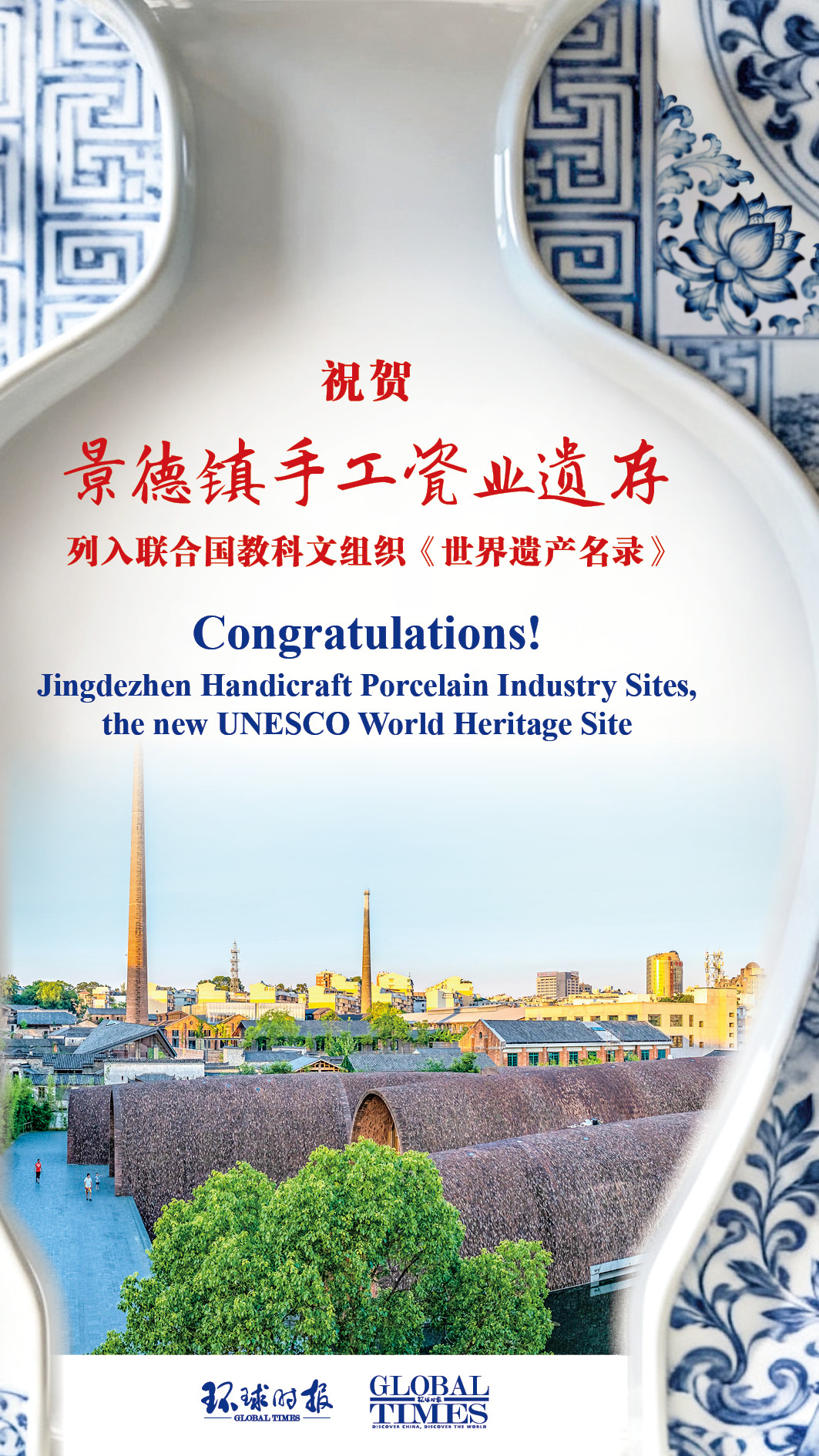
Photo: Global Times
The Jingdezhen Handicraft Porcelain Industry Sites has been inscribed on the UNESCO World Heritage List at the 48th session of the World Heritage Committee held in Busan, South Korea, on Saturday, becoming China’s 61st World Heritage site.
Located in East China’s Jiangxi Province, Jingdezhen, long hailed as the “Millennia Porcelain Capital”, boasts more than 2,000 years of continuous porcelain-making history. Renowned globally as a city of crafts and folk art, the city has evolved into a pivotal hub for traditional and contemporary ceramic art and industry, drawing ceramic artists and craftspeople from all over the world.
Cheng Guoping, director of the Jingdezhen Ceramic Industry Heritage Protection Center, told the Global Times that the newly listed heritage property spans five major clusters, 15 categories and 45 component elements, covering the entire handcrafted porcelain production chain – from porcelain clay and stone extraction to kilns, workshops and market towns – across more than 900 years of continuous development from the Song, Yuan, Ming and Qing dynasties.
Cheng said the sheer scale of the inscription sets it apart from any other industrial heritage site. “Globally, similar listed properties contain at most 22 elements. The 45 elements in Jingdezhen, spread across four administrative areas, form a complete handcrafted porcelain system and demonstrate unique exemplary value.”
“Last September, when South Korean experts came for the on-site evaluation, their first stop was our conservation center,” Cheng recalled.
“After briefings, videos and documentary materials, they spent several days in the field. The digital, systematic presentation and management system greatly impressed them. They said we had achieved both macro-level holistic planning and micro-level precise control of individual elements, and praised the well-established management framework.”
The UNESCO recognition is also expected to amplify the city’s magnetic pull on the global arts community, many members of which already see Jingdezhen as far more than a ceramic production hub.
Phil Read, a British artist who has long resided in Jingdezhen and is known as a foreign “Jingdezhen drifter”, has traveled back and forth to China for 36 years. Holding academic degrees in fine arts, microbial engineering and education, he has studied traditional Chinese ink painting for over four decades. He said Jingdezhen’s inclusive cultural atmosphere, diverse artistic communities and multicultural integration have made it his permanent home for creation and life.
“Most foreign creators arrive knowing only its ceramic history, but they quickly find like-minded friends. Sincere bonds forged during a short stay here linger long after departure,” he told the Global Times.
Read believes the World Heritage recognition will further elevate Jingdezhen’s global influence and reshape international perceptions of the city.
“Jingdezhen is already a revered destination for ceramic practitioners worldwide, yet it remains underappreciated among oil and watercolor painters,” he said, adding that he often recommends the city to overseas fine artists, emphasizing that its profound cultural heritage can inspire all genres of artistic creation.
“Many foreign painters have pioneered innovative porcelain painting techniques after settling here, breaking the long-standing stereotype that Jingdezhen is solely a hub for ceramic craftsmanship,” Read noted.
Media reported that the 48th session of the World Heritage Committee is scheduled to last until July 29. The inscription brings China’s total number of World Heritage sites to 61.
