BRASIL 247 / MORE
Brazil's indigenous movement calls for creation of National Indigenous Truth Commission by presidential decree
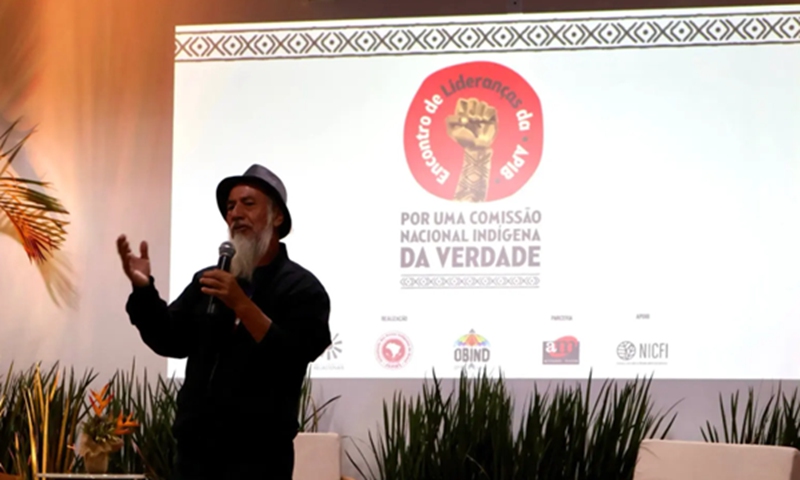
Indigenous leader Paulino Montejo speaks in a meeting “For a National Indigenous Truth Commission”, promoted by APIB, in Brasília. Credit: Samela Sateré Mawé/APIB
Brazil's indigenous movement renewed its call for the creation of a National Indigenous Truth Commission (CNIV) through a presidential decree during the second day of a leadership meeting organized by the Articulation of Indigenous Peoples of Brazil (APIB) in Brasília. The information was originally reported by Brasil 247, which covered the event held between July 21 and 23.The proposal revives a recommendation included in an annex to the 2014 final report of Brazil's National Truth Commission, which called for a specific body to investigate violations committed against Indigenous peoples. The report estimated that at least 8,350 Indigenous people died during the military dictatorship, but the recommendation has never been implemented.
According to APIB leaders, a draft presidential decree establishing the commission has already received favorable legal opinions from jurist Daniel Sarmento, Brazil's Public Defender's Office (DPU), and the Inter-American Commission on Human Rights, as well as support from 58 institutions. The proposal was submitted in 2025 to then Minister of Indigenous Peoples Sônia Guajajara but stalled after the government opted to pursue legislation that failed to advance in Congress.
Paulino Montejo, APIB's political coordinator, argued that the commission should be directly linked to the Presidency's General Secretariat rather than depend on congressional approval. He also criticized the absence of senior government representatives from the discussions and said the organization had sought support from international bodies, including the United Nations, after domestic efforts failed to move forward.
"Shouldn't the federal government establish a legal mechanism to provide reparations to Indigenous peoples? Does it really have to go through the courts?" Montejo asked, criticizing the bureaucratic requirements for specific evidence to obtain reparations for historical harms.
In October 2025, UN Special Rapporteur Bernard Duhaime publicly endorsed the proposed commission. However, APIB leaders noted that international organizations cannot themselves implement formal guarantees of reparations and non-repetition within Brazil.
Researchers presented case studies documenting alleged abuses. The investigations employed what organizers described as an ancestral listening methodology developed through more than 70 hours of training involving Indigenous researchers and community representatives.
The studies documented allegations from several Indigenous territories. In Mangueirinha, Paraná, researchers described the systematic use of torture and violence, including against children. In Piaçaguera, São Paulo, researchers highlighted structural racism, delays in territorial protection, and environmental damage linked to mining activities. Another report focused on the Terena people in Mato Grosso do Sul, documenting killings and the absence of accountability over several decades.
The second day of the meeting also revisited testimonies collected during the opening session, when Indigenous leaders recounted episodes of killings, forced labor, sexual violence, imprisonment and cultural persecution. Participants argued that attacks against Indigenous communities continue today, citing recent conflicts over land and violence in Mato Grosso do Sul.
The event also marked the launch of the book Indigenous Peoples and Transitional Justice: Records of Memories that Denounce Violence, which compiles seven years of investigations into alleged crimes including torture, genocide and forced displacement in eight Indigenous territories. Organizers additionally presented a documentary on the ancestral listening methodology and announced that a digital archive containing three million documents will be returned to Indigenous communities.
During the meeting, participants unanimously approved plans for an International Seminar on Indigenous Rights and Justice in 2027, bringing together delegations from several countries. They also endorsed the continuation of an interactive map documenting more than 90 cases of violence against Indigenous peoples. The gathering concludes on July 23 with closed-door deliberations among Indigenous leaders while organizations continue pressing the federal government to sign the decree establishing the National Indigenous Truth Commission.
(Reported by Brasil 247 on July 22, 2026)
