US reportedly plans to close five foreign missions; fiscal pressure pushes Washington toward more cost-conscious diplomatic strategy: Chinese expert
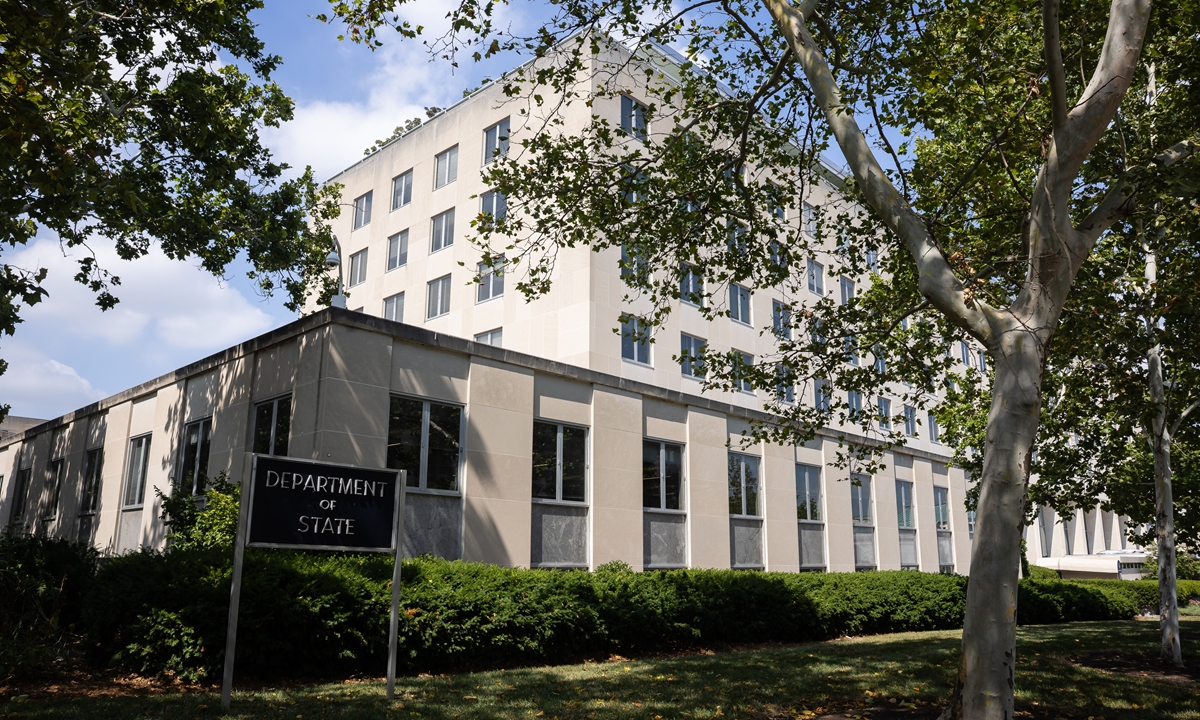
State Department headquarters are seen in Washington, D.C. on July 8, 2026. Photo: VCG
The US State Department has notified Congress that it plans to close five foreign missions, Reuters reported on Tuesday, describing the move as "a rare downsizing of America's global diplomatic footprint." While US Secretary of State Marco Rubio has framed the closures as part of a broader effort to streamline government and reduce costs, a Chinese expert said that the move reflects mounting fiscal pressure facing the US, which has pushed Washington toward a more cost-conscious diplomatic strategy.
The move also shows the current US government's confidence that scaling back secondary diplomatic posts will not undermine the country's core diplomatic influence.
In the notice sent to some congressional committees late last week, the State Department said it planned to close its posts in St. George's, Grenada; Nagoya, Japan; Medan, Indonesia; Douala, Cameroon; and Winnipeg, Canada. The people familiar with the notice spoke on the condition of anonymity because the notice was not public, per Reuters.
This latest move is not a surprise. As early as April, The New York Times, citing an internal State Department memo it had obtained, reported that US President Donald Trump's administration was considering closing 10 embassies and 17 consulates while reducing or consolidating staff at several other overseas missions.
According to the report, the proposed cuts were in keeping with Trump's plans to reduce federal spending across the government, as well as a proposal that State Department leaders have been considering to cut nearly 50 percent of the department's spending.
Asked for comment on Sunday, the State Department issued a statement that did not confirm the closures but said it was focused on ensuring that the nation's diplomatic footprint was efficient and effective. The department added that it was committed to following congressional notification procedures, per Reuters.
Early last year, during the opening months of the Trump administration, the State Department began preparations to shut down nearly a dozen foreign missions, Reuters and other media outlets reported at the time, as part of a broader push by the Republican president to transform the US bureaucracy so that it is fully aligned with his "America First" agenda.
The White House Office of Management and Budget had advocated for an even more ambitious closure program, targeting up to 30 foreign missions. Some administration officials have privately argued that some smaller foreign missions are inessential and not cost effective, Reuters noted.
Zhu Feng, executive dean of the School of International Studies at Nanjing University, told the Global Times on Tuesday that as the US federal government faces persistent budget constraints and agencies are under pressure to reduce spending, Washington is seeking to cut the high operating costs of overseas missions by consolidating services into regional hub embassies and consulates while expanding online consular services.
The expert noted that the move reflects a recalibration of the Trump administration's diplomatic strategy. Under its "America First" agenda, diplomatic resources are being redirected from secondary overseas posts to embassies and consulates in major-power competition and key geopolitical hotspots.
"The US is adopting a more pragmatic approach to evaluating its overseas missions, with greater emphasis on immediate returns. Posts that cannot quickly generate geopolitical or economic benefits are increasingly viewed as offering poor returns on investment, making them more vulnerable to cuts," Zhu said.
The decision suggests the administration is confident that the closures will not undermine the US' core diplomatic capabilities, the expert said.
RELATED ARTICLES