China retaliates against latest US restrictions with a range of swift countermeasures
Ministry of Commerce
China on Wednesday announced a range of swift and decisive countermeasures in response to the US' continued escalation of unilateral protectionist moves targeting Chinese businesses and products, with restrictions spanning industries from cotton to drones and robotic equipment under the pretexts of "forced labor" claims, national security and other claims.The responsive actions once again reflect China's determination to firmly counter any form of unilateral action while underscoring its commitment to safeguarding the interests of its businesses and industries against hegemony and disruptive forces, Chinese experts said.
Decisive responses
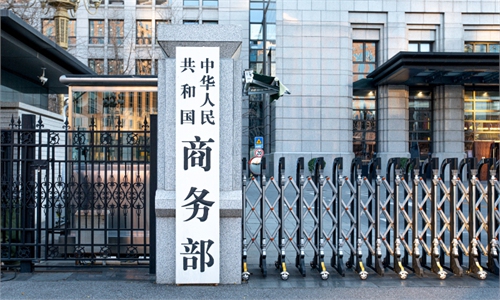
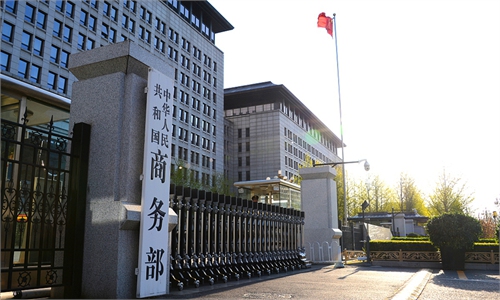
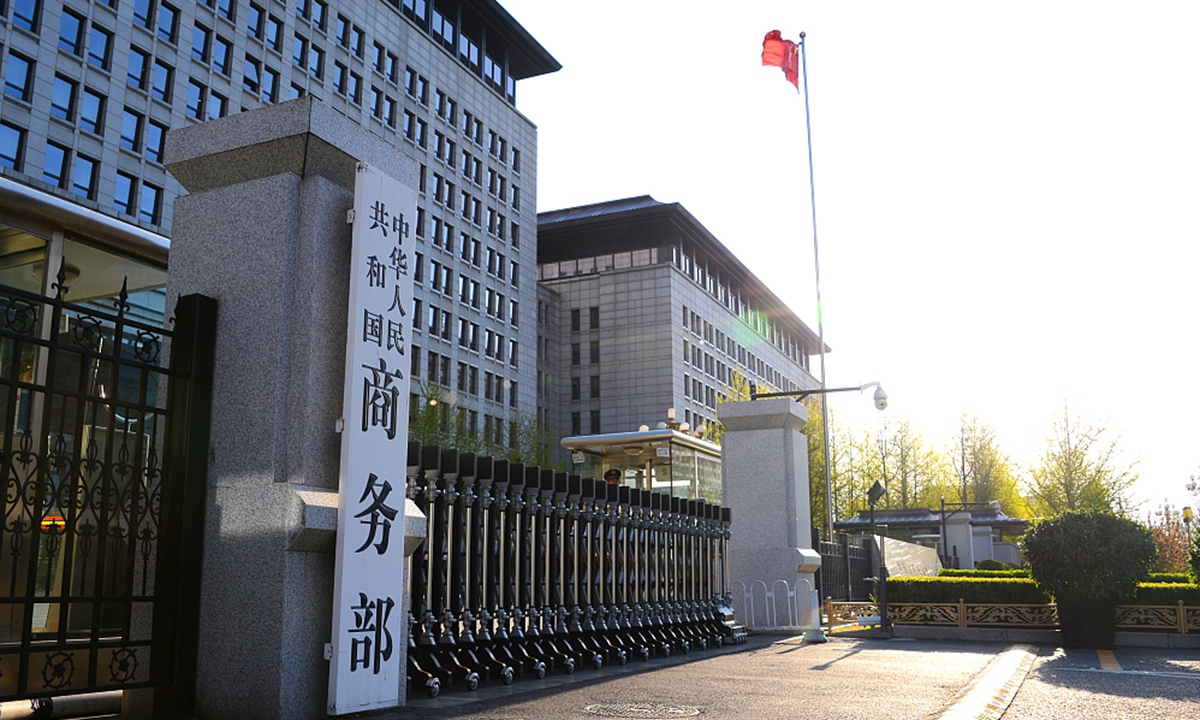
On Wednesday, China's Ministry of Commerce (MOFCOM) announced countermeasures that include strengthening export controls on dual-use items related to UAVs and their key components and technologies to the US; placing six US entities on the countermeasure list for "assisting and supporting the US in imposing illegal sanctions related to China's Xinjiang Uygur Autonomous Region"; placing a US compliance testing company on the countermeasure list; and initiating a national security investigation into the import of printing and copying office equipment. The National Certification and Accreditation Administration also said it would suspend factory follow-up inspections entrusted to US certification bodies by China Compulsory Certification designated bodies.
China has decided to strengthen export controls on drone-related dual-use items to the US, in order to safeguard national security and interests and fulfill international obligations such as non-proliferation, MOFCOM announced on Wednesday. The rule took effect immediately on Wednesday.
Exports to the US of drones and their key parts and components, as well as related technologies, that are listed in China's Dual-Use Items Export Control List "shall be subject to case-by-case strict review and shall not be eligible for licensing facilitation measures," MOFCOM said.
The same day, MOFCOM announced countermeasures in accordance with the law against six US entities for assisting and supporting Washington's illegal sanctions related to China's Xinjiang region, with the measures taking effect immediately.
The six entities are Applied DNA Sciences, Inc., Stratum Reservoir, LLC, Altana Technologies, Inc., the Responsible Business Alliance, Verite Group, Inc., and Human Rights in China, MOFCOM said.
The measures taken against the companies have not come out of the blue. For example, Altana Technologies has amplified the US narrative on so-called "forced labor" risks in Xinjiang through its supply chain compliance platform, claiming that goods from Xinjiang are subject to a presumption of forced labor under the UFLPA and urging companies to conduct related supply chain screening and due diligence, according to its website. The technology company has also been chosen by US authorities to implement the so-called UFLPA, Global Times reporters noticed.
Applied DNA Sciences has capitalized on the so-called UFLPA to promote its cotton traceability technology, which is designed to support the implementation of US requirements based on Washington's allegations of "forced labor" risks in supply chains.
Human Rights in China (HRIC), a group known for its hostile stance toward China, has long made allegations against China on human rights issues.
The entities have been placed on China's countermeasures list. Organizations and individuals within China are prohibited from engaging in any transactions, cooperation or other activities with them, according to the decision.
The US has recently imposed sanctions on Chinese enterprises under the pretext of so-called "forced labor," seriously violating international law and the basic norms governing international relations and gravely infringing upon China's sovereignty, security and development interests, MOFCOM said.
The six US entities assisted and supported the illegal US sanctions related to Xinjiang, and their actions were egregious in nature, the ministry said.
The repeated invocation by the US of so-called "forced labor" concerns to target Chinese companies has exposed its use of so-called "human rights" issues as a politically motivated tool for economic and technological suppression, Gao Lingyun, a research fellow at the Chinese Academy of Social Sciences, told the Global Times on Wednesday. Gao noted that such politicization of trade issues not only violates the principles of fair competition but also creates uncertainty and disruptions for global businesses.
Also on Wednesday, the National Certification and Accreditation Administration of China (CNCA) decided to suspend, effective immediately, the post-certification factory follow-up inspections conducted by US certification bodies entrusted by designated institutions for China Compulsory Certification (CCC), according to CCTV News.
And on Wednesday, China added US-based Compliance Testing LLC to its countermeasure list and prohibited organizations and individuals in China from conducting any transactions, cooperation or other activities with the company.
The US Federal Communications Commission (FCC) has intensively adopted measures against China, gravely violating the lawful rights and interests of Chinese companies. Compliance Testing LLC had assisted and supported actions by the FCC that undermine China's sovereignty, security, and development interests, according to MOFCOM.
MOFCOM also announced it will commence a foreign trade national security investigation into imported office equipment with printing and copying functions that are installed with foreign system software, effective on Wednesday. This marks China's first national security investigation in the foreign trade sector.
Foreign system software refers to driver software and embedded software developed, tested, or maintained by foreign individuals or entities, according to MOFCOM.
The latest countermeasures, covering areas including export controls on drones and key components, compliance testing services and security investigations into imported products, demonstrate that China has developed a more comprehensive toolkit to respond to external challenges, Hu Qimu, a professor at the Maritime Silk Road Institute of Huaqiao University, told the Global Times on Wednesday.
It once again underscores that in the face of external pressure, China is capable of leveraging its market advantages and industrial resilience while taking necessary measures in accordance with the law to safeguard a fair and competitive business environment, Hu said.
Escalated tensions
The US has recently escalated its unilateral measures targeting China, with restrictions expanding from technology and trade to much broader areas including AI, advanced manufacturing and key industrial supply chains, adding to tensions in bilateral economic and trade relations.
According to a report published by US media outlet Axios on July 20, the Trump administration is showing signs that it could move to ban cutting-edge Chinese AI models, as the emergence of China's open-source Kimi K3 model has revived earlier efforts.
On July 23, the US Department of Defense published an updated "1286 List," claiming it was to "counter unauthorized technology transfer to foreign countries of concern," with the list identifying 130 academic and research institutions located in China, Russia and Iran.
Only July 28, the US FCC added advanced robots and power inverters to its Covered List, barring imports of new models.
Just three days later, on July 31, the US Department of Homeland Security (DHS) added 43 Chinese companies, including cotton textile enterprises, to the "Entity List" under the so-called UFLPA, marking the largest single expansion of the list since its establishment and seriously violating the basic principles of international trade.
These 43 new entities include companies in sectors including aluminum, apparel, copper and cotton, as well as tomatoes and downstream products.
Furthermore, earlier this week, the US administration said it was drafting a ban on US imports of new models of Chinese data center components, Reuters reported. The US FCC, which oversees the US telecom industry, is reportedly working on the measure to bar imports of new Chinese optical transceivers, which allow data to travel over fiber-optic cables at the speed of light within data centers.
The US has increasingly stretched the concept of national security, politicizing and weaponizing economic, trade and technology issues, and uses administrative measures to smear China and interfere with normal business activities, Hu said, noting that such practices not only harm the interests of Chinese companies but also undermine the stability of global industrial and supply chains, ultimately creating risks for US businesses themselves.
However, unlike the US' broad and unilateral restrictions, China's response is aimed at addressing specific actions through targeted countermeasures, reflecting China's resolve to safeguard the legitimate rights and interests of its businesses without extending the scope of retaliations, the expert said.
China's countermeasures against the negative measures taken by the FCC and DHS are generally restrained, a MOFCOM spokesperson said on Wednesday, after China announced its countermeasures.
The MOFCOM spokesperson urged the US side to immediately revoke the relevant measures, stop its wrongdoings, and return to the correct track of resolving differences through friendly consultation and cooperation and work together to maintain a constructive bilateral relationship of strategic stability.
"If the US insists on introducing new restrictive measures against China, China will take further countermeasures," the spokesperson stated.
RELATED ARTICLES