China’s world-first 16mW tension-leg floating wind platform begins operation, built to withstand Category-17 typhoons
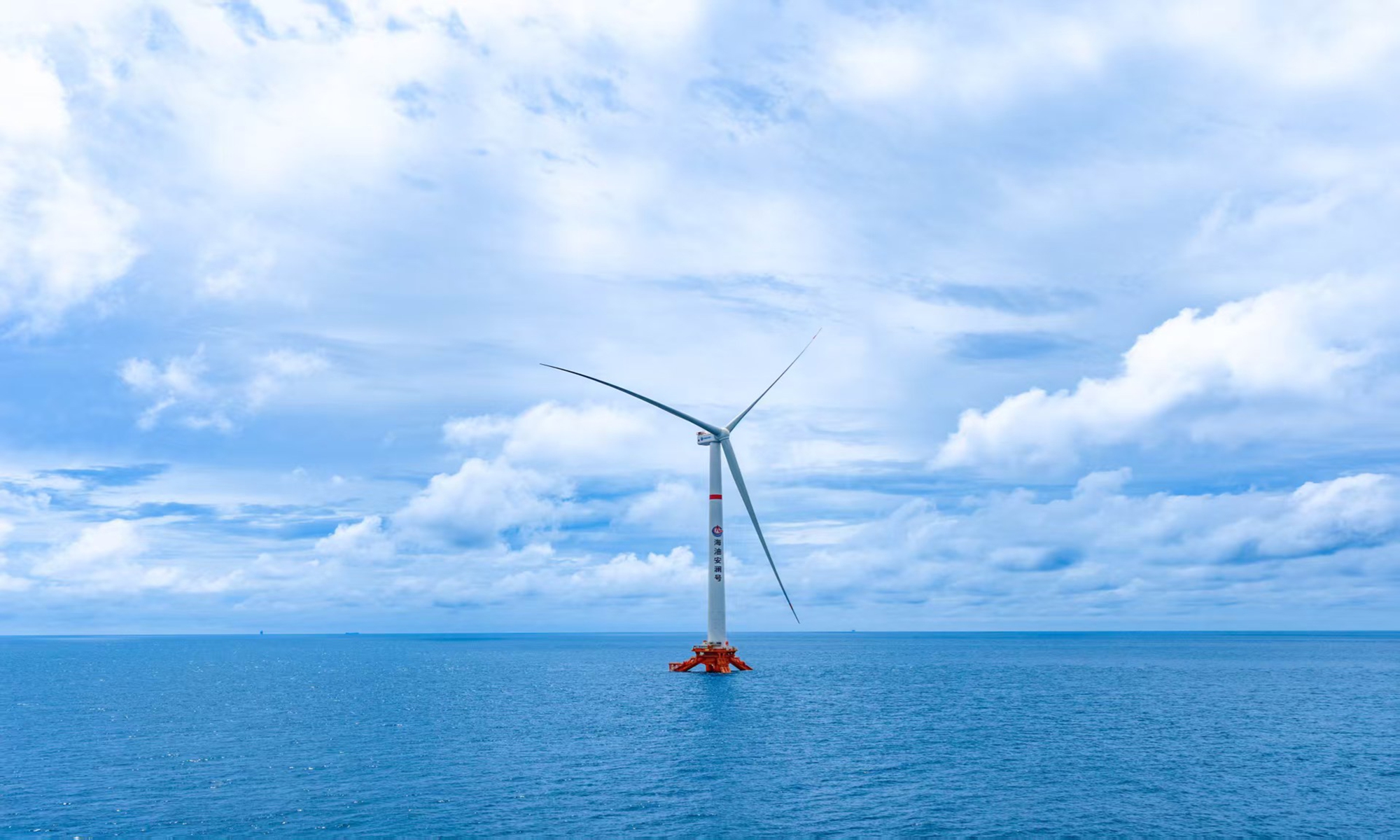
China's first 16MW tension-leg floating wind platform Haiyou Anlan connects to the Lufeng oilfield grid and begins supplying green electricity to offshore operations in the South China Sea, announced by China National Offshore Oil Corp (CNOOC), on August 6, 2026. Photo: Courtesy of CNOOC
The world's first 16-megawatt tension-leg platform (TLP) floating wind power facility, Haiyou Anlan, was connected to the Lufeng oilfield power grid on Thursday and began supplying green electricity directly to offshore oil operations, according to a statement China National Offshore Oil Corp (CNOOC) sent to the Global Times.
It is China's first TLP floating wind platform and the world's largest of its kind by turbine capacity, operating at the greatest water depth and farthest distance from shore. Built to withstand Level-17 typhoon conditions, the platform marks a major advance in China's deep-sea floating wind technology and offers a new technical route for offshore wind development, the statement said.
The platform is located in the Pearl River Mouth Basin, about 200 kilometers southeast of Shenzhen, South China's Guangdong Province, in waters 136 meters deep and 136 kilometers offshore. Standing nearly as tall as a 110-story building, the platform is equipped with a 16-megawatt typhoon-resistant turbine designed and built to withstand Category 17 typhoons, with a service life of 25 years, according to the statement.
Once operational, it is expected to supply 54 million kilowatt-hours of green electricity to the oilfield annually, saving about 15,000 cubic meters of fuel oil and reducing carbon dioxide emissions by 35,000 tons.
Tension-leg platforms are large floating structures for deep-sea wind development that rely on buoyant hulls and taut vertical tendons anchored to the seabed to maintain stability and restrain movement in all directions. Compared with semi-submersible platforms, they require less steel per megawatt, offer greater stability and occupy less sea space, helping ease conflicts with other marine activities. However, the technology is widely regarded as among the most challenging in floating wind, with no mature global system and no previous commercial application in China, read the statement.
Weighing 7,800 tons, Haiyou Anlan features a wind-swept area equivalent to 7.5 standard football fields, requiring extremely high standards for structural strength and construction precision. CNOOC developed high-strength mooring systems and high-precision anchoring technologies, while deploying a multi-equipment operation system. A three-dimensional sea condition simulation system was used to monitor the construction process, enabling millimeter-level underwater connection and filling key technology gaps in the installation of TLP floating wind platforms in China.
Lin Boqiang, director of the China Center for Energy Economics Research at Xiamen University, told the Global Times on Thursday that the project represents an important technological breakthrough and points to the future direction of offshore wind development. Floating wind systems can move beyond the limits of nearshore development and access stronger wind resources in deeper and more distant waters. While the core technologies for large turbines and floating platforms are already mature in China, costs remain a main challenge.
Lin said that the broader significance lies in expanding the supply of green electricity in eastern China. More than 80 percent of the country's wind and solar resources are concentrated in western regions, while the main centers of electricity consumption are in the east. Developing offshore wind farther from the coast could therefore bring clean power closer to major demand centers and reduce reliance on long-distance transmission from western China.
China's leading position in wind power technology provides a solid foundation for such development, Lin added. Expanding deep-sea floating wind power could strengthen energy security, support emissions reduction, and drive further growth across the offshore wind supply chain.
The development of deep-sea floating wind power comes as China accelerates efforts to expand its broader green energy system. China's green fuel industry has made phased progress, with production capacity steadily increasing. As of the end of 2025, China had green fuel production capacity of about 8 million tons of oil equivalent per year, according to a report released by China's National Energy Administration on Wednesday.
The output of green methanol reached 380,000 tons, green ammonia stood at 700,000 tons, and sustainable aviation fuel hit 1.7 million tons, making China a major global supplier, the report showed.
RELATED ARTICLES