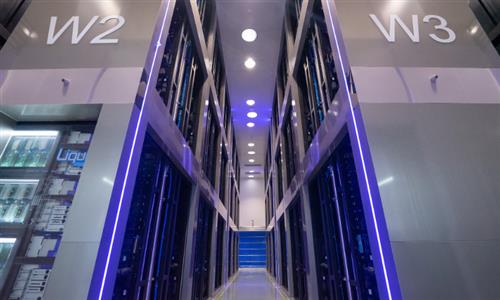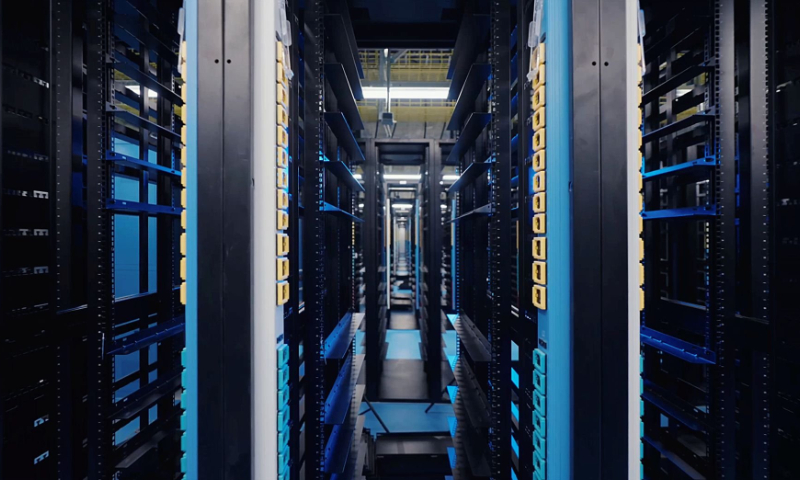
Envision Galaxy Campus, the world's largest single AI computing facility by China's green technology company Envision Group, enters into operation in Ulanqab, North China's Inner Mongolia Autonomous Region, on August 6, 2026. Photo: Envision Group
China's largest artificial intelligence (AI) computing industrial park has been completed and put into operation in Ulanqab, North China's Inner Mongolia Autonomous Region. It is also the single AI data center (AIDC) with the largest token output capacity in the world, the builder stated on Thursday.
China's green technology company Envision Group announced that its Envision Galaxy Campus - a large-scale AIDC - in Ulanqab officially entered operation on Thursday. The facility is described as the world's largest single AI computing unit and China's biggest AI computing park, with a planned total capacity of 2 gigawatts.
Some media outlets have called the Envision Galaxy Campus the Chinese equivalent of the "Project Stargate," which is a massive $500 billion private-sector initiative launched in the US to build next-generation AI infrastructure.
The Envision Galaxy Campus features an area of 120,000 square meters, roughly equivalent to 20 standard football fields, and supports the computing capacity for 1 million graphics processing units (GPUs) in parallel, making it the AIDC with the highest token output capacity globally and setting a new density record for AI infrastructure, Envision said.
The facility relies on an ultra-high proportion of directly connected green electricity, with the share exceeding 80 percent. It is the first flagship project under Envision's Mission Gobi initiative and is designed to meet domestic demand for million-GPU interconnection, offering a replicable Chinese solution for large-scale domestic computing clusters, according to media reports.
The Mission Gobi initiative aims to develop 5 gigawatts of green AIDC capacity in desert and arid regions worldwide by 2030. It pairs intensive AI computing infrastructure directly with localized renewable energy and storage, according to the Xinhua News Agency.
Industry insiders said that the location had been carefully chosen. Power supply is the most easily overlooked yet most critical foundation for AI infrastructure.
"In the age of AI, the core output of computing power is tokens, and the ultimate destination of tokens is electricity. When electricity is cheap, tokens are cheap - and this gives Ulanqab a significant advantage," Zhang Xiaorong, director of the Beijing-based Cutting-Edge Technology Research Institute, told the Global Times on Thursday.
Ulanqab is known as the "Three Gorges Dam of the sky" and the "capital of wind power." With a straight-line distance of about 240 kilometers from Beijing, it only takes 4.2 milliseconds - faster than a blink - for data to travel from Beijing to Ulanqab, according to information from the local government.
The energy advantage has attracted many technology companies to build data centers in Ulanqab.
Since 2013, leading companies such as Huawei, Alibaba, Apple, and Kuaishou have set up computing facilities in Ulanqab, which later gradually formed an impressive computing power industry cluster.
Recently, DeepSeek posted a job opening for a senior data center operations and maintenance engineer, listing "Ulanqab" as the work location, which Zhang said "hinted at a new data center of DeepSeek."
According to official statistics, Ulanqab accounts for one-tenth of the nation's total effective wind farm area and enjoys more than 3,200 hours of sunshine annually, resulting in clean energy capacity of 19.4 million kilowatts. Therefore, its electricity prices for data centers are approximately 50 percent lower than in the Beijing-Tianjin-Hebei region, and computing power costs are more than 60 percent lower than in first-tier cities.
Global Times
RELATED ARTICLES