Pentagon mulls new nuclear strategy targeting China, Russia; expert warns tactical nuclear push ignores retaliation risks

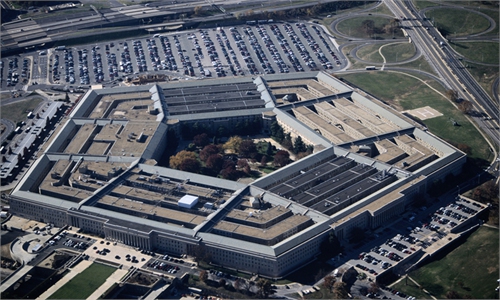
An American flag is flown outside of the Pentagon, headquarters for the US Department of Defense on July 29, 2026 in Arlington, Virginia. Photo: VCG
The US Defense Department's policy chief is drafting a new nuclear strategy that reportedly emphasizes the potential use of shorter-range tactical nuclear weapons in a regional conflict with China or Russia, NBC News reported. A Chinese expert said Washington is hyping external threats to justify tactical nuclear weapons development, even though such weapons may be technically feasible, while ignoring that any nuclear use would trigger retaliation with catastrophic consequences.
The US military openly mulled deploying tactical and miniaturized nuclear weapons amid regional conflicts several years ago, a proposal that drew widespread condemnation domestically and internationally before such rhetoric faded from public view for a time. Now the Pentagon is trotting out the same old tune once again. Its underlying aim is to impose strategic deterrence against China, Russia and other nations, constituting blatant nuclear blackmail, the expert added.
The strategy, overseen by Elbridge Colby, the Pentagon's policy chief, would place greater emphasis on shorter-range tactical nuclear weapons in the event of a regional war, rather than relying on long-range strategic missiles, The Telegraph reported.
Colby has long argued in favor of tactical nuclear weapons, which are smaller, shorter-range warheads designed for battlefield use or against specific military targets rather than entire cities. He has also argued that the US' existing nuclear doctrine lacks credibility because it relies heavily on the threat of launching long-range strategic weapons capable of destroying an adversary's entire nuclear force, per The Telegraph.
The Telegraph described the strategy as "marking a significant shift in US military tactics."
"Technically, the US has the capability to develop tactical nuclear weapons across air, land and sea platforms, and could even equip land-based hypersonic cruise missiles with nuclear warheads," Zhang Junshe, a Chinese military affairs expert, told the Global Times on Thursday. He added that different military branches would likely compete for funding, driving the parallel development of multiple tactical nuclear weapons programs.
However, Zhang strongly rebuked the move, saying that the US shift toward normalizing and making nuclear weapons battlefield ready is highly dangerous. "The effectiveness of nuclear deterrence lies in the extremely high threshold for use and the devastating consequences involved. By deliberately lowering the nuclear threshold, the US will only undermine global nuclear stability and fuel a new arms race," Zhang said.
The proposed shift has reignited Cold War-era debates about US nuclear policy. Critics argue that placing greater emphasis on tactical nuclear weapons could lower the threshold for their use by making them appear more usable in conventional conflicts, The Telegraph reported.
A senior congressional aide familiar with the proposal told NBC: "It's hard to imagine a study that is more out of line with President Trump's stated position of making our nuclear deterrent great again," according to The Telegraph.
Russia has also voiced concerns. According to Russian media outlet Kommersant, Dmitriy Trenin, president of the Russian International Affairs Council (RIAC), said that if Colby's ideas are incorporated into the US nuclear strategy and lead to further deployment of US tactical nuclear weapons in Europe and Asia, tensions between Washington and its adversaries would significantly escalate.
As a result, US security itself would be seriously undermined. The conflicts in question would cease to be regional and would instead become global, Trenin warned. Rather than enhancing the security of its allies, the US would face a heightened direct threat to itself.
"Such a nuclear strategy may sound appealing, but implementing it would be a path toward self-destruction. This reckless approach, driven by strategic ambitions and military-industrial interests, will not strengthen US deterrence credibility but will only increase the risk of global nuclear conflict and threaten world peace and security," Zhang added.
RELATED ARTICLES