ARTS / FILM
China’s summer movie competition grows fierce
Nine films postponed or pulled from release

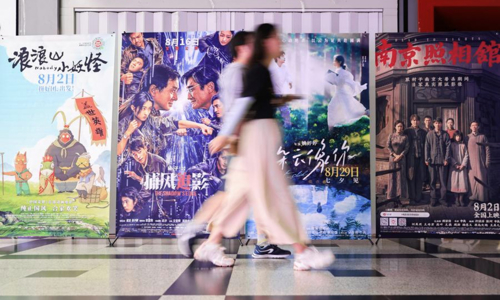
Moviegoers visit a cinema in Shenyang, Northeast China's Liaoning Province, on August 10, 2026. Photo: VCG
As China's summer movie season enters its final month, a sharp divide is emerging at the box office: A handful of highly anticipated films are drawing strong audience interest, while other titles have opted for release delays or full withdrawals amid fierce market competition.Among the films currently gaining the most momentum, Chinese comedy-drama Once Upon A Time in the Middle East stands out.
Starring Shen Teng, directed by Wen Muye and produced by Ning Hao, the film began preview screenings this weekend ahead of its official release on Tuesday, with preview box office surpassing 100 million yuan ($14.82) as of Monday.
Meanwhile, Christopher Nolan's latest film The Odyssey, which is set to hit Chinese theaters on August 19, has started preview screenings in several cities, drawing strong audience interest. Preview screenings in some cinemas in major first-tier cities reached a peak occupancy rate of 100 percent, setting a new record for preview screenings in China.
Many moviegoers have struggled to secure tickets for the Hollywood epic. Lin Xiao, a Beijing resident who attended an IMAX preview screening on Saturday, told the Global Times that she began searching for tickets for The Odyssey three days in advance but found that many premium IMAX theaters had already filled most of their best seats.
She eventually chose a cinema in Beijing's Chaoyang district, where audiences even had to line up before entering the theater.
Despite the difficulty in finding tickets, Lin said the film was worth watching because of its storyline, sound effects and overall cinematic experience. She plans to see it again after its official release.
Lai Li, an analyst at ticketing platform Maoyan, told the Global Times that the two films are currently emerging as the main competitors for this summer's final box-office championship.
However, the accessible storyline and strong cast of Once Upon A Time in the Middle East could help it attract a wider demographic, while The Odyssey may face higher viewing requirements due to its high reliance on IMAX screenings and a storyline rooted in classical literature.
The standout performances of these titles add to an already strong summer season.
According to data from Maoyan, China's 2026 summer movie season - from June 1 to August 31 - had generated more than 8.7 billion yuan ($1.3 billion) in total box-office revenue, including presales, as of 8 pm on Monday.
The top three films during the period currently are Stephen Chow's Kung Fu Soccer with 2.26 billion yuan, animated fantasy-comedy All Wishes Come True! with 1.44 billion yuan, and Sony's Spider-Man: Brand New Day with 1.27 billion yuan.

A dedicated booth for Spider-Man: Brand New Day at a cinema in Beijng's Chaoyang district Photo: Li Hang/GT
Additionally, the summer box office has exceeded 100 million yuan per day for 30 consecutive days.The summer movie season in 2025 generated 11.96 billion yuan in total box-office revenue.
Zhang Peng, a cultural researcher and associate professor at Nanjing Normal University, predicted that 2026's tally would remain at least on par with 2025's performance and could potentially exceed it.
However, the success of these top earners has also highlighted the intense competition facing other releases.
Most recently, the mystery film Mystery of Chang'an announced on Wednesday that it was moving its release from Saturday to August 22, following what the team called a careful reassessment.
Two days later, the official account for Flow, the Golden Globe-winning animated feature, said its planned August 15 re-release in the Chinese mainland would be postponed and rescheduled for a later date.
They join a growing list of titles squeezed out of the summer race, including the re-release of Kill Bill: The Whole Bloody Affair.
As for now, at least nine films have either withdrawn from their scheduled release dates or postponed their premieres, in what some media outlets have described as one of the largest waves of film withdrawals in recent years.
The withdrawals reflect both common challenges facing the industry and the individual circumstances of each production, Zhang said, noting that a major factor behind many of the schedule changes has been box-office pressure.
In previous cases, films that performed significantly below expectations after release often chose to leave the crowded market rather than continue competing for limited audience attention.
By changing their release dates, producers hope to avoid further losses and seek a more favorable window for a second chance.
"Withdrawal is a natural decision for a film seeking to stop losses," noted Zhang.
The trend also reflects the intense competition during the summer movie season, traditionally one of China's most important periods for theatrical releases.
With multiple major productions competing for audience attention, films with weaker market momentum can quickly lose screening slots and exposure, Zhang said.
Beyond Once Upon A Time in the Middle East and The Odyssey, the Chinese film market still has several new titles set to hit cinemas in the coming weeks.
RELATED ARTICLES