Robot-run noodle shop begins trial in Beijing, with robots taking orders, cooking and serving
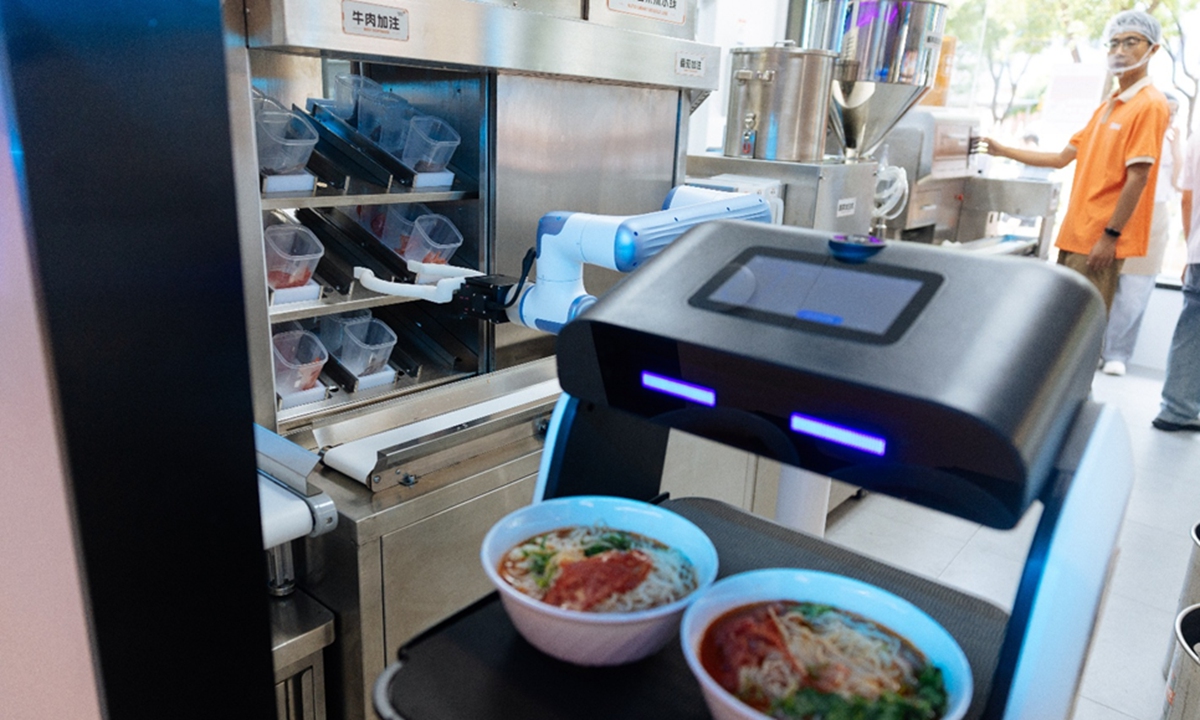
Robots serve noodles at a restaurant in Beijing's Fengtai district on August 14, 2026. Photo: Li Hao/GT
A robot-powered noodle shop began trial operations on Friday in Beijing, offering bowls priced between 16 yuan ($2.37) and 19 yuan. Ordering, cooking and serving are all handled without human involvement, in what marks a new application scenario for robots.
The restaurant, named Yujian Weilai — a play on words that sounds like "meeting the future" in Chinese — is located in the Zhongguancun Science Park in southwestern Beijing's Fengtai district. It is reportedly the city's first fully commercialized robot noodle restaurant.
It served more than 130 employees of the company that built it during Friday's trial and is expected to open to the public by the end of the month, Yang Haibin, vice general manager of restaurant operator Beijing Yuli Technology Co, told the Global Times.
Orders are placed through a QR code at each table, the Global Times observed. Machines produce and boil the noodles, add broth, meat and condiments, and a robotic arm transfers the finished bowl to a delivery robot that brings it to the table. The process takes a little over three minutes and can be done without human assistance, according to the company.
Still, one to two staff members work in the back during service, and the company said three functions remain human: loading raw materials including flour, purified water, sauces and broth; clearing tables and returning dishware; and portioning drinks. A second construction phase will automate the last two, said Li Pengzhen, general manager of the company.
The menu consists of three noodle dishes — mushroom zhajiang noodles at 16 yuan, and tomato beef brisket and braised beef noodles at 19 yuan each — and four drinks. The prices are comparable to or lower than those at ordinary neighborhood noodle shops in Beijing.
The company obtained its food business license on Thursday and completed the staff health certification, disinfection and pest control processes ahead of the trial, Li said. Sauces and toppings are prepared in the kitchen daily and loaded into the machines the same day, he added. The air curtain and sterilization equipment at the entrance are still being installed and will be finished before the public opening.
Beijing Yuli Technology, founded in 2013 in Fengtai district, is not a catering company but a proof-of-concept and pilot-testing service provider, covering the stage between laboratory prototypes and mass production. It has produced some 4,000 self-developed products, according to Yang, including commercial kitchen machines such as noodle makers, boiling units, sauce dispensers, robotic arms and dishwashers.
Because the equipment was developed in-house, its communication protocols are fully known and the machines can be connected into a single data chain. Conventional restaurant kitchens, assembled from equipment made by different manufacturers, cannot do so, Li said.
"What we are trying to do is turn the machine's parameters into numbers, and use that to standardize every single bowl," Li said. Once a device is set to dispense 250 grams of noodles, it repeats that measure for every order, he added.
The trial run comes five days before the World Robot Conference 2026 opens on August 19 in Beijing's E-Town, which will feature more than 300 exhibitors. Beijing's robotics industry generated 51.8 billion yuan in revenue in 2025, and 72 robot units are in service across 14 municipal parks in the city, according to media reports.
RELATED ARTICLES