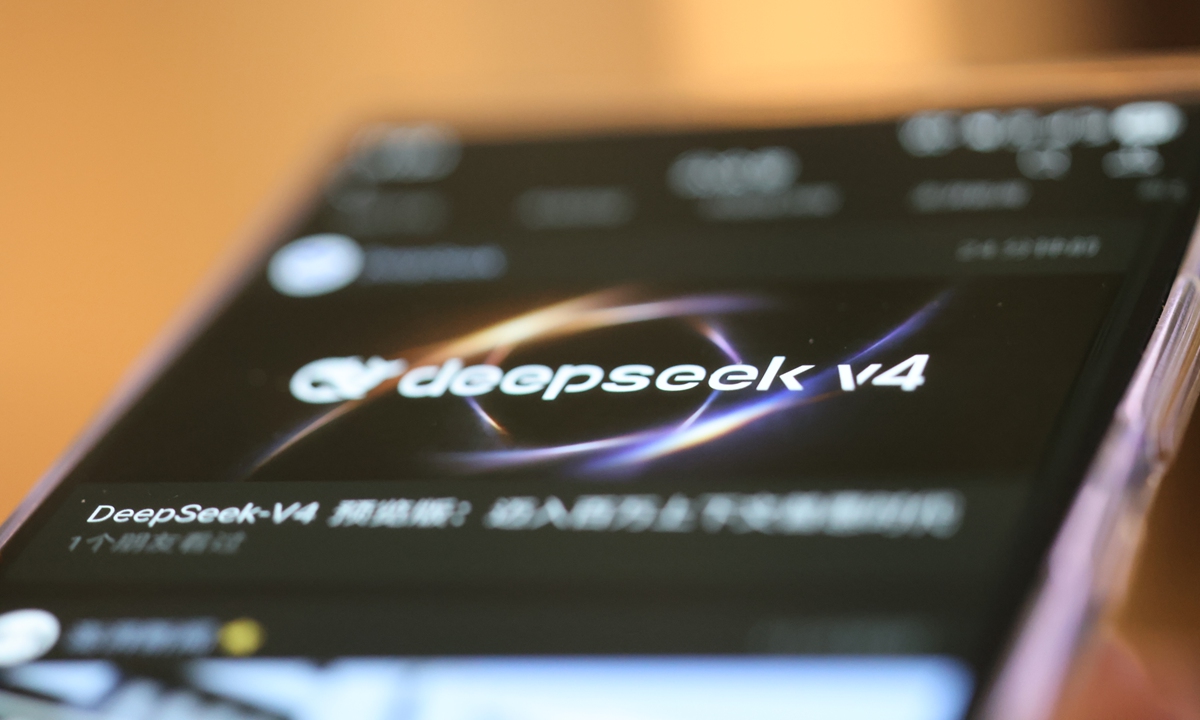
DeepSeek V4 Photo: VCG
Chinese artificial intelligence (AI) developer DeepSeek has raised application programming interface (API) charges for its latest flagship models while introducing peak and off-peak pricing, a shift that analysts said might signal healthier commercialization and a new phase in the global AI competition.
DeepSeek's off-peak prices are set at half the peak rates. Peak hours are 9 am-noon and 2-6 pm Beijing time. The new pricing took effect at midnight on August 17.
The adjustment came just days after DeepSeek quietly launched the official version of DeepSeek-V4 Pro on August 12. At launch, uncached input was priced at 3 yuan ($0.44) per million tokens, output at 6 yuan and cached input at as little as 0.025 yuan.
Under the latest adjustment, peak hour prices rise to 9 yuan per million tokens for uncached input, up 200 percent, 27 yuan for output, up 350 percent, and 0.3 yuan for cached input, up 1,100 percent. Off-peak rates are set at half those levels.
Wang Peng, an associate research fellow at the Beijing Academy of Social Sciences, told the Global Times that the price increase could reflect stronger market demand and growing user stickiness for DeepSeek's latest models. As DeepSeek has already established itself as a highly cost-competitive AI provider, it may no longer need to rely on ultra-low prices to attract users. The adjustment could therefore mark a further step toward commercialization, testing how much customers are willing to pay for stronger model performance and more stable services.
More importantly, the introduction of peak and off-peak pricing suggests that AI companies are paying greater attention to computing-resource allocation rather than simply raising prices across the board, Wang said. Higher peak-hour rates could encourage those with non-urgent workloads to shift to off-peak periods, while lower off-peak prices could improve the utilization of otherwise idle computing capacity. This reflects the increasingly infrastructure-like nature of AI computing, where efficient scheduling of limited computing resources is becoming an important part of competition.
The move comes as leading US AI developers are cutting prices. The Financial Times reported that OpenAI and Anthropic are lowering their prices as they fight to retain customers who are switching to cut-price alternatives from Chinese rivals.
OpenAI recently slashed the price of its GPT-5.6 Luna model by 80 percent. It also cut the price of its mid-range Terra model by 20 percent, according to Business Insider.
Anthropic launched Opus 5 at $5 per million input tokens and $25 per million output tokens - half the price of its Fable 5 model. This week, the company called off a planned rise in prices for its Sonnet 5 model, which had been due to take effect from September, according to media reports.
The price cuts by US AI companies reflect the growing competitive pressure from Chinese developers. Chinese models have already helped push down the cost of advanced AI services globally, forcing US rivals to reassess their pricing strategies, insiders said. As Chinese AI companies strengthen their technological capabilities and expand their global user bases, they are gaining greater influence over global AI pricing, insiders said.
DeepSeek's latest price increase is widely seen as a signal of a broader shift in China's AI industry. Since the beginning of the year, major Chinese model developers including Zhipu AI, Moonshot AI and MiniMax have adjusted their pricing strategies amid mounting pressures on both the demand and cost sides.
The shift also comes as AI agents drive up inference demand, while spending on computing infrastructure, chips and operations continues to rise, according to media reports.
The latest adjustment also echoes DeepSeek founder Liang Wenfeng's earlier assessment of the company's pricing power.
Wang said that as model capabilities, user demand, and spending on computing power and research and development (R&D) continue to grow, moderate price adjustments of DeepSeek are a normal part of commercialization, provided the models remain cost-competitive. Such adjustments could also help support sustainable investment in R&D and service capabilities.
Wang said that what matters more is whether the models remain competitive in performance, service quality and overall usage costs after the price increase. If higher prices are matched by better performance, more efficient computing-resource allocation and greater service stability, the move would signal a shift by Chinese AI developers from relying on ultra-low prices to rapidly expand their user base toward a more mature and sustainable business model.
Morgan Stanley said in an August 9 report that average API prices among major Chinese model developers rose sharply in the second quarter of 2026, with input prices up about 48 percent and output prices up 80 percent from the first quarter of 2025.
It said that the industry is moving toward healthier commercialization, with competition shifting from price to model capability.
RELATED ARTICLES