Chinese economy maintains stable growth in first 7 months of 2026, led by equipment making, high-tech manufacturing sectors
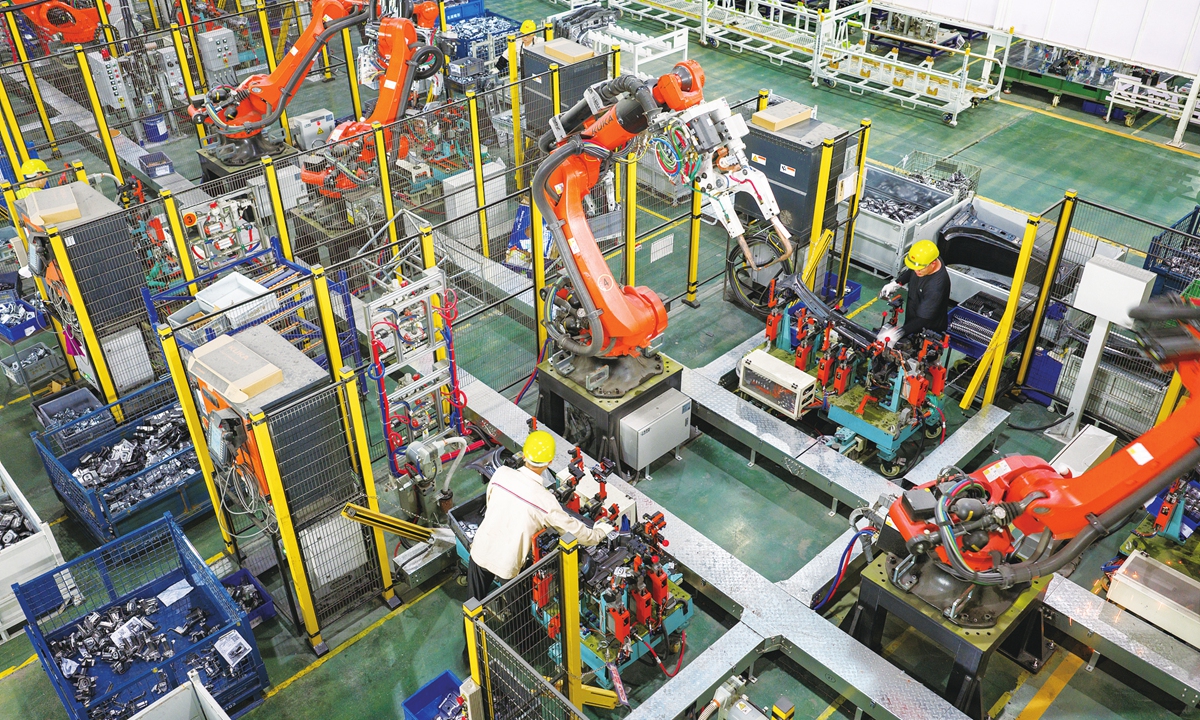
Industrial robot production lines run at full capacity at a new-energy vehicle parts company in Jinhua, East China's Zhejiang Province on June 22, 2026. Photo: VCG
From January to July, despite external uncertainties and conflicts, China's national economy remained largely stable and continued to move toward innovation-driven, higher-quality, and positive development. Official data released on Monday showed that the value added of the equipment manufacturing industry grew by 9.7 percent year-on-year, while that of high-tech manufacturing rose by 13.8 percent.
A Chinese expert told the Global Times that China's industrial structure is undergoing a profound transformation, with new growth drivers now becoming a pillar of the country's economic development, which includes high-tech industry and a number of strategic emerging industries.
According to the National Bureau of Statistics (NBS), during the first seven months of the year, the value added of industrial enterprises expanded by 5.3 percent year-on-year. The output of 3D printing equipment, lithium-ion batteries, and industrial robots rose by 52.3 percent, 40.2 percent, and 28.5 percent year-on-year, respectively.
In July, the value added of industrial enterprises rose by 4.5 percent year-on-year and by 0.11 percent month-on-month. The value added of equipment manufacturing enterprises grew by 12.3 percent year-on-year, accounting for 38.2 percent of the total.
In July, the value added of high-tech manufacturing enterprises increased by 16.9 percent year-on-year, 2.8 percentage points faster than one month earlier. Driven by AI, the output of sensors, storage chips, electronic components and optical fiber increased by 35.3 percent, 30.2 percent, 23.4 percent and 21.1 percent respectively. The robotics sector also developed rapidly, with the output of industrial robots and robot reducers growing by 30.2 percent and 22.7 percent respectively.
From January to July, new growth drivers represented by high-tech manufacturing and digital product manufacturing contributed about 50 percent to the growth of value added of industrial enterprises, approximately 3 percentage points higher than in the first half of the year, with their leading role continuing to strengthen, the NBS noted.
"These data fully demonstrate that China's industry is accelerating the optimization and upgrading of its industrial structure and the transformation of growth drivers. New growth drivers represented by high-tech manufacturing, equipment manufacturing, digital intelligence and AI applications have become the dominant force driving industrial growth," Hu Qimu, a deputy secretary-general of the Digital-Real Economies Integration Forum 50, told the Global Times on Monday.
The services sector has maintained steady growth, with modern services keeping its momentum. From January to July, the national services production index grew by 4.7 percent year-on-year. The production index of information transmission, software and information technology services rose by 10.6 percent, and that of leasing and business services grew 9.5 percent, the NBS data showed.
In the first seven months, the retail sales of consumer goods and services expanded by 2.6 percent year-on-year, of which sales of services increased by 5.0 percent and retail sales of goods rose by 1.1 percent. Among retail sales of services, those of communications and information services, tourism consulting and leasing services, and culture, sports and leisure services saw faster growth.
Hu noted that the share of services consumption in household consumption expenditure will continue to rise. "Behind the relatively rapid growth of services consumption lies the trend of quality improvement and efficiency enhancement in the services sector, which includes a large number of high-tech services such as AI and intelligent services," he said.
National fixed-asset investments excluding rural households dropped 6.7 percent year-on-year during the first seven months. Investment in intellectual property products grew by 9.1 percent year-on-year, and investment in high-tech industries rose by 5.0 percent.
Hu said that whether in investment, consumption or industrial value-added, indicators related to strategic emerging industries have significantly led the average growth rate. This fully demonstrates that China's industrial structure is undergoing a profound transformation, with new growth drivers gradually emerging.
The NBS noted that the national economy has kept its momentum and continued to move toward innovation-driven, higher-quality, and positive development. That said, the external environment remains complex and volatile, the domestic imbalance of strong supply and weak demand has persisted, some enterprises are facing operational difficulties, and the foundation for steady economic improvement still needs to be strengthened.
"Looking ahead, the long-term growth trajectory of Chinese economy remains unchanged. Growth is increasingly driven by strategic emerging industries, high-end manufacturing and services, with the structure continuing to optimize. New growth drivers are being cultivated and strengthened, which will underpin higher-quality and sustainable growth," Hu said.
RELATED ARTICLES