GT Voice: With more new products, what stage has China’s robotics sector reached?
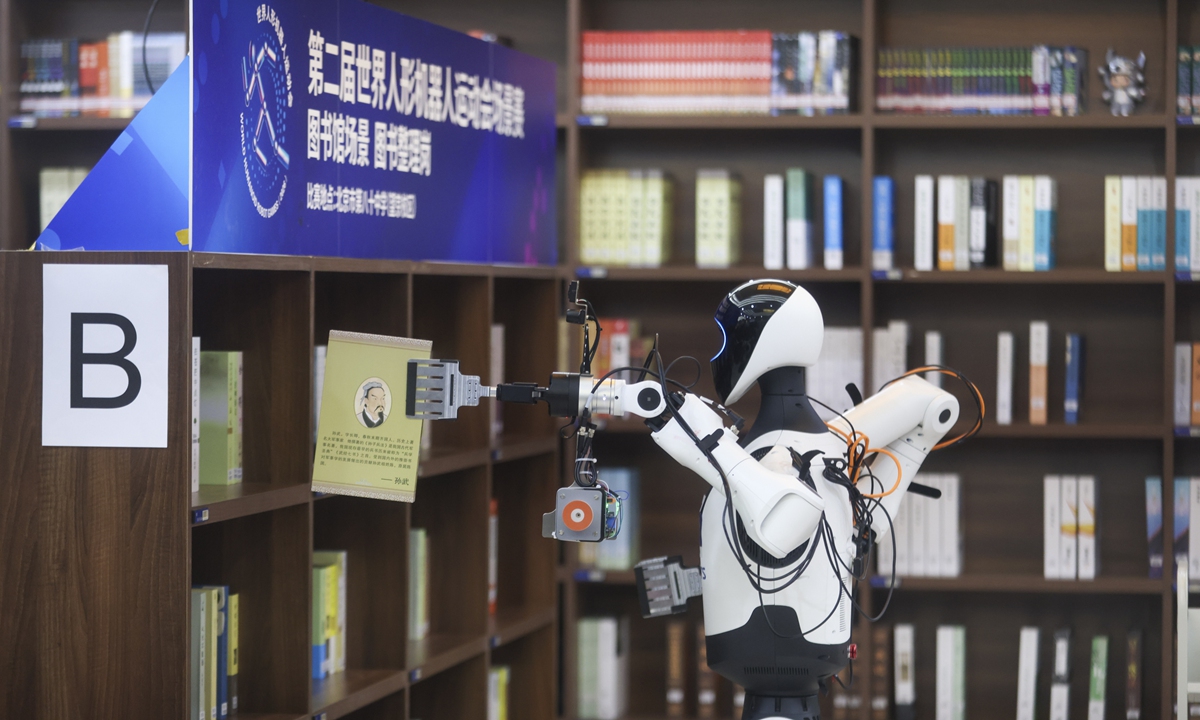
A robot competitor checks bookshelves for misplaced books during a library scenario event at the second World Humanoid Robot Games in Beijing on August 16, 2026. Photo: VCG
The World Robot Conference 2026 will be held from August 19 to 23 in Beijing's Yizhuang, which is expected to showcase robust industrial vitality and innovative momentum in China's robotics sector.
This year's event is expected to feature more than 2,000 exhibits presented by more than 300 exhibitors, and it has received support from nearly 30 international organizations, including the United Nations Industrial Development Organization, the International Federation of Robotics, and the World Federation of Engineering Organizations.
More than 150 new products will make their global debuts at the conference, up 21 percent year-on-year.
Behind these striking figures lies a more significant story: China's robotics industry is no longer a showcase for a handful of star players, but a full-scale industrial transformation - one that mobilizes the entire supply chain in a collective push toward large-scale deployment that tackles real-world challenges. The surge in new product launches shows that the sector has entered an era defined by mature product definition, integrated supply chains, and efficient cost control.
Major domestic events and performances surrounding robots have drawn widespread attention both domestically and internationally this year. While people are impressed by the ever-improving smoothness of robot motions, there are also skeptics questioning how long it will take before these robots can perform genuinely useful work.
This year's World Robot Conference offers a resounding answer. While participating companies follow diverse technical paths and target different product tracks, they share a highly unified development direction. The entire sector has shifted its focus to real industrial scenarios, making the delivery of practical, usable value its core objective. This marks a fundamental transformation in the development philosophy of the entire robotics industry, and the 150-plus debut products showcased at this conference serve as the most solid testament to this industry-wide pragmatic transition.
For instance, MagicLab's MagicBot D1 industrial robot - equipped with a wheeled chassis and a humanoid upper torso - can autonomously identify materials on shelves, and perform grasping, transporting, and precise placement operations, and its multi‑machine cluster system enables closed‑loop, unmanned assembly‑line workflows.
Siasun will unveil its wheeled humanoid robot Songyi, which directly targets the high-frequency, high-demand needs of material handling and transfer in manufacturing.
The Agile version supports lateral displacement and zero-radius steering, eliminating the need for reserved turning clearance and offering excellent compatibility with space-constrained production line configurations.
The CASBOT BAND robot band brought by Zhongke Huiling consists of four full-sized CASBOT 02 humanoid robots. The robots need to complete a full performance with beat synchronization, multi-robot coordination, arm control, and force control.
This industry-wide shift is no accident, but an inevitable outcome of long-term technological accumulation and upgrading. China's robotics industry has transitioned from the technology-demonstration phase into a new stage of large-scale commercialization.
Chinese humanoid robotmakers are widening their lead over global rivals, accounting for more than 97 percent of worldwide shipments in the first half of 2026, according to market research firm Smart Analytics Global.
For every 10 humanoid and four-legged intelligent robots sold globally, eight are made in China, according to the National Development and Reform Commission.
Beyond the factory floor, commercial applications of domestic robots have achieved comprehensive breakthroughs across 3C manufacturing, warehousing and logistics, industrial inspection, and commercial services. Authorities have set a target for humanoid robots to complete application validation and routine deployment in representative scenarios by year-end, cultivating more than 100 high-value application scenarios and catalyzing the capacity for large-scale deployment.
Taken as a whole, the 150 new product debuts convey far more than quantitative growth. Together, they answer a single defining question: what can robots truly do for the real world?
Now that "getting the job done" has become the industry‑wide consensus, China's robotics sector is entering a new phase - one that is more pragmatic and holds significantly greater growth potential.
RELATED ARTICLES