Foreign holdings of US Treasury debt fall as countries seek currency diversification to strengthen portfolio stability: expert
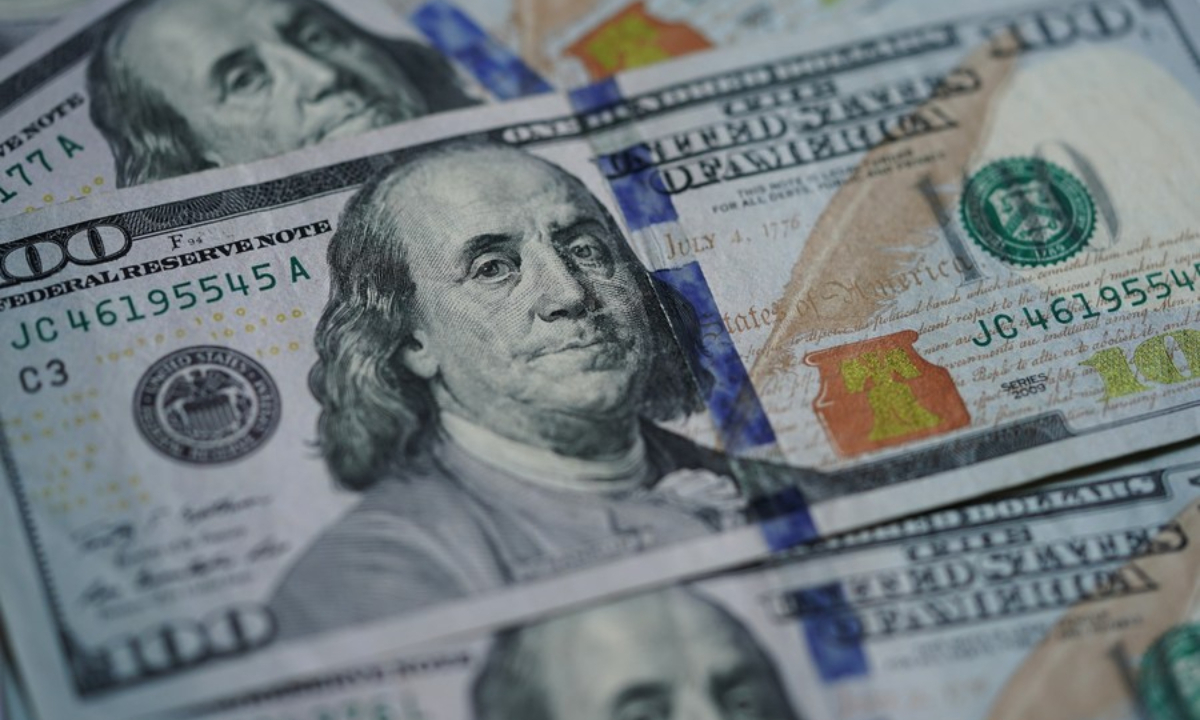
Photo shows US dollar banknotes in Washington, DC, the United States. Photo:Xinhua
Multiple countries including Japan, the UK and China trimmed their holdings of US Treasury debt in June, according to the US Department of the Treasury. Chinese experts attributed the phenomenon to multiple factors including the maturity of some US Treasury debt and certain countries' moves to reduce their holdings to ease foreign exchange pressure, and they predicted greater long-term diversification of global foreign exchange reserves.
Japan's holdings fell to $1.116 trillion in June, down 2.3 percent month-on-month. It remained the biggest non-US holder, the data showed.
The UK, the second-largest foreign holder, showed a 1 percent month-on-month decline in holdings to $939.9 billion in June.
China's holdings of US Treasury debt stood at $633.4 billion in June, down from $659.3 billion in May, remaining the third-largest non-US holder. China's holdings in June were the lowest since September 2008, when holdings tumbled to $618.2 billion, Reuters reported.
"Short-term fluctuation in foreign countries' holdings of US Treasury debt is normal, as some foreign holders may not have extended their holdings after maturity, while countries such as Japan conducted foreign exchange interventions to support their currencies," Zhao Qingming, a veteran financial analyst, told the Global Times on Tuesday.
Japan likely drew on its holdings of foreign securities, including US Treasury debt, to finance its record currency market intervention over the past month, Bloomberg reported in June.
Xi Junyang, a professor at the Shanghai University of Finance and Economics, told the Global Times on Tuesday that it is a long-term trend for countries to diversify their foreign asset holdings in a bid to strengthen the overall safety and stability of their portfolios, especially referring to the increase of gold reserves by central banks across the world.
Gold has overtaken US government bonds as the world's largest reserve asset following years of relentless buying by central banks and a historic rally that has seen prices nearly double over the past two years, the Financial Times reported in June.
Bullion accounted for 27 percent of global central bank reserve assets as of the end of 2025, up from 20 percent a year earlier, according to a report published by the European Central Bank last month. US Treasury debt fell to 22 percent from 25 percent over the same period, the report said.
According to the People's Bank of China, the country's official gold reserves rose to 76.08 million ounces at the end of July, up from 75.44 million ounces at the end of June. The latest increase means that the central bank added 640,000 ounces of gold last month, the 21st consecutive month of increases.
Meanwhile, with the steady progress of yuan internationalization, the resilience and stability of China's foreign exchange market will be further strengthened, Xi Junyang, the professor, said.
In response to a question over the operation of China's foreign exchange market since July, Li Bin, deputy head of the State Administration of Foreign Exchange (SAFE), said on Monday that the external environment has become increasingly complex and volatile, geopolitical uncertainty has risen, and international financial markets have remained unsettled.
However, China's foreign exchange market has maintained stable operations, the scale of cross-border receipts and payments has steadily expanded, overall market expectations have stayed stable, and foreign exchange transactions have been rational and orderly, Li said, according to a statement on the SAFE website.
According to data released by the SAFE, China's foreign exchange reserves stood at $3.4188 trillion at the end of July, up by $2.5 billion, or 0.07 percent, from the end of June.
RELATED ARTICLES