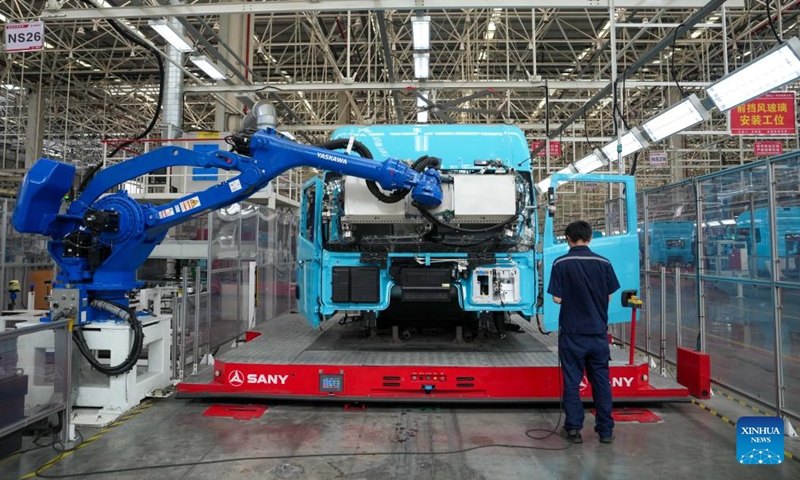
A worker works besides an automated guided vehicle carrying a heavy truck cab at an industrial park of Sany, China's leading heavy equipment manufacturer, in Changsha, central China's Hunan Province, May 12, 2026. Stepping into an intelligent heavy truck industrial park of Sany in Changsha, Hunan Province, one can see a bustling scene on the intelligent production lines.(Xinhua/Xue Yuge)
Global sales of electric trucks and buses exceeded 500,000 in 2025, with sales nearly doubling for the second consecutive year, driven largely by China's electric truck sales, according to a report released by the International Council on Clean Transportation (ICCT) on Thursday.
The report showed that global electric truck and bus sales grew by 86 percent year-on-year in 2025.
China accounted for nearly 90 percent of global electric truck and bus sales, with particularly strong growth in the medium- and heavy-duty truck segments, where sales more than quintupled over two years. Nearly 30 percent of China's heavy truck sales were fully electric in 2025. Declining battery costs and strong local supporting policies helped to advance the electrification of these segments, according to the report posted on the ICCT website.
"In a sector traditionally defined by low profit margins, the long-term economic case for battery electric trucks is becoming clear, and China offers lessons to draw from. Battery electric trucks offer operational cost advantages that have made the case for truck electrification very compelling," said Shiyue Mao, ICCT researcher and lead author of the report.
Battery electric buses, which made up 17 percent of global bus sales in 2025, led the transition of commercial vehicles toward electrification across most regions. In contrast to the bus market, battery electric truck sales remained relatively low, reaching about 41,000 units when excluding China, according to the report.
As the Middle East tension has led to a significant increase in international energy prices, China's new-energy vehicle (NEV) sector is reshaping the competitive landscape of the global commercial vehicle industry with advantages including a complete industrial chain, technology and fast delivery capability, Cui Dongshu, secretary-general of the China Passenger Car Association, told the Global Times on Thursday.
By not burning diesel, China's e-truck fleet is expected to save the equivalent of 141 million barrels of oil this year, more than 3 percent of China's total and equivalent to its entire oil imports from Kuwait, according to the Centre for Research on Energy and Clean Air, Reuters reported earlier this month.
By comparison, China's e-truck exports in the first half replaced fuel at an annual rate of 1.6 million barrels, Reuters reported, citing the Helsinki-based center.
As China's NEVs demonstrate scale advantages and market demand grows, an increasing number of Chinese-made NEV brands are going global, with their international recognition steadily rising, Cui said.
China has developed a thriving NEV industry. According to data from the China Association of Automobile Manufacturers, NEVs accounted for more than 60 percent of new car sales in July for the first time.
An official of China's Ministry of Commerce told a press conference on July 28 that China has the world's largest consumer market, providing a testing ground for new technologies, products and services. The country has ranked first globally in NEV sales for 11 consecutive years.
Global Times
RELATED ARTICLES