Turning language barriers into bridges
Chinese tech companies train LLMs for BRI partner countries, provide tailored AI services and industrial robots
By and Zhang Weilan Published: Aug 20, 2026 09:22 PM
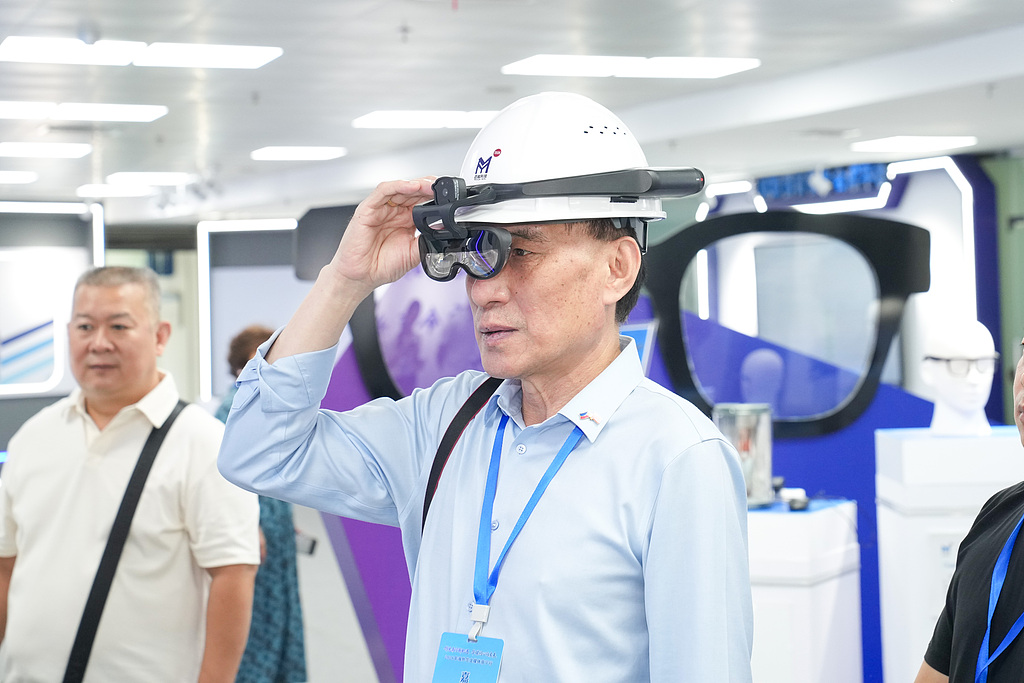
A visitor tries on AR smart glasses equipped with an intelligent inspection system. Photo: VCG
In a classroom at Guangxi University in Southwest China's Guangxi Zhuang Autonomous Region, Cambodian student Reachie Bun - wearing a pair of AI glasses - was busy taking notes, catching every term and example without pause. As the professor's Chinese flows through the room, Khmer words bloom before his eyes — clear, floating subtitles that keep perfect pace with every explanation, as if the lecture itself has learned his language.
One year ago, when he first arrived in China, even ordering a simple meal or asking for directions felt like navigating a maze. Now the same woman who once hesitated at street corners stood at the China-ASEAN Expo as a Khmer interpreter last year, turning conversations between two countries into something effortless.
"For me, they are not just translation tools — they are reliable partners for studying and living in China," he told the Global Times. His pair of AI glasses, developed by Guangxi-based Maiyue Technology and weighing just 61 grams, is able to support AI-powered interaction across more than 40 languages, including lesser-spoken languages of ASEAN.
Bun's experience reflects a much broader challenge facing global AI innovation: the digital divide. While major large language models (LLMs) are now highly capable in widely used languages such as English and Chinese, LLMs supporting low-resource languages (such as Swahili, Cambodian or Burmese) remain limited. This leaves many countries in the Global South, most of which are the Belt and Road Initiative (BRI) partner countries, at risk of being left behind in the next wave of technological development.
Against this backdrop, Chinese tech companies have been training LLMs designed for BRI partner countries, while also providing tailored intelligent devices, such as service and industrial robots, that have been quietly transforming how people in those countries work and interact in daily lives, the Global Times learned. Those footprints not only help BRI partner countries close digital divide and keep pace with the next technological wave, but also deepen their integration into global high-end manufacturing supply chain, analysts pointed out.
Local data, local solutions
Huang Yuyang, marketing director of Maiyue Technology which produces AI glasses, told the Global Times that the devices now cover 11 ASEAN languages, with translation accuracy at around 80 percent for major Southeast Asian languages such as Vietnamese, Thai, Cambodian, Indonesian and Malay, and up to 90 percent for higher-priority ones.
An industry insider pointed out that general-purpose LLMs are mostly trained on languages like Chinese and English, so their ability to understand and generate Southeast Asian minority languages is limited. Meanwhile, the lack of local datasets, the diversity of dialects, and development costs continue to slow the emergence of AI solutions adapted to the region.
"Models, trained on speech data and designed around local linguistic environments can help bridge this gap. Locally trained corpora represent a form of 'digital infrastructure' that is just as critical as fiber-optic cables or data centers," the industry insider noted.
The Chinese company has built a corpus of over 800 million accurately matched entries by collaborating with universities in Guangxi and local institutions to gather data from libraries, websites, television programs, hospitals, schools, and government bodies.
Leveraging the BRI and Guangxi's role as a gateway to ASEAN countries, the company also plans to expand the use of its AI glasses in tourism and consumer markets across the region, potentially injecting new impetus into the region's development, Huang said.
Likewise, Chinese AI companies have been expanding their presence in BRI partner countries to promote the inclusive sharing of technology and capabilities.
For example, Chinese tech company iFlytek has customized its AI-powered smart blackboard, also known as AI Board, for Indonesian classrooms, which effectively addresses the shortage of quality teachers on remote islands.
Shen Lin, deputy general manager of iFlytek International, told the Global Times that the company aims to deepen its presence in BRI partner countries, including Southeast Asia, Central Asia, and the Middle East. "Our overseas expansion is not just about exporting devices; we hope to bring China's digital experience in balanced education to the world and build bridges for communication through digital classrooms," Shen said.
With regards to the development of minority languages, in Europe, iFlytek has partnered with a Serbian team to integrate Serbian and related South Slavic languages into its translation devices and intelligent applications, and to build a localized LLM. In Southeast Asia, the company said it is partnering with Viettel Telecom in Vietnam on speech recognition, synthesis and local-accent recognition, and co-developing a Vietnamese LLM as well as the ability to recognize multiple regional dialects.
Service and industrial robots
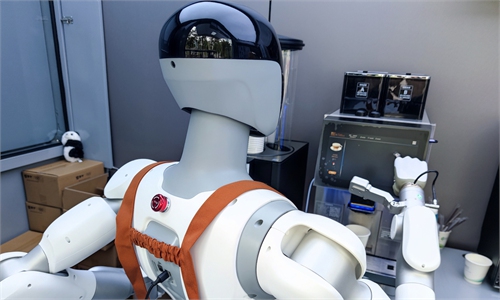
At the 1.5-gigawatt solar project in Abu Dhabi, the United Arab Emirates (UAE), Chinese-made photovoltaic module-installation robots have been deployed for the first time in the Middle East, helping the desert site move toward faster, safer and more automated construction. Nearby, an AI-powered floor-cleaning robot from Chinese company Narwal, engineered specifically to address the unique challenges of sandy and dusty desert environments, has also become a popular cleaning solution among local households in Dubai.
"There's great potential in Middle East markets such as Egypt, Dubai and Saudi Arabia. At the industry level, the region is promoting robot adoption, and Dubai and Saudi Arabia have well-developed service and hotel sectors, creating broad space for commercial robots. In logistics, last-mile delivery infrastructure is still developing, creating opportunities for growth in the doorstep delivery market," Bin Ye, global brand director of Shenzhen-based cleaning robot maker Narwal, told the Global Times.
Industry insiders stressed that in the future, those service and industrial robots could play an important role in facilitating manufacturing automation and upgrade in BRI partner countries, while significantly bringing down labor cost and making essential services in those countries more accessible.
Tian Feng, former dean of SenseTime's Intelligence Industry Research Institute, told the Global Times that Chinese tech companies have distinct strengths in product design, business model innovation, core technology development, and the integration of global resources.
"Their expansion into BRI markets reflects China's broader vision of promoting tech for good and helping partner countries share in the gains of the new technological wave — by making advanced tools more affordable, closing development gaps and strengthening their place in global industrial chains," he noted.
According to Tian, Chinese tech companies are shifting from simply exporting products to exporting complete solutions. For example, unlike one-size-fits-all models built around a single dominant language, this ecosystem-based approach recognizes that real technological progress must be culturally and linguistically diverse.
In the first half of 2026, China's industrial robot exports reached 6.29 billion yuan, up 18.6 percent, and were sold to 141 countries and regions, customs data showed. Smart products such as AI glasses, translators and robotic exoskeletons also saw rapid development in the first half of the year, with new innovations continuing to emerge.
RELATED ARTICLES