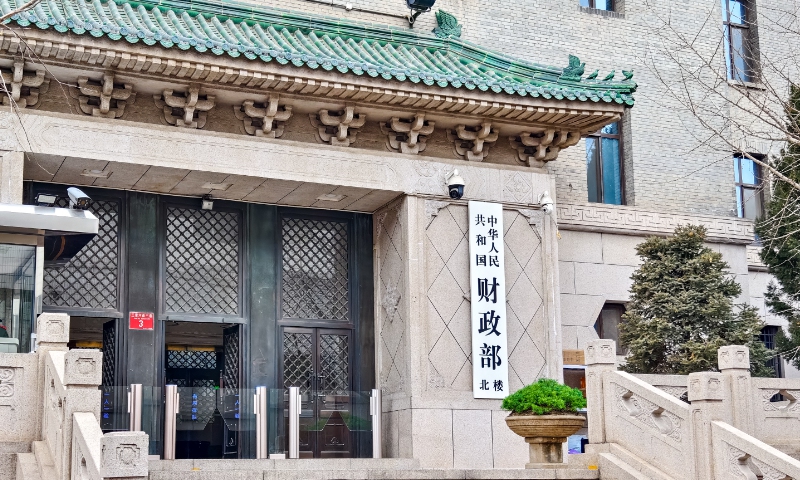
The Ministry of Finance of China File Photo: VCG
China plans to roll out new policies in the second half of the year to strengthen financial coordination in boosting domestic demand, Vice Minister of Finance Liao Min said on Friday, the latest update that shows the government's efforts in responding to the actual needs of economy development.
The latest push to strengthen financial coordination shows the government's determination to boost domestic demand by using fiscal funds to mobilize more financial resources for consumption and investment, a Chinese expert said.
Starting August 1, all newly initiated credit card installment purchases, including those for automobiles and home renovation, have been included in the policy support framework. Consumers can enjoy interest subsidies as long as they use credit card installments for their purchases, according to the Ministry of Finance (MOF).
At a press conference held by the State Council Information Office on Friday, Liao said that expanding domestic demand is "not an expedient measure, but a strategic move." This year, the central government has allocated 100 billion yuan to establish six policy tools aimed at promoting domestic demand through fiscal financial coordination, leveraging fiscal guidance, financial support and market based operations.
Promoting household consumption is a key focus. From January to July, two consumption measures supported about 1.88 trillion yuan in household spending, covering services such as dining, accommodation, culture, entertainment, healthcare and elderly care, according to the MOF official.
Since the policy package was introduced, fiscal funds have increasingly leveraged financial resources to support the real economy. From January to July, six measures, four supporting investment and two supporting consumptions, backed more than 20 trillion yuan in new lending to relevant sectors, up over 880 billion yuan, or 4.5 percent, from a year earlier.
Building on these measures, the latest policy adjustment further extends support to everyday household consumption. The eligible loan limit for service sector businesses was raised from 10 million yuan to 20 million yuan, while the interest subsidy cap for personal consumption loans was increased from 3,000 yuan to 5,000 yuan, according to the government official.
The current push to strengthen fiscal financial coordination shows that the government is placing greater emphasis on using fiscal funds as a lever to attract more financial resources into the real economy, thereby amplifying the overall policy impact, Hu Qimu, a professor at the Maritime Silk Road Institute of Huaqiao University, told the Global Times on Friday.
Compared with relying on a single policy tool, greater coordination between fiscal and financial policies can improve policy transmission to consumption and investment and enhance the efficiency of fund use, Hu said.
Consumption demand is increasingly becoming a key driver of China's economic growth. China has a population of 1.4 billion and a middle-income group of more than 400 million, according to the MOF.
In 2025, China's per capita GDP exceeded $13,000, retail sales topped 50 trillion yuan, and final consumption contributed 52 percent to economic growth.
As the world's largest developing country, China has remained the world's second largest consumer market for goods and the largest online retail market for years. It is also one of the world's major consumer goods import markets, with products from around the world popular among Chinese consumers, Liao noted.
Global Times
RELATED ARTICLES