China's economic performance will remain within a reasonable range in H2, meet annual goals: Zhong Caiwen article
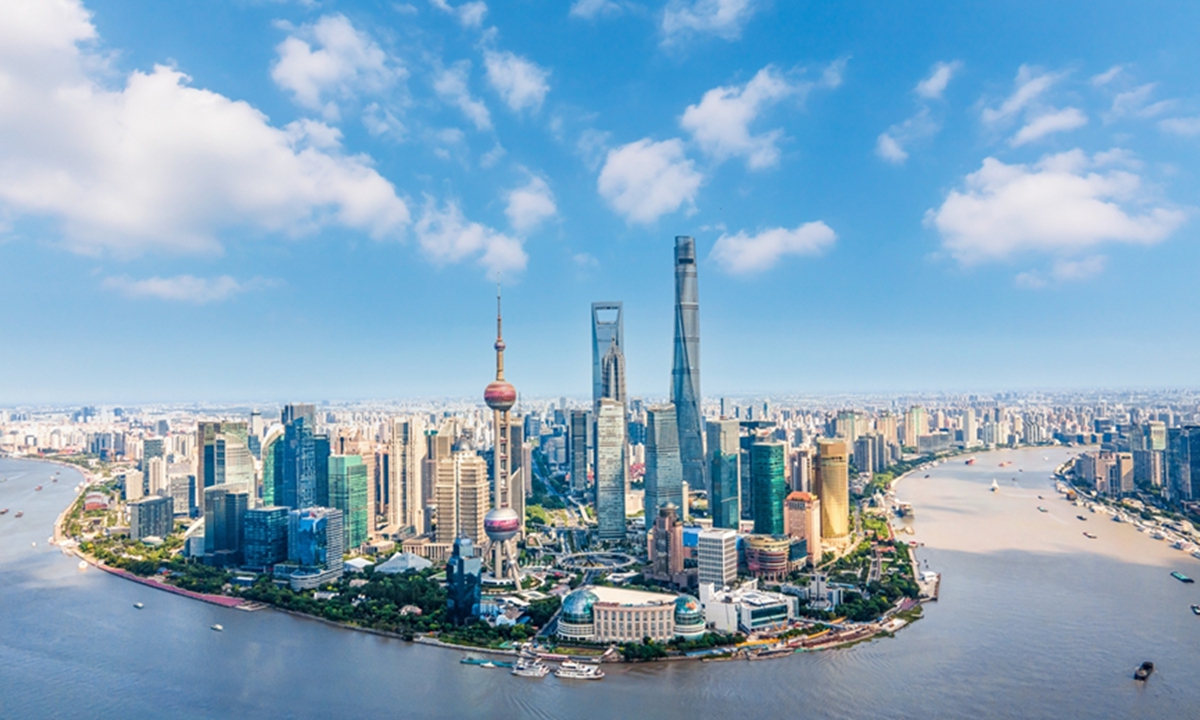
A view of the Lujiazui area in Shanghai Photo: VCG
Since the beginning of the year, under the firm leadership of the Party Central Committee with Comrade Xi Jinping at its core, all regions and departments have taken proactive steps and risen to challenges, effectively responding to various external shocks and internal difficulties while steadily promoting high-quality development. As a result, China's economic performance has shown a trajectory marked by new drivers of growth and an improved structure — achievements that are truly commendable.In the first half of the year, China's major macroeconomic indicators remained broadly stable. The country's GDP grew by 4.7 percent, continuing to rank among the fastest growth rates of the world's major economies. Prices saw a reasonable recovery, employment remained generally stable, and the balance of payments was broadly balanced. Meanwhile, profits of industrial enterprises above designated size rose by 18.7 percent, national general public budget revenue increased by 4.7 percent, and the economic performance of some market entities improved.
China's economy is currently at a critical stage of accelerating the transition from old growth drivers to new ones and transforming its development model. To understand the Chinese economy, it is important to look beyond the pace of growth and avoid focusing too much on fluctuations in individual quarterly or monthly indicators.
Greater attention should be paid to the quality of economic performance, including the strength of technological innovation, the upgrading of industries, the sustainability of economic development, and the vitality of businesses. In fact, viewed in terms of quality and efficiency and from a longer-term perspective, profound changes are taking place in the Chinese economy, underscoring its strong resilience and vitality.
New growth drivers
China's technological innovation is increasingly translating into industrial competitiveness. Since the beginning of this year, China made a number of notable technological breakthroughs, including new advances in key and core technologies such as integrated circuits, world-leading progress in innovative drug development, and successful rocket recovery operations both at sea and on land.
New growth drivers played a stronger supporting and leading role. In the first six months, the value added of the equipment manufacturing industry grew by 9.3 percent, while that of high-tech manufacturing rose by 13.3 percent, maintaining strong growth momentum.
Research, development and applications in areas such as robotics and artificial intelligence also gained momentum, with industrial robots, surgical robots, cleaning robots and bionic robots emerging as representative products of China's intelligent manufacturing.
China's role as a key hub in global industrial and supply chains continues to strengthen. For a new-energy vehicle, an automaker in the Yangtze River Delta can source more than 10,000 parts within four hours, while for a humanoid robot, efficient collaboration among companies in the Pearl River Delta has created a "one-hour industrial ecosystem."
Meanwhile, China's exports of intermediate goods have grown rapidly, providing key components for global industrial and supply chains and helping ensure their stable operation. China's complete industrial and supply chain system not only improves production efficiency in China and around the world, but also provides greater certainty for a stable global economic growth.
Chinese enterprises are undergoing transformation and upgrading through digital and intelligent technologies. Some companies have utilized big data to assess market demand and AI algorithms to optimize production scheduling, providing flexible production and customized services to precisely meet the market's needs for small-batch and personalized products.
In addition, some companies have connected production lines, logistics centers, and consumer orders seamlessly through digital production systems, enabling an end-to-end "zero-touch" integrated fulfillment process. This greatly shortens delivery times and makes the products consumers receive even "fresher." Changes like these have greatly expanded enterprises' business scope, broken geographical constraints, and demonstrated strong vitality.
Risks contained
The risks and hidden dangers in China's economic operations are being steadily resolved and contained. Since the beginning of 2026, the real estate market has shown stronger signs of stabilization; In some first and second tier cities, second-hand home transactions increased significantly and exceeded new home sales in volume. Housing prices have stabilized, and inventory pressure has eased somewhat.
Existing hidden local government debt has been replaced in an orderly manner, and the number of financing platforms has continued to decline. Reform and risk resolution among small and medium-sized financial institutions have been steadily advanced, with a reduction in quantity and improvement in quality, and the number of high-risk small and medium-sized local financial institutions has decreased.
Overall, China has been adhering to strict control of new risks, properly addressing existing ones, and preventing "major risk events," thus preventing and defusing major risks in the economic sphere and ensuring that the bottom line of avoiding systemic risk is upheld.
Recently, a business delegation led by the China Council for the Promotion of International Trade visited the US, reflecting the aspirations and voices of the business communities in both countries. In face-to-face exchanges, the US business community highly recognized China's development advantages in emerging fields such as advanced manufacturing, artificial intelligence, clean energy, quantum computing, and life sciences. They called for expanding practical cooperation while maintaining necessary competition.
Meanwhile, several heads of US companies investing in China said that the Chinese government's efforts to boost domestic demand, safeguard and improve people's livelihoods, strengthen public services, and enhance local R&D capabilities will bring bright prospects to the Chinese economy and also create new scenarios and opportunities for multinational companies to deepen their presence in China. They said they will increase investment and business expansion in China.
China's economy is like a vast ocean and can withstand winds and waves. It has the solid foundation built up over more than 40 years of reform and opening-up, along with a huge consumer market, a strong manufacturing base, well-developed infrastructure, a robust talent pool, and a complete industrial and supply chain system. The conditions supporting China's long-term positive economic outlook, as well as its underlying trend, have not changed.
To understand China's economy, one must fully appreciate the various strengths and enormous potential of China's development; only then can one "not let one's vision be blocked by floating clouds."
In the second half of the year, as major projects outlined in central and local 15th five-year plans (2026-30), and as macro policies are implemented promptly and more effectively, China's economic performance will surely remain within a reasonable range and successfully meet the annual goals and tasks.
RELATED ARTICLES