Carney vows retaliatory tariffs on US as trade disputes between traditional allies enter period of frequent friction, expert says
By Published: Aug 23, 2026 11:13 AM

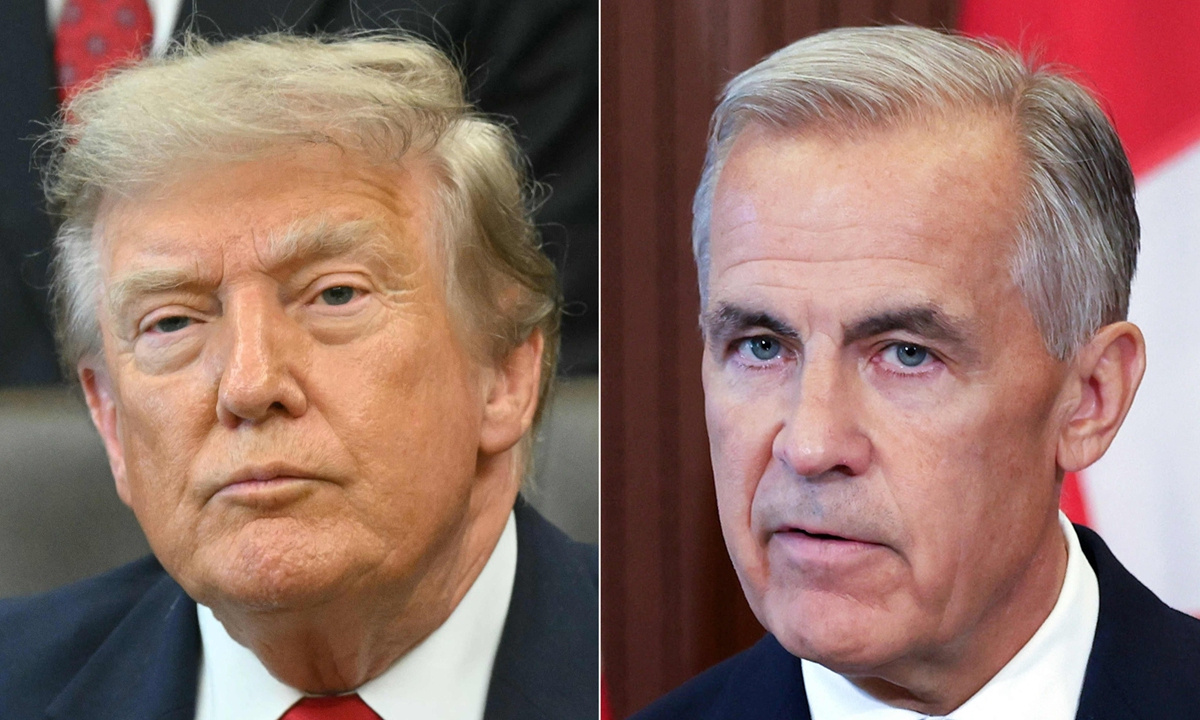
This combination of pictures created on August 22, 2026 shows US President Donald Trump in Washington, DC, on July 13, 2026 and Canadian Prime Minister Mark Carney on August 22, 2026. Canadian Prime Minister Mark Carney announced retaliatory tariffs on the United States on August 22, after walking away from a "bad deal" on trade in a deepening rift between the longtime allies. Photo: VCG
In response to US President Donald Trump's 50 percent tariffs, Canadian Prime Minister Mark Carney said on Saturday that Canada would impose retaliatory tariffs on US steel, electronics and other imports starting September 8, media reported.
After days of intense negotiations, the two countries failed to reach a trade deal late Friday, worsening a delicate relationship between the longtime trade partners and allies and complicating the future of the continental free trade pact known as the US-Mexico-Canada Agreement, per Reuters.
Trump's new tariffs hit sectors including wine, furniture, dairy products, cement, clothing, fishing rods and hockey equipment, and cover some $20 billion of Canadian exports to the US. These duties do not exempt Canadian products under the USMCA, which has shielded most Canadian exports to the US in the last 18 months.
"Canada will match Washington's new tariffs dollar for dollar in order to protect Canadian workers, farmers, families, and businesses," Carney told a press conference.
"You're at war when you get attacked. We got attacked," Carney said when asked whether Canada was engaged in a trade war.
Carney said his government will release more details about these retaliatory policies in the "coming days" and that the tariffs would apply to goods like steel, dairy, appliances, agricultural equipment, pulp and paper and electronics.
"In recent days, the US proposed new terms that were uneconomic, unfair, and undermined the net benefits to Canada, calling into question the reliability of any deal," Carney said, adding these demands included curtailing Canada's ability to forge new trade deals, per Reuters.
"We've recognized from the start that America has changed," he said in an address to Canadians. "We recognize that sometimes, its signature is written in pencil," according to the New York Times.
"We cannot accept what they offered and we will not give what they asked," he added. "We were not prepared to compromise Canada's sovereignty or undermine our key industries."
US Trade Representative Jamieson Greer said on social media that "despite the US offer to Canada to receive the best treatment of any major exporter to our market, new demands and walk backs of other commitments by Canada have upended the careful balance reached in the past days," he wrote, calling this a "missed opportunity" for an economic partnership between the two countries.
B.C. Premier David Eby said that his government would support Canada's counter-measures in the wake of an escalation in the US-Canada trade war. "The suggestion that Canada would not trade with other countries or reduce our trade with other countries ... would reduce us to the economic equivalent of the 51st state," Eby said, CBS reported.
Trump's previous remarks about turning Canada into the "51st state" were an affront to Canada's sovereignty, while the current tariffs have further undermined its economic sovereignty. Faced with Washington's aggressive trade policies, Carney, whose domestic political support is largely built on defending Canada's sovereignty and national interests, has little choice but to take tough retaliatory measures, Wu Xinbo, dean of the Institute of International Studies at Fudan University, told the Global Times.
The conflict between US and Canada also calls into question the future of a North American trade agreement that is crucial to industry in all three countries, according to PBS.
Carney said the breakdown was "certainly not good news" for the review of that agreement and that the failed negotiations had given Canada "a new perspective" on what Washington wants from the broader economic relationship.
Wu said the ongoing tariff dispute between Canada and the US is not merely about trade, but reflects deeper tensions in bilateral relations over sovereignty, economic autonomy and the distribution of interests. As Ottawa adopts increasingly tough countermeasures in response to Washington's pressure, the relationship between the two allies could deteriorate further, with more frequent frictions and disputes likely to emerge in the future.
RELATED ARTICLES