ARTS / CULTURE & LEISURE
‘2026 version of Journey to the West’ goes viral as classic comes alive in young people’s everyday lives
Young people leverage modern technology to interact with ‘Journey to the West’ figures
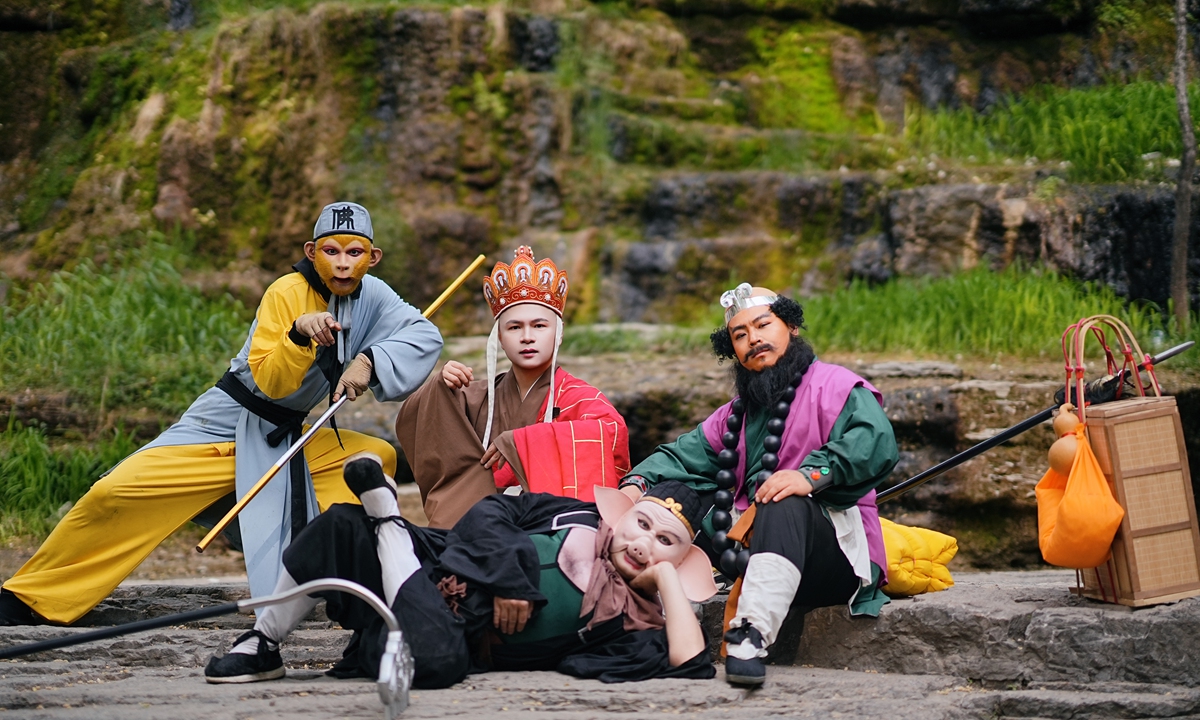
Livestreaming team of Journey to the West: Heroes' Gathering, featuring the four master-disciples Photo: Courtesy of the cast team of Journey to the West: Heroes' Gathering
At dusk, in an unassuming grove in Shouguang, East China's Shandong Province, performers dressed as Tang Sanzang (Monk Xuanzang), Sun Wukong (Monkey King) and other characters from the renowned Chinese classic Journey to the West set up a thatched hut and cooked around a bonfire while livestreaming. They were not fighting demons or embarking on a pilgrimage, but chatting, joking and improvising in response to comments from live viewers.This seemingly makeshift Journey to the West: Heroes' Gathering livestream has gone viral lately, with related videos garnering more than 140 million views and more than 400,000 viewers tuning in simultaneously at its peak on Douyin, the Chinese version of TikTok. Netizens gave it a distinctly contemporary nickname — the "2026 version of Journey to the West."
Behind the viral success is a format far removed from traditional film and television productions: The livestream does not rely on tightly scripted dialogue.
Gao Guancheng, director of the team, told the Global Times that the team usually prepares only a basic outline before each livestream, leaving about 80 percent of each livestream to improvisation.
"Comments from viewers, trending internet memes, and even unexpected incidents on site can all become the starting point for the next scene," he said. This seemingly spontaneous approach, however, is far from unprepared.
Into daily life
The performers playing the "four pilgrims" all have years of experience portraying characters from Journey to the West. That experience has given them the chemistry needed to pick up and build on one another's cues during livestreams.
"The actor playing Tang Sanzang has years of rich experience imitating the character, the actor playing Sun Wukong has studied monkey opera since childhood, and the actor playing Zhu Bajie has been portraying the character for nearly 20 years," Gao said.
"One look, one movement, or one punchline, we all know who should pick it up and who shouldn't," he added.
That chemistry may be the foundation for bringing the characters to life, but what truly connects this new Journey to the West with contemporary life is the seemingly ordinary daily routine.
Peng Tao, a young viewer in his 20s who works in the internet industry, told the Global Times that when he first came across Journey to the West: Heroes' Gathering, he felt as if he were watching a spin-off of Journey to the West, one in which familiar characters were simply going about their daily lives.
"In the past, we saw them on the pilgrimage and fighting the demons. Now we see them eating together, chatting and working. That contrast really draws me in," he said.
In his view, the relationships among Tang Sanzang and his disciples remain familiar, but placing them in everyday situations gives those relationships a new resonance.
"For example, at work, there may be a relatively domineering boss, someone who always rushes to take responsibility, someone who keeps the atmosphere lively, and someone who doesn't say much but always gets things done in the end. You start to feel that they're no longer mythical figures, but people around you," he said.
That sense of familiarity may be one way for classics to reconnect with younger audiences.
"I don't think they are doing Journey to the West a disservice," Peng said. "The basic personalities of the characters are still there; they've simply been placed in a new setting. If a classic can only be told in the same way it was decades ago, it may actually become increasingly distant from young people."
Finding the right balance between the old and the new is also something the creators of Journey to the West: Heroes' Gathering have been thinking about.
"We are not remaking Journey to the West. By preserving the basic characteristics of the characters while placing them in new everyday settings, we are bringing Journey to the West into the lives of ordinary people," Gao said.
Stories reimagined
The modern revival of classic traditional classics is by no means limited to Journey to the West.
Classic Chinese texts taught in schools, including Letter to Wife, Pipa Song and The Golden Fishhook, have also been turned into vivid and engaging short videos. One video based on The Golden Fishhook has garnered more than 100 million views. Such adaptations have attracted widespread attention online, according to the Beijing Daily.
These time-honored texts have become part of a generation's collective memory and naturally come with an established audience. Yet with countless classics to draw from, there is no shortage of adaptations that simply capitalize on established IPs or recycle old memes, and not every adaptation wins over audiences. What truly resonates is finding a thoughtful way to bring classics back down to earth, according to the Beijing Daily.
Beijing-based cultural scholar Wang Deyan told the Global Times that the vitality of a classic does not lie simply in repeating it word for word, but in its ability to continually forge new connections with contemporary life, emotions and aesthetics.
"Classics can continue to resonate in new eras because the relationships between their characters, their emotional structures and the values they convey can still connect with people today," he said.
In Wang's view, the popularity of Journey to the West: Heroes' Gathering is essentially a way for young audiences to rediscover a classic through new forms of media: The characters remain the same, but the way audiences view them has changed.
"Short videos, livestreams and online fan creations have lowered the threshold for creative expression, giving classics opportunities to enter more tangible settings of everyday life," he said.
Perhaps classics truly come "alive" in moments like these, when they are no longer simply "old stories" preserved in textbooks and on screens, but enter livestreams, short videos and the everyday lives of young people, gaining new vitality in a new era through each retelling and each new way of being seen.
RELATED ARTICLES